

2002-27, Scott 3249-52 Gibbons

 (4-1), Hylobates lar, 80 fen, 30*40 mm
 (4-2), Hylobates leucogenys, 80 fen, 30*40 mm
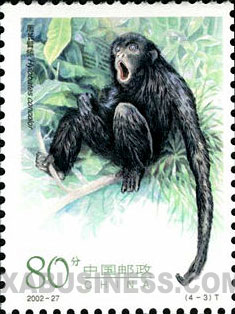 (4-3), Hylobates concolor, 80 fen, 30*40 mm
 (4-4), Hylobates hoolock, 200 fen, 30*40 mm
Technical details
Scott No: 3249-52Serial number: 2002-27
Values in set: 4
Denomination: 4.40 yuan
Date of issue: 7th Dec. 2002
Designer: Yin Huili
Size of stamps: 30*40 mm
Perforation: 11.5*11
Sheet composition: 20
Printing process: Photogravure-engraving
Printer: Beijing Postage Stamp Printing House
Background
The stamp set is cataloged as 2002-27, titled Gibbons. It was issued on December 7, 2002. The set consists of four stamps in a combined offset and intaglio printing edition printed by Beijing Stamp Printing Works. The designer is Yin Huili, with engraving by Yan Bingwu, Hu Zhenyuan, Jiang Weijie, Li Qingfa, and Hao Ou. The total face value is 4.4 yuan. Each stamp measures 30×40 mm, with a perforation gauge of 11.5×11 degrees. Each sheet contains 20 stamps.Gibbons are first-class protected primates in China. They are small apes, tailless, with long arms, and they swing through the forest using their arms. Historically, gibbons were widely distributed in the forests of southern China. Today, they survive only in a few pristine rainforests in Yunnan and other places, with very small populations. This stamp set features four native Chinese gibbon species, showcasing these rare primates and raising public awareness of tropical rainforest ecology and endangered species protection.
Stamp Designs and Historical Background
White-Handed Gibbon
The white-handed gibbon mainly inhabits the tropical rainforests of southern Yunnan. Its hands and feet are pale white, and its face is surrounded by a light-colored ring. There are dark and light color types. They live in the high canopy year-round, feeding on fruits, tender leaves, and flower buds, and live in family groups. Due to deforestation, the wild population of this species in China is now extremely rare, making it a critically endangered primate. The stamp depicts a gibbon perched on a rainforest branch, surrounded by broadleaf plants, recreating its native habitat.
White-Cheeked Gibbon
The white-cheeked gibbon is found in the rainforests of Xishuangbanna in Yunnan, Laos, and northern Vietnam. Males and females have distinctly different fur colors. Males are entirely black with distinctive white patches on both cheeks, while females are mostly light yellowish-brown. They have loud calls and often call in groups in the early morning to declare territory. They depend on intact primary forests for survival, and habitat fragmentation severely threatens them. The stamp shows a male and female white-cheeked gibbon nestled together in the forest, vividly displaying the species' sexual dichromatism.
Black Gibbon
The black gibbon, also known as the black-crested gibbon, inhabits the mountain forests of the Ailao and Wuliang Mountains in Yunnan. Males are entirely black with a distinctive crest on the top of the head, while females are light brownish-yellow. They live in small family groups, and their calls are high and distant. Most of the "ape calls" described in ancient Chinese poetry refer to this type of gibbon. This species has extremely high habitat requirements and is a flagship species of the subtropical mountain forest ecosystem. The stamp shows a black gibbon sitting on a branch with its mouth open in a long call, recreating its typical territorial display posture.
White-Browed Gibbon
The white-browed gibbon inhabits the Gaoligong Mountain area in western Yunnan. Its eyebrows are a distinctive white. Males are blackish-brown, while females are lighter brown. They live in high-altitude mountain rainforests, are agile and nimble, and feed on fruits, tender shoots, and insects. The unique environment of Gaoligong Mountain provides them with shelter. It is the westernmost gibbon species in China. The stamp depicts a mother and child together among the branches and leaves, showing the gibbon family's habit of raising young.
Artistic and Design Features
The stamps use a combination of offset and intaglio printing. The engraved lines are delicate and solid, accurately expressing the texture of the gibbons' fur, while the offset colors enhance the layers of tropical rainforest vegetation. The stamps use a vertical format, with dense tropical broadleaf forests in the background, using green tones to create a primeval rainforest atmosphere. The four stamps depict four gibbon species, highlighting the unique physical identifying features of each species. The animals' expressions are vivid and natural. Through realistic painting combined with engraved printmaking, the stamp set showcases the forms and living environments of four rare gibbon species and conveys the theme of wildlife protection.
Share: 
Price List
Item location: China
Ships to: Worldwide
*Shipping (via registered air mail) is based on subtotal of order. See detials below.
* 1) for special items shipping and handling cost may be included. 2) Other fast shipping is available.
To special order, please let us know what you are looking for. We will help you to meet your unique interests.
Ships to: Worldwide
*Shipping (via registered air mail) is based on subtotal of order. See detials below.
| Order Subtotal | S & H |
| $0.01---$15.00 | US $5.00 |
| $15.01---$50.00 | US $6.00 |
| $50.01---$100.00 | US $7.00 |
| $100.01---$180.00 | US $8.00 |
| $180.01---over | US $9.00 |
To special order, please let us know what you are looking for. We will help you to meet your unique interests.


