

1997-4, Scott 2749-54 Selected Paintings of Pan Tianshou
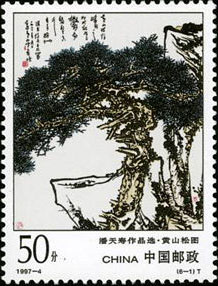
 (6-1), Pines on the Yellow Mountain, 50 fen, 38*50mm
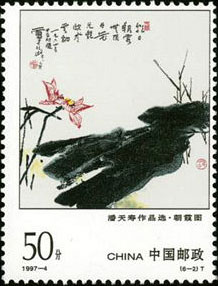
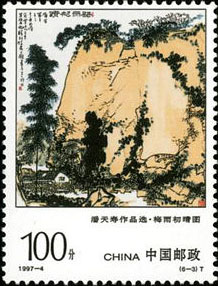
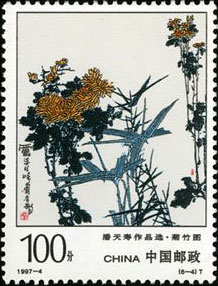
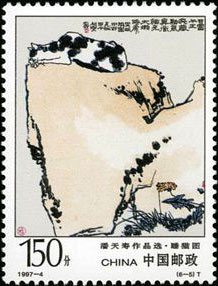
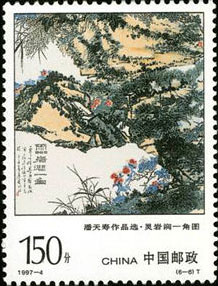
Technical details
Scott No: 2749-54Serial number: 1997-4
Values in set: 6
Date of issue: Pan Gongkai; Li Guoyi
Designers: March 14, 1997
Size: 38*50mm
Perforation: 11.5
Sheet composition: 32
Printing process: gravure
Background
Pan Tianshou was another outstanding arts virtuoso who promoted the development of Chinese painting after Wu Chang shuo, Qi Baishi and Huang Binhong.Pan was born into a peasant family in Ninghai County, Zhejiang Province in 1807. His parents gave him the name Tianshou (meaning endowed by the heaven, later changed to Tianshou meaning live as long as the heaven). His styled name was Dayi, alias Ashou, but he often used Leipuotoufeng Shouzhe when he signed his later works.
Pan's family lived in a direly poor situation since he was young, but he deeply loved calligraphy and painting. Through self-teaching, he learned the art of painting by imitating the works of Xu Wei, Zhu Da and Shi Tao. Later, he took democratic educators Li Shutong, Jing Hengyi, etc., as his teachers. In his pursuit of carrying forward the national arts, he cherished no vanity, was upright and never sacrificed principles. His painting art paid particular attention to such standards of values of Chinese national paintings as artistic conception , styles and patterns. His works were magnificent, picturesque, hold and creative. His artistic language and styles were unique, and he tapped the artistic method of Chinese painting which emphasized lines to the most. With his unique appreciation and understanding on arts, he blazed new trails in the structure and composition of the Chinese painting, making his works full of inspiration and modern senses. His works were a kind of compendium of traditional Chinese paintings blending poems, calligraphy, painting and seal.
In 1923, he and Mr. Zhu Wenyun established China's first department of Chinese paintings at the Shanghai School of Fine Arts. He later taught at the National School of Arts, the East China branch of the Central Academy of Fine Arts and Zhejiang Academy of Fine Arts. He was indisputably one of the principal founders in the teaching of modern Chinese painting. After the founding of the People's Republic of China, he served as the president of Zhejiang Academy of Fine Arts and vice-president of Zhejiang Association of Artists. He died in 1971.
Share: 
Price List
Item location: China
Ships to: Worldwide
*Shipping (via registered air mail) is based on subtotal of order. See detials below.
* 1) for special items shipping and handling cost may be included. 2) Other fast shipping is available.
To special order, please let us know what you are looking for. We will help you to meet your unique interests.
Ships to: Worldwide
*Shipping (via registered air mail) is based on subtotal of order. See detials below.
| Order Subtotal | S & H |
| $0.01---$15.00 | US $5.00 |
| $15.01---$50.00 | US $6.00 |
| $50.01---$100.00 | US $7.00 |
| $100.01---$180.00 | US $8.00 |
| $180.01---over | US $9.00 |
To special order, please let us know what you are looking for. We will help you to meet your unique interests.


