

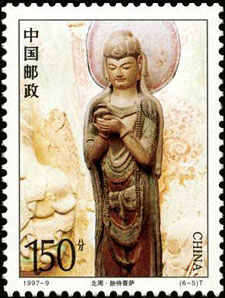
1997-9, Scott 2769-74 Maiji Grottoes
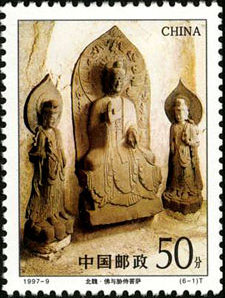
 (6-1), Buddha and Xieshi Bodhisattva, 50 fen, 30*40mm

Technical details
Scott No: 2769-74Serial number: 1997-9
Values in set: 6
Date of issue: Jiang Weijie; LI Qingfa
Designers: June 13,1997
Size: 30*40mm
Perforation: 12
Sheet composition: 50
Printing process: offset
Background
The Maijishan grottoes located along the ancient Silk Road near Tianshui City, Gansu Province are one of the four most famous grottoes in China. The grottoes were dug on a precarious cliff of the Xiaolong Mountain in the forest, and got its name because the mountain is shaped like a "piled wheat straw of a rural family".During the late Qin period in the era of sixteen kingdoms 1,600 years ago, the emperors ordered to dig cave-shrines on the cliff more than several dozens meters in height on which figures were created and paintings were done. During the Western Qin period, eminent Buddhist masters began to assemble there to teach Buddhist scriptures. During the Northern Wei Dynasty, Maijishan Mountain had become a famous holy site of Buddhism, in which more than 100 caves were added, and more than 10,000 figures were sculptured. Huge grottoes thus took shape.
The Maijishan Grottoes have witnessed twelve dynasties after they were completed. Now, 194 caves are preserved, containing more than 7,200 small mud figures, stone sculptures and more than 1,300 square meters of frescoes. The sculptures in the Maijishan Grottoes demonstrate the contributions of Chinese traditional arts of sculpture to the Buddhist arts, they personalized the divine figures and made them vivid. The figures in the Maijishan Grottoes can be classified into mud figures, stone sculptures and stone-engraved figures, with mud figures as the dominant. Therefore, Chinese and foreign scholars regard it as the "museum of Oriental sculptures".
Share: 
Price List
Item location: China
Ships to: Worldwide
*Shipping (via registered air mail) is based on subtotal of order. See detials below.
* 1) for special items shipping and handling cost may be included. 2) Other fast shipping is available.
To special order, please let us know what you are looking for. We will help you to meet your unique interests.
Ships to: Worldwide
*Shipping (via registered air mail) is based on subtotal of order. See detials below.
| Order Subtotal | S & H |
| $0.01---$15.00 | US $5.00 |
| $15.01---$50.00 | US $6.00 |
| $50.01---$100.00 | US $7.00 |
| $100.01---$180.00 | US $8.00 |
| $180.01---over | US $9.00 |
To special order, please let us know what you are looking for. We will help you to meet your unique interests.


