

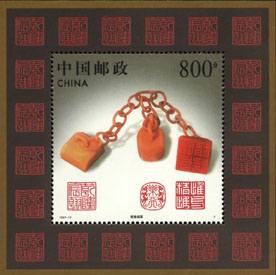
1997-13, Scott 2787-91 Stone Carving of Shoushan
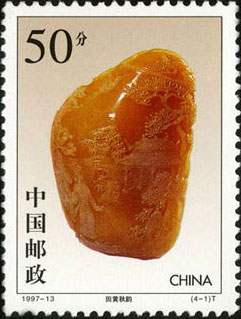
 (4-1), Rhythm of Autumn, 50 fen, 30*40mm
Technical details
Scott No: 2787-91Serial number: 1997-13
Values in set: 4
Date of issue: August 17,1997
Designers: Ren Guoen; Ke Yongsheng
Size:
30*40mm for Value 1 and 2
40*30mm for Value 3 and 4
Size of the S/S stamp: 60*60mm
Size of S/S: 97*97mm
Perforation: 12
Sheet composition: 50
Printing process: offset
Themes: Art, Gems and minerals,
Background
Shoushan stone, produced in Shoushan Township in the northern suburb of Fuzhou City, is one of China's three most famous stones. The stones are known for their fine texture, multicolours and carveability. There is an old saying about the legendary Nuwa repairing the heaven with stones. Nuwa hid the remnant coloured stones in the Shoushan Mountain, which later became the Shoushan Stones. According to another legend, in the ancient times, a five-coloured phoenix stopped at Shoushan Mountain; wherever she went, lardite was produced, which was smooth and greasy. The eggs that the phoenix laid became Shoushan stones.The Shoushan stones are flawless beauties. There are more than 100 kinds of Shoushan stones which are classified as Tiandeng, Shuikeng and Shankeng. The art of Shoushan stone carving dated back to 1500 years ago. The carving techniques vary. Some are simple and solid, and some are small and exquisite. Besides seals the Shoushan stones are carved into figures, animals, ancient holy animals, flowers and fruits, fish and insects, and mountain and river. The craftsmen of different dynasties created many masterpieces which had been passed down from generation to generation. The Qianlong Chain Seals, regarded as a precious treasure, was carved out from a whole piece of Tianhuang jade into two square seals and one oval seal, which were linked by three chains. The chain seals were passed sown from Emperor Qianlong to emperors Jiaqing, Daoguang, Xianfeng, Tongzhi, Guangxu and Xuantong. When the last emperor Pu Yi was driven out of the Imperial Palace, he hid the seals in his suitcase. After being reeducated. Pu Yi donated this precious antique to the State. So the Qianlong Chain Seals were brought back to the Palace Museum.
Share: 
Price List
Item location: China
Ships to: Worldwide
*Shipping (via registered air mail) is based on subtotal of order. See detials below.
* 1) for special items shipping and handling cost may be included. 2) Other fast shipping is available.
To special order, please let us know what you are looking for. We will help you to meet your unique interests.
Ships to: Worldwide
*Shipping (via registered air mail) is based on subtotal of order. See detials below.
| Order Subtotal | S & H |
| $0.01---$15.00 | US $5.00 |
| $15.01---$50.00 | US $6.00 |
| $50.01---$100.00 | US $7.00 |
| $100.01---$180.00 | US $8.00 |
| $180.01---over | US $9.00 |
To special order, please let us know what you are looking for. We will help you to meet your unique interests.


