

2026-21 National Archaeological Site Parks (II)
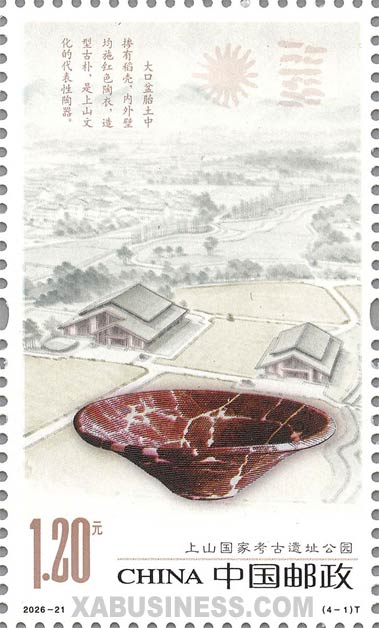
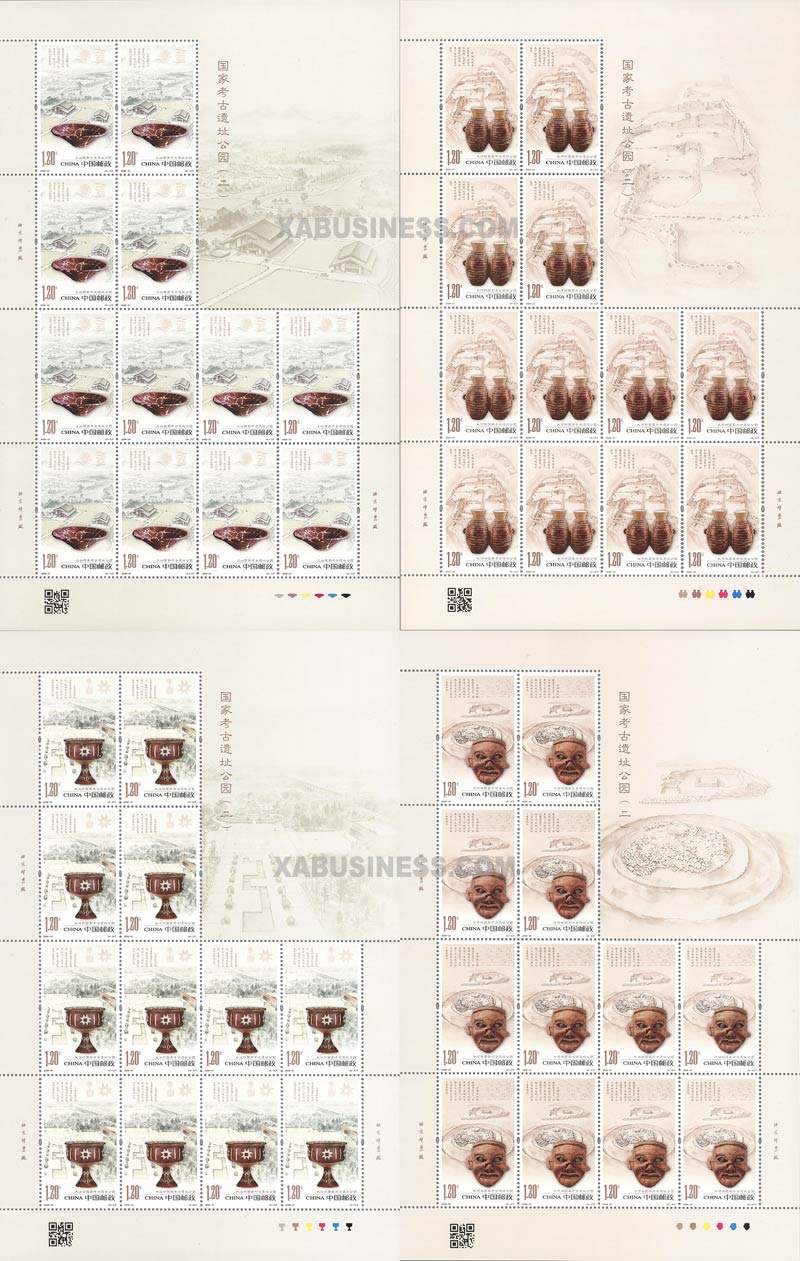
 (4-1), Shangshan National Archaeological Site Park, 120 fen, 30 * 50 mm
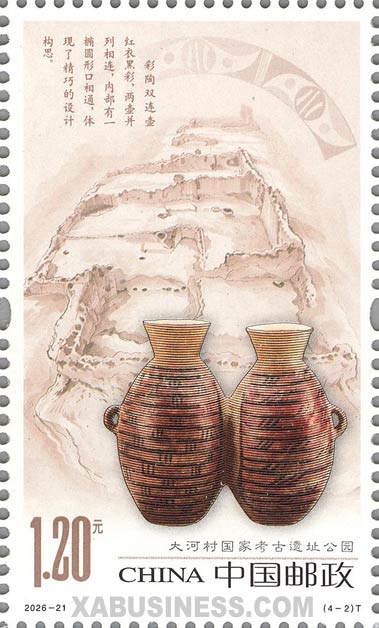 (4-2), Dahecun National Archaeological Site Park, 120 fen, 30 * 50 mm
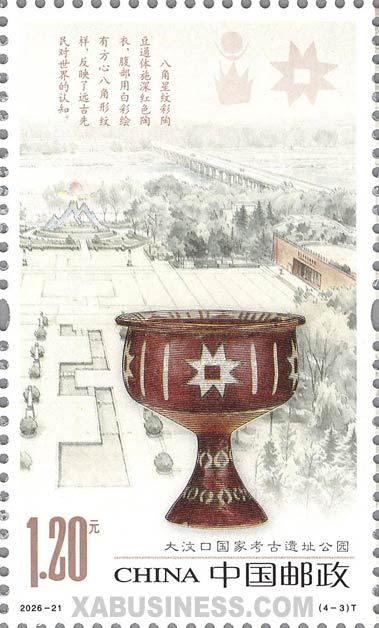 (4-3), Dawenkou National Archaeological Site Park, 120 fen, 30 * 50 mm
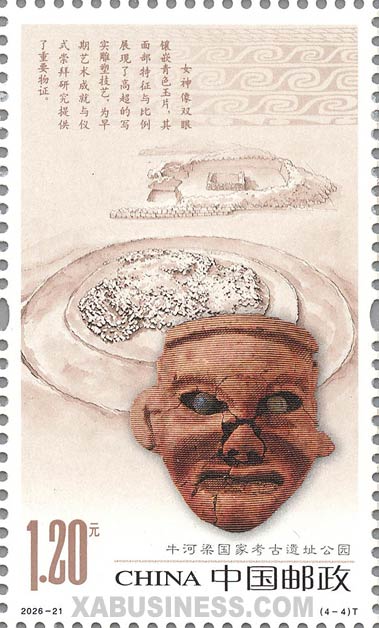 (4-4), Niuheliang National Archaeological Site Park, 120 fen, 30 * 50 mm

Technical details
Scott No: -Serial number: 2026-21
Values in set: 4
Date of issue: November 22, 2026
Denomination: 480 fen
Designer: Xu Zhe, Yang Zhiying
Size of stamps: 30 * 50 mm
Perforation: 13.5
Sheet composition: 12
Size of sheet: 150 * 235 mm
Printing process: Offset + Engraving
Printing House: Beijing Postage Stamp Printing Works
Background
"The National Archaeological Site Parks (II)" special stamps, serial number 2026-21, will be issued on November 22, 2026. The set consists of 4 stamps, each with a face value of 1.20 yuan, with a total face value of 4.80 yuan for the set. Stamp size 30 × 50 mm, perforation gauge 13.5, 12 stamps per sheet, sheet size 150 × 235 mm. Printed by offset combined with engraving, with anti-counterfeiting features including anti-counterfeiting paper, anti-counterfeiting ink, specially shaped perforations, and fluorescent serial numbers. Designed and engraved by Xu Zhe and Yang Zhiying, responsible editor Li Kexin, materials provided by the Zhejiang Provincial Institute of Cultural Relics and Archaeology, the Zhengzhou Dahecun Archaeological Site Park, the Tai'an Dawenkou Culture Protection and Inheritance Center, and the Chaoyang Niuheliang Site Museum, printed by Beijing Stamp Factory Co., Ltd., with a planned circulation of 3.9 million sets.Theme of the Set
This set continues the theme of the project tracing the origins of Chinese civilization, selecting four important prehistoric sites belonging to different cultural regions—the lower Yangtze, the Central Plains, Haidai, and western Liaoning—to present the pluralistic and integrated pattern of early civilization through the medium of stamps, displaying China's long-standing and profound prehistoric archaeological achievements, and conveying the concept of protecting major sites and carrying forward the Chinese cultural lineage.
Stamp Designs and Historical Background
Shangshan National Archaeological Site Park
In the foreground is the iconic Shangshan culture large-mouthed pottery basin with charcoal-tempered red coating, into whose clay body a large amount of rice husk was deliberately mixed, leaving clear rice-husk impressions on the basin walls—direct physical evidence of the world's ten-thousand-year-old cultivated rice, corroborating that the lower Yangtze was the core region of the origin of rice agriculture. The background uses light-ink line drawing to depict the site protection and exhibition buildings and the native rice-field landscape, with the Shangshan culture sun pattern dotted in the upper left corner, echoing the ancestors' worship of the sun. The site is located in Pujiang, Zhejiang, dating back about ten thousand years, and completely preserves the evidence chain of rice harvesting, processing, and consumption; it is honored as "ten-thousand-year Shangshan, the world's source of rice" and is the starting point of early Neolithic civilization in the lower Yangtze.
Dahecun National Archaeological Site Park
The main artifact is the Yangshao culture painted pottery double-connected pot: two olive-shaped pot bodies are joined, with an opening between the bellies allowing them to communicate; the red coating is the ground, and the two pot bodies are painted with different combinations of black parallel-line patterns. It is a ritual vessel for prehistoric tribal alliances and ceremonial drinking, symbolizing harmonious coexistence. The background depicts the cross-section of the iconic Dahecun wood-bone integrally molded house foundation—the famous "First House under Heaven"; the walls of this five-thousand-year-old suite of rooms were baked by fire and are in excellent condition, establishing the early form of northern dwellings. The site is located in Zhengzhou, Henan, and lasted for thousands of years; it is a benchmark settlement for studying the development thread of Central Plains Yangshao culture.
Dawenkou National Archaeological Site Park
The main artifact is the painted pottery dou with octagonal star pattern, a high-stemmed ritual vessel for serving food. The whole body is coated with red pottery slip, and the belly is painted with groups of octagonal star patterns in white; the octagonal points radiate outward with a square center. Academia generally believes the pattern represents the ancestors' cosmological understanding of a round heaven and square earth, while some interpret it as sun rays. The background is the site protection facility and field landscape, paired with simple Dawenkou culture geometric patterns. The site is located in Tai'an, Shandong, dating back more than six thousand years, and completely records the development process of prehistoric social differentiation and the budding of ritual systems in the Haidai region; it is the core representative of Haidai civilization in the lower Yellow River.
Niuheliang National Archaeological Site Park
The core image is the Hongshan culture goddess head, close to the size of a real human head, with blue jade pieces inlaid in the eyes, realistic and soft facial contours, and a hoop-shaped ornament on the forehead; it is the main deity statue enshrined in the Goddess Temple and is a cultural relic prohibited from being exhibited abroad. The background is supplemented by the stone outlines of cairns, the plan of the altar, and typical Hongshan cloud patterns, presenting the ritual architectural complex integrating altar, temple, and tomb. The site is in Chaoyang, Liaoning, dating back more than five thousand years; it is the earliest large-scale prehistoric sacrificial center in China, empirically demonstrating that the western Liaoning region was the first to enter the stage of ancient state civilization and supporting the thesis of China's five-thousand-year civilization.
Artistic Design Features
The whole set adopts a vertical composition, forming a series echo with the horizontal format of the first group. Offset printing expresses the site environment, light-colored patterns, and background layers, while the engraved lines focus on shaping the main artifacts, strengthening the texture of the objects and the three-dimensionality of their outlines. The tones are plain and calm, and the elements are arranged with restraint and simplicity, creating an atmosphere relying on the weighty feel inherent in archaeological remains. The stamps are accompanied by AR digital display, expanding the viewing dimension of cultural-relic science popularization.
Share: 
Price List
Item location: China
Ships to: Worldwide
*Shipping (via registered air mail) is based on subtotal of order. See detials below.
* 1) for special items shipping and handling cost may be included. 2) Other fast shipping is available.
To special order, please let us know what you are looking for. We will help you to meet your unique interests.
Ships to: Worldwide
*Shipping (via registered air mail) is based on subtotal of order. See detials below.
| Order Subtotal | S & H |
| $0.01---$15.00 | US $5.00 |
| $15.01---$50.00 | US $6.00 |
| $50.01---$100.00 | US $7.00 |
| $100.01---$180.00 | US $8.00 |
| $180.01---over | US $9.00 |
To special order, please let us know what you are looking for. We will help you to meet your unique interests.


