

2026-4 Chinese Seal Engraving (3)
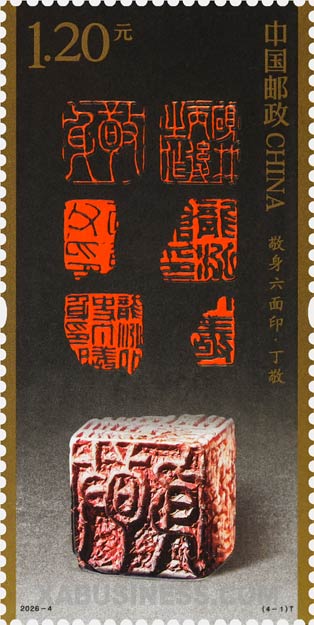
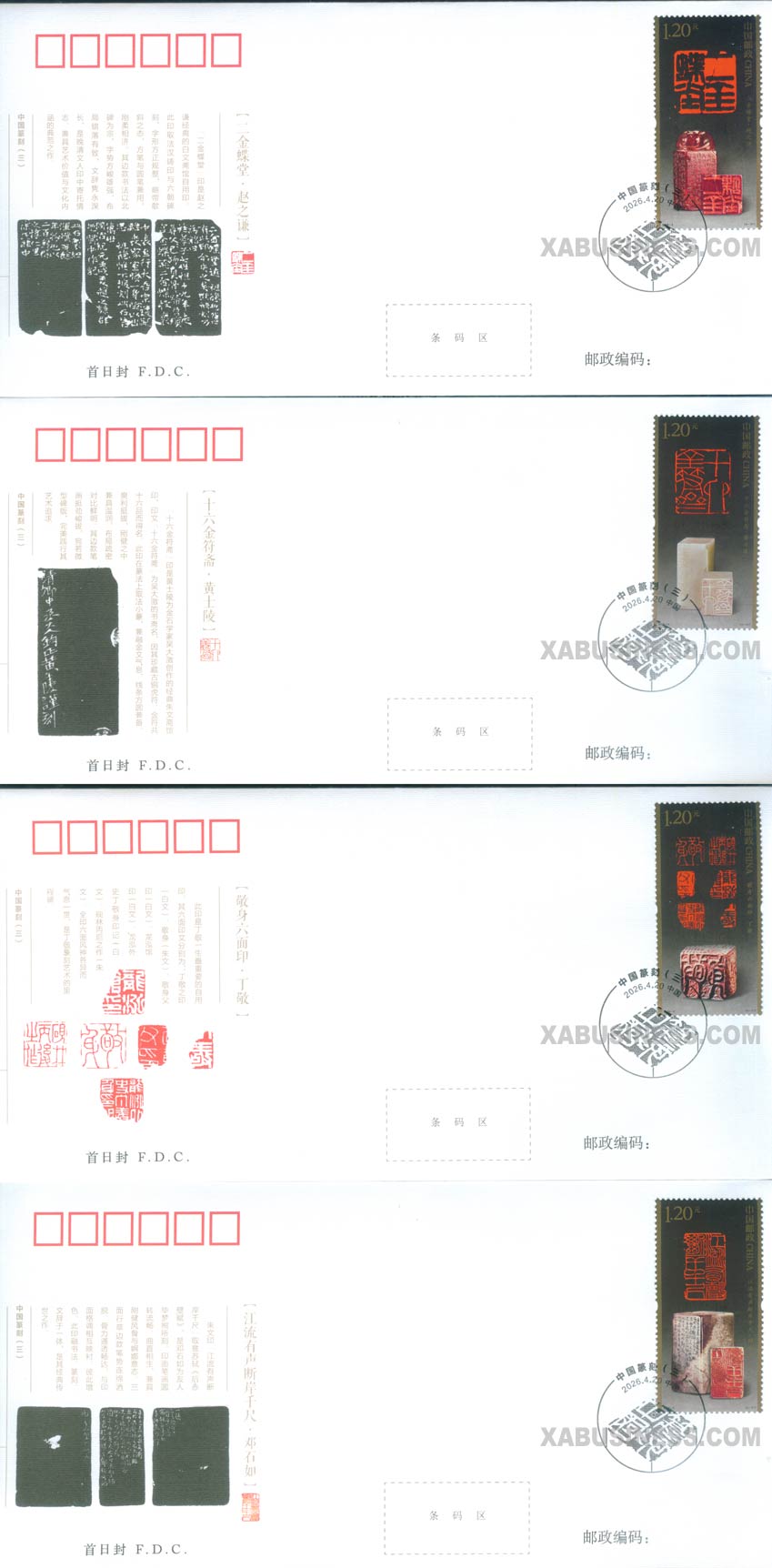
 (4-1), Six‑Faced Self‑Seal - Ding Jing, 120 fen, 30 * 60 mm
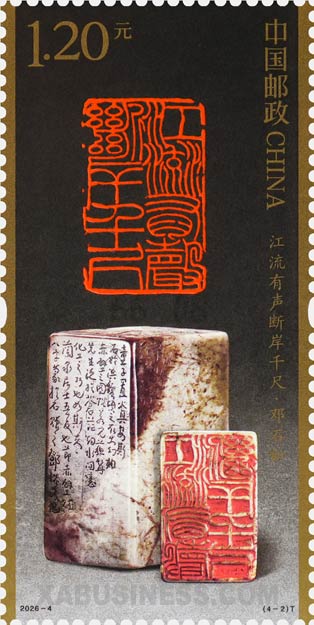 (4-2), The River Roars; Steep Cliffs Stretch a Thousand Feet - Deng Shiru, 120 fen, 30 * 60 mm
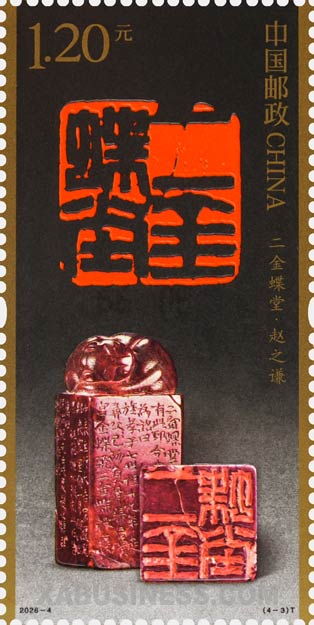 (4-3), Hall of Two Golden Butterflies - Zhao Zhiqian, 120 fen, 30 * 60 mm
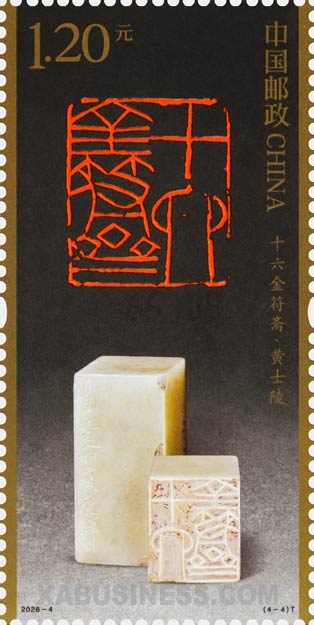 (4-4), Studio of Sixteen Golden Tally Charms - Huang Shiling, 120 fen, 30 * 60 mm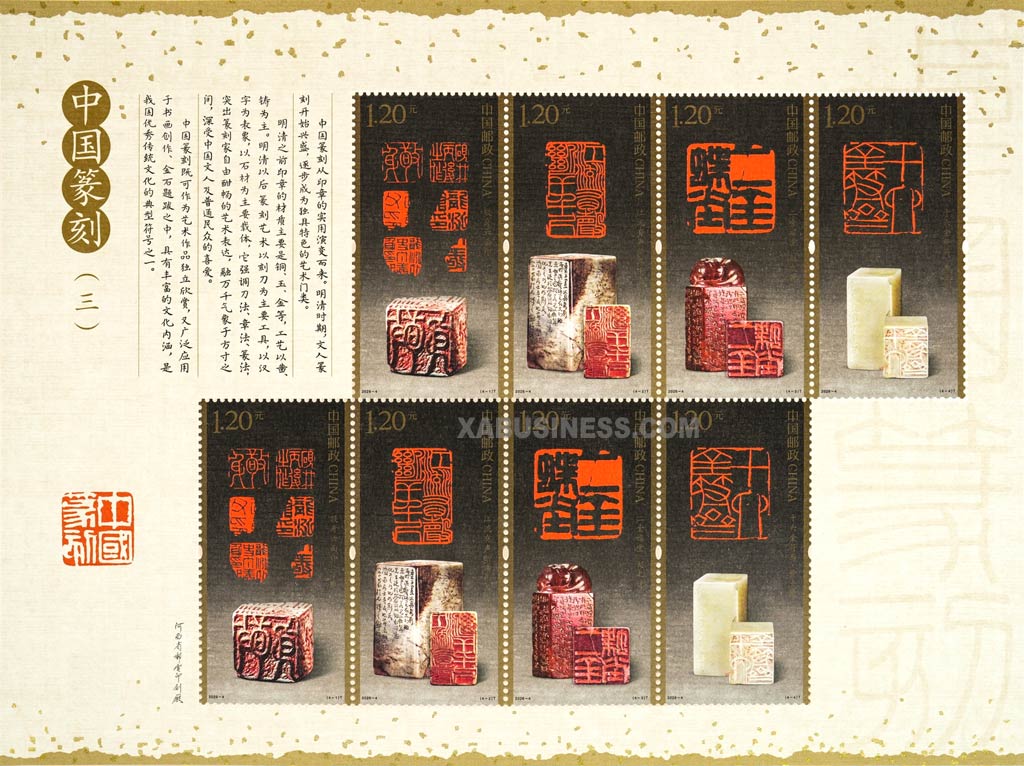

Technical details
Scott No: -Serial number: 2026-4
Values in set: 4
Date of issue: April 20th, 2026
Denomination: 480 fen
Designer: Yu Xue
Size of stamps: 30 * 60 mm
Perforation: 13.5 * 13
Sheet composition:
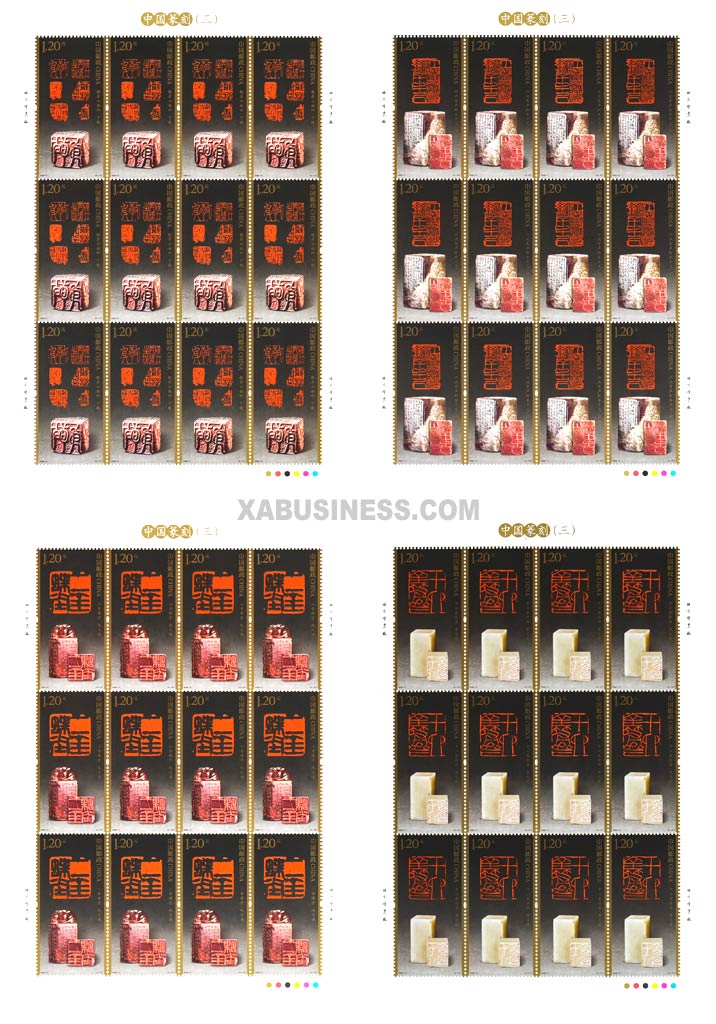
12 for Sheet I;
8 for Sheet II (2 sets)
150 * 215 mm for Sheet I;
200 * 150 mm for Sheet II
Printing process: Offset
Printing House:
Sheet I: Beijing Postage Stamp Printing Works
Sheet II: Henan Post and Telecommunication Technology Co., Ltd.
Background
China Post plans to issue a special stamp set Chinese Seal Carving (III) on April 20, 2026, containing four individual stamps. The stamp designs are titled:Six‑Faced Self‑Seal - Ding Jing’s
The River Roars; Steep Cliffs Stretch a Thousand Feet - Deng Shiru
Hall of Two Golden Butterflies - Zhao Zhiqian
Studio of Sixteen Golden Tally Charms - Huang Shiling
The total face value of the four‑stamp set is 4.80 yuan. The planned circulation is 3.926 million regular sets and 532,000 sheetlet panes.
Seal carving art is a splendid treasure of traditional Chinese visual culture, bearing the enduring and evolving civilizational marks of the Chinese nation. Taking seals as its carrier and nurtured by thousands of years of cultural heritage, it has been refined through the ingenuity and artistic creation of literati across dynasties, evolving into a unique and irreplaceable Eastern art form admired worldwide. As a globally renowned cultural symbol, Chinese seal carving integrates practical authentication functions with profound aesthetic value. Within the tiny space of a seal lies the elegance of millennia, worthy of collection and inheritance by cultural enthusiasts for generations.
The first stamp features Six‑Faced Self‑Seal by Ding Jing. As the founding master of the Zhe School of seal carving and the leading figure of the Eight Masters of Xiling, Ding Jing pioneered the cutting knife technique, forming a concise, powerful and simple artistic style. This six‑faced personal seal ranks among his most important lifetime works. Originally a mother‑and‑son seal carved by Liang Qianqiu in the late Ming Dynasty, the stone was acquired by Ding Jing, who first engraved five sides and later added the sixth side bearing the inscription Made after the Bing Year by Yanlin following a fire accident. Its two red inscriptions follow small seal script with lean, firm and upright lines; the four white inscriptions adopt Han archaic seal script, featuring a neat, dense, vivid and extraordinary layout, fully embodying his core artistic proposition that “ancient seal carvers sought to break away from conventional norms”.
The second stamp presents Deng Shiru’s famous seal The River Roars; Steep Cliffs Stretch a Thousand Feet. Deng Shiru, the pioneer of Qing‑dynasty stele studies and the culminating master of the Wan School of seal carving, established the groundbreaking artistic concept of “integrating calligraphy into seal carving”. Inspired by Su Shi’s Ode to the Red Cliff (Part II), this seal was carved to thank a friend for gifting an ancient rubbing of Crane Burial Inscription. Infused with the brushwork of small seal script, the eight characters on the seal feature a compact left layout and a spacious right layout, reflecting his famous aesthetic theory: “sparse spaces may let a horse gallop through, while dense gaps leave no breath of wind”. Carved with smooth and unrestrained pressing knife strokes, it bears three sides of cursive inscriptions adapted to the stone’s natural shape. The inherent stone textures echo the scenery of the Red Cliff, creating a vast, powerful and profound artistic conception and securing its status as an immortal masterpiece in Qing‑dynasty seal carving history.
The third stamp showcases Zhao Zhiqian’s seal Hall of Two Golden Butterflies. A pioneering reformer of late Qing seal carving, Zhao Zhiqian advocated “drawing creative inspiration beyond traditional seal patterns”, widely incorporating characters from ancient steles, bronze mirrors and other classical inscriptions into his works. Hall of Two Golden Butterflies is his personal white‑script studio seal, named after an auspicious legend of his ancestors who witnessed “two golden butterflies hovering around”. Its seal script derives from Han casting inscriptions and Six Dynasties stele calligraphy. In composition, the broken‑edge structure of the character “Two” echoes the character “Hall”, while the slanted strokes of “Butterfly” eliminate rigidness, perfectly interpreting the subtle balance between extreme sparseness and density. He combined pressing and cutting knife techniques to unify cutting force and calligraphic charm. Its side inscriptions adopt Northern Wei stele styles with direct single‑blade carving, conveying deep remembrance and respect for his ancestors.
The fourth stamp features Huang Shiling’s Studio of Sixteen Golden Tally Charms. Founder of the Yishan School, Huang Shiling opposed the deliberate imitation of weathered and worn ancient Han seals, arguing that such textures formed naturally over time. He pursued a refined, neat, elegant and authentic artistic style. The Studio of Sixteen Golden Tally Charms belonged to Wu Dacheng, a renowned epigrapher and antiquarian, who collected sixteen ancient bronze and golden tally charms, hence the studio’s name. Crafted primarily in small seal script with integrated bronze inscription elements, the five characters are arranged in two vertical columns with striking contrasts between sparseness and density. Executed mainly with pressing knife strokes, the lines are sleek, sharp and powerful, revealing subtle agility within poised solemnity. Its side inscriptions are carved in Northern Wei regular script with single blades, resembling miniature stone steles and fully realizing his artistic pursuit of “extraordinary charm within balanced composure”.
Seal carving of this period inherited the epigraphic scholarship of the Qianlong and Jiaqing eras. Breaking the shackles of traditional schools, it embraced diversified innovation and marked a crucial turning point for the transition from classical to modern seal art. Masters of this era rooted their creations in epigraphy, retaining the essence of Qin and Han traditions while developing distinctive personal styles. They blended pressing and cutting knife techniques, emphasized the interplay of void and solid in layout, prioritized the integration of seal carving and calligraphy, and infused seal script brushwork into carving craftsmanship. Side inscriptions complemented seal faces perfectly, jointly reaching the supreme artistic realm of “unified principles in calligraphy and seal carving”. This artistic trend guided seal carving away from rigid ancient imitation toward free expressive creation, opening up new artistic horizons for future generations of seal carvers.
The entire stamp set features crisp artwork with deep black as the dominant background, creating a striking visual contrast with bright red seal inscriptions. The regular sheet (Format I) adopts high‑precision six‑color offset printing combined with three‑dimensional embossing technology. High‑bright red ink is used for seal inscriptions, delivering rich, translucent vermilion tones that replicate the classic texture of traditional cinnabar seal paste. Special gold ink highlights titles, face values and other key information. The classic color combination of red, gold and black creates layered visuals and a clear thematic presentation. Three‑dimensional embossing is applied to seal inscriptions, carved surfaces and stone textures, vividly restoring the complete form of seal stones, carved surfaces and character strokes. The flat stamps take on a relief‑like three‑dimensional effect, reproducing the texture of chiseled jade and stone in traditional seal carving. With upgraded tactile and visual experiences, the stamps deliver an immersive artistic experience that is visible, touchable and perceptible, showcasing exquisite printing craftsmanship and high collectible value.
The border decorations of Format II sheetlets adopt gold dust sprinkling craftsmanship, unfolding a three‑thousand‑year cultural legacy forged by knife and stone through modern printing techniques and leading viewers into an artistic palace of epigraphic art. Printed on anti‑counterfeit rice paper, the stamps exude classical elegance. They silently carry forward traditional Chinese culture, restore the charm of stone carving and brush aesthetics within a miniature frame, and fully demonstrate the outstanding artistic expression and profound cultural connotation of the stamps.
This stamp set is designed by Yu Xue and edited by Wen Yaya.
Share: 
Price List
Item location: China
Ships to: Worldwide
*Shipping (via registered air mail) is based on subtotal of order. See detials below.
* 1) for special items shipping and handling cost may be included. 2) Other fast shipping is available.
To special order, please let us know what you are looking for. We will help you to meet your unique interests.
Ships to: Worldwide
*Shipping (via registered air mail) is based on subtotal of order. See detials below.
| Order Subtotal | S & H |
| $0.01---$15.00 | US $5.00 |
| $15.01---$50.00 | US $6.00 |
| $50.01---$100.00 | US $7.00 |
| $100.01---$180.00 | US $8.00 |
| $180.01---over | US $9.00 |
To special order, please let us know what you are looking for. We will help you to meet your unique interests.


