

2026-17 90th Anniversary of the Victory of the Long March of the Chinese Workers' and Peasants' Red Army
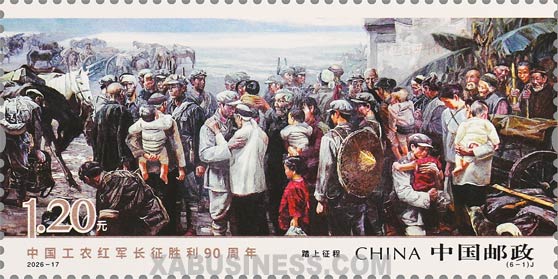
 (6-1), Setting Out, 120 fen, 60 * 30 mm
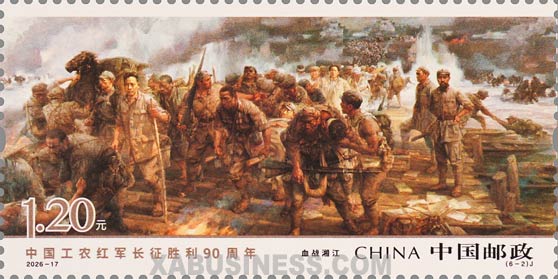 (6-2), Bloody Battle at the Xiangjiang River, 120 fen, 60 * 30 mm
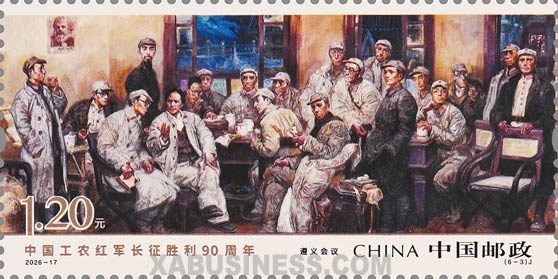 (6-3), The Zunyi Conference, 120 fen, 60 * 30 mm
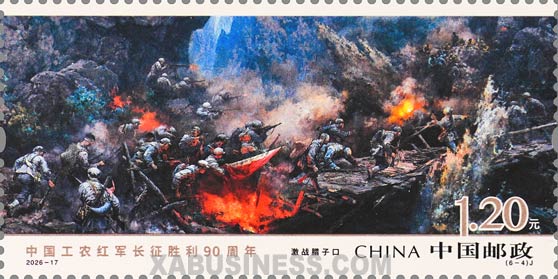 (6-4), Fierce Battle at Lazikou, 120 fen, 60 * 30 mm
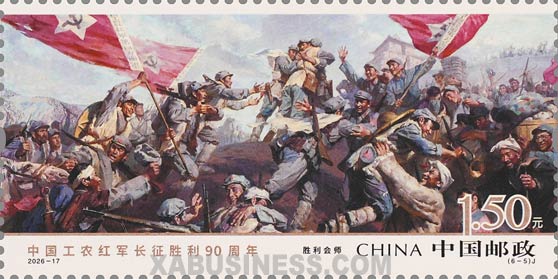 (6-5), Victorious Rendezvous, 150 fen, 60 * 30 mm
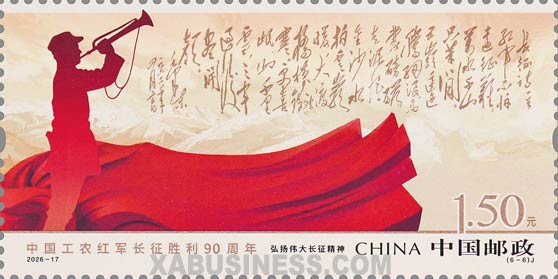 (6-6), Promoting the Great Long March Spirit, 150 fen, 60 * 30 mm

Technical details
Scott No: -Serial number: 2026-17
Values in set: 6
Date of issue: October 22, 2026
Denomination: 780 fen
Designer: Xia Jingqiu
Size of stamps: 60 * 30 mm
Perforation: 13.5 * 13
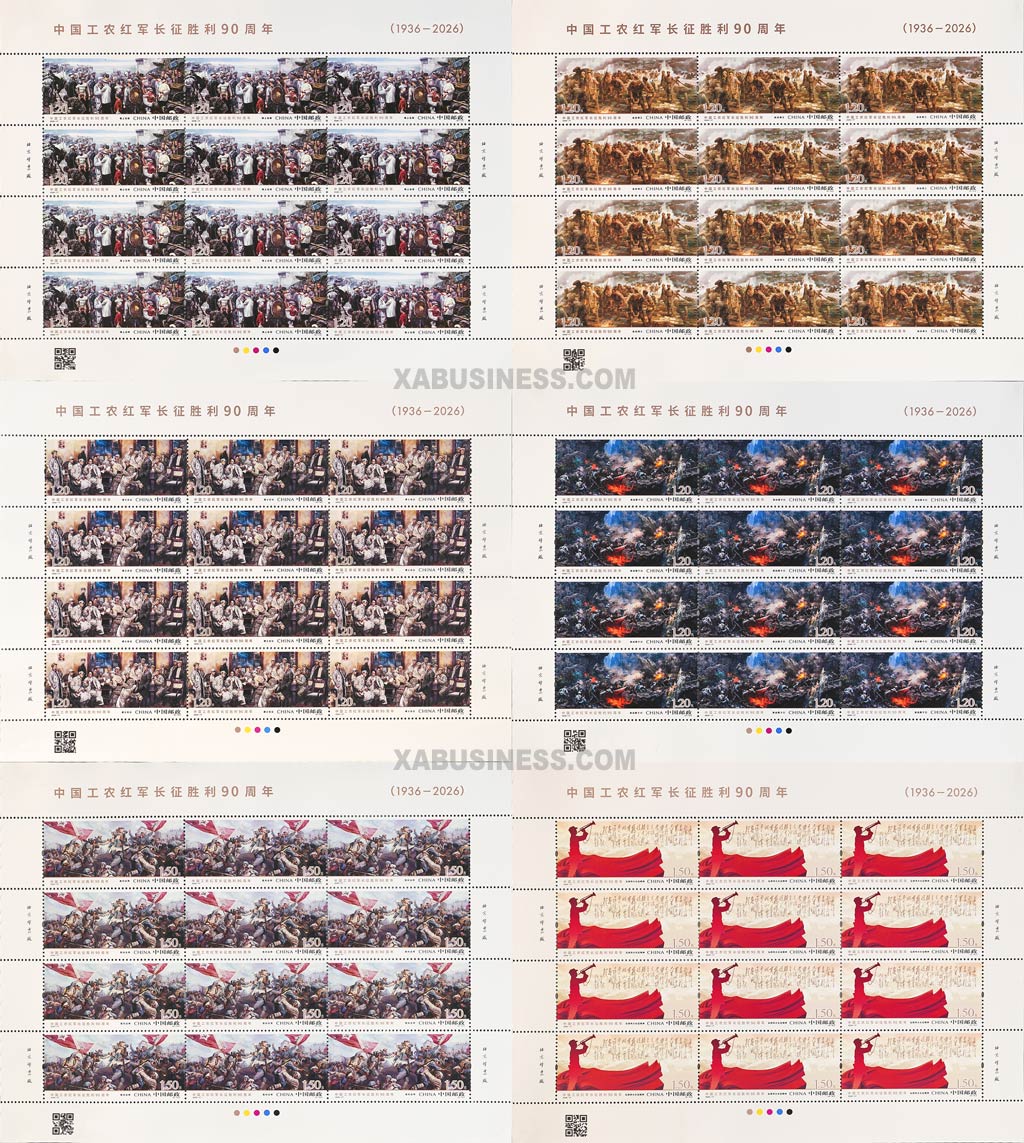
Sheet composition: 12
Size of sheet: 216 * 161 mm
Printing process: Offset
Printing House: Beijing Postage Stamp Printing Works
Background
Issued on October 22, 2026, this set contains six stamps printed by offset process. Each stamp measures 60 mm × 30 mm, with a perforation gauge of 13.5 × 13 degrees. Twelve stamps are printed per sheet, and the sheet size is 216 mm × 161 mm. Designed by Xia Jingqiu and printed by China National Stamp Corporation Beijing Stamp Factory Co., Ltd., the planned circulation stands at 4.3 million sets. Multiple anti-counterfeiting technologies are adopted, including anti-counterfeiting paper, security ink, special-shaped perforations and fluorescent coding.Theme Overview
This set is issued to commemorate the victory of the three main forces of the Chinese Workers' and Peasants' Red Army in October 1936, marking the 90th anniversary of the triumph of the Long March. The Long March was an earth-shaking revolutionary feat in human history and a magnificent epic composed by the Communist Party of China and the Red Army. Following the chronological timeline of the Long March, the stamps present key milestones: departure, bloody battles, a historic turning point, assault operations, and the grand rendezvous. The first five stamps adopt realistic oil painting styles to recreate major historical scenes, while the last one uses symbolic freehand brushwork to elevate the theme. The stamps pay tribute to the Red Army’s arduous 25,000-li expedition, promote the great Long March spirit of fearlessness of sacrifice, perseverance and solidarity, carry forward the revolutionary heritage, and inspire people to overcome difficulties and forge ahead on the new Long March of the new era.
Stamp Designs and Historical Background
Setting Out
The design is adapted from the historical oil painting of the same title by Sun Lixin. It depicts the scene in October 1934 when the Central Red Army bade farewell to the Central Soviet Area and embarked on the long expedition. Villagers embraced and bid farewell to Red Army soldiers. Women held children in their arms, while soldiers lined up with straw hats slung over their shoulders and rifles on their backs. Pack horses and porters stood beside the troops, and crowds waved goodbye at the village entrance. This scene, filled with quiet sorrow, marks the starting point of the Long March narrative.
Bloody Battle at the Xiangjiang River
Based on the historical oil painting by Zhang Qingtao, the stamp reconstructs the brutal Battle of the Xiangjiang River in the winter of 1934. On rafts and pontoons across the river, Red Army soldiers supported the wounded and carried stretchers to fight their way out amid smoke and gunfire. Troops and horses waded through the river under fire. The Battle of the Xiangjiang River was the deadliest engagement along the Long March route. After breaking through the Kuomintang’s fourth blockade line, the Red Army shrank from more than 80,000 troops to roughly 30,000. The heavy brushstrokes of the painting highlight the Red Army’s heroic struggle and the solemn tragedy of this breakthrough.
The Zunyi Conference
The artwork is adapted from Shen Yaoyi's depiction of the conference scene. Inside the meeting room in Zunyi, Guizhou, Mao Zedong stands at the center speaking, while Zhang Wentian, Zhou Enlai, Zhu De and other leaders and Red Army generals sit around listening intently. Teacups and manuscripts lie on the table, a portrait of Lenin hangs on the wall, and night falls outside the window. The Zunyi Conference, convened in January 1935, established Mao Zedong’s leadership over the Party and the Red Army in practice. It was a fateful turning point for the Long March and even for the Communist Party of China.
Fierce Battle at Lazikou
The stamp features the battle oil painting created by Yan Yang and Li Wu, recreating the Red Army’s capture of the perilous Lazikou Pass in Gansu in September 1935. Steep cliffs tower on both sides of the narrow valley. Red Army soldiers charged toward the mountain top along wooden bridges and cliff ladders. Firelight reddened the canyon, smoke billowed, and a red flag rose above the frontline. Lazikou was a strategic pass on the border of Sichuan and Gansu. By seizing this natural stronghold through a surprise strike, the Red Army opened the route northward into the Shaanxi-Gansu Soviet Area.
Victorious Rendezvous
The design draws from the rendezvous oil painting by Cai Liang and Zhang Zixi. In October 1936, the First, Second and Fourth Front Armies of the Red Army met triumphantly at Huining and Jiangtaibao in Gansu. Soldiers from the two contingents ran toward each other and embraced amid cheering crowds. Two hammer-and-sickle red flags flew high, bugles blared, and mounted soldiers and welcoming civilians celebrated together. The rendezvous of the three main forces marked the end of the Long March, a two-year expedition spanning more than ten provinces, and closes the historical narrative of the Long March.
Promoting the Great Long March Spirit
Breaking away from specific historical scenes, this stamp adopts symbolic freehand expression. On the left stands a red silhouette of a Red Army bugler. In the middle surges a wave of red banners. In the background, faint ink outlines stretch across snow-capped mountains, and the calligraphy of Mao Zedong’s poem *The Long March* (Seven-Character Lvshi) appears in the upper right corner. Bugles, red flags, the poem and snow mountain imagery are interwoven. Instead of recounting a single battle, this stamp elevates historical facts into a spiritual totem, signifying that the great Long March spirit transcends ninety years and continues to be inherited and carried forward in the new era.
Artistic Features
The first five stamps adopt a unified realistic oil-painting style with solid brushwork and solemn lighting. They follow the historical sequence of departure, bloody combat, turning point, assault and rendezvous to form a complete and coherent narrative. The sixth stamp shifts to flat, symbolic red decorative language. Figures, banners, calligraphy and snow mountain symbols are highly condensed. The contrast between realistic historical narration and abstract spiritual sublimation creates a striking effect.
Share: 
Price List
Item location: China
Ships to: Worldwide
*Shipping (via registered air mail) is based on subtotal of order. See detials below.
* 1) for special items shipping and handling cost may be included. 2) Other fast shipping is available.
To special order, please let us know what you are looking for. We will help you to meet your unique interests.
Ships to: Worldwide
*Shipping (via registered air mail) is based on subtotal of order. See detials below.
| Order Subtotal | S & H |
| $0.01---$15.00 | US $5.00 |
| $15.01---$50.00 | US $6.00 |
| $50.01---$100.00 | US $7.00 |
| $100.01---$180.00 | US $8.00 |
| $180.01---over | US $9.00 |
To special order, please let us know what you are looking for. We will help you to meet your unique interests.


