

2026-16 Blue-and-White Porcelain (Yuan Dynasty)
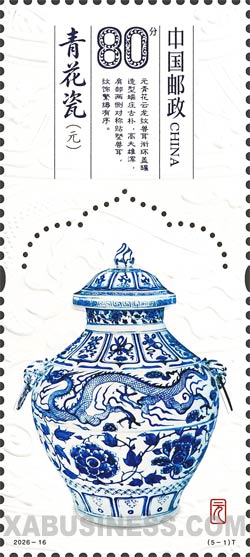
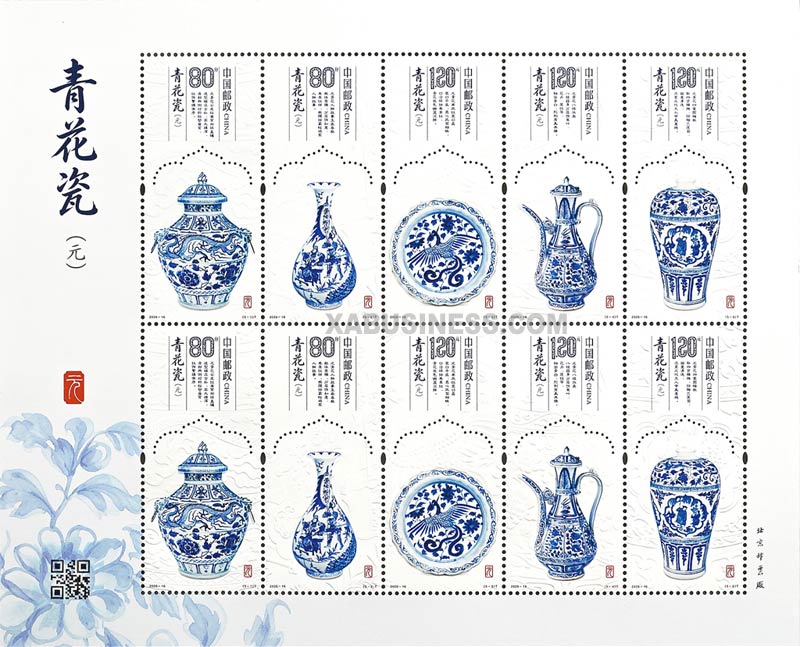
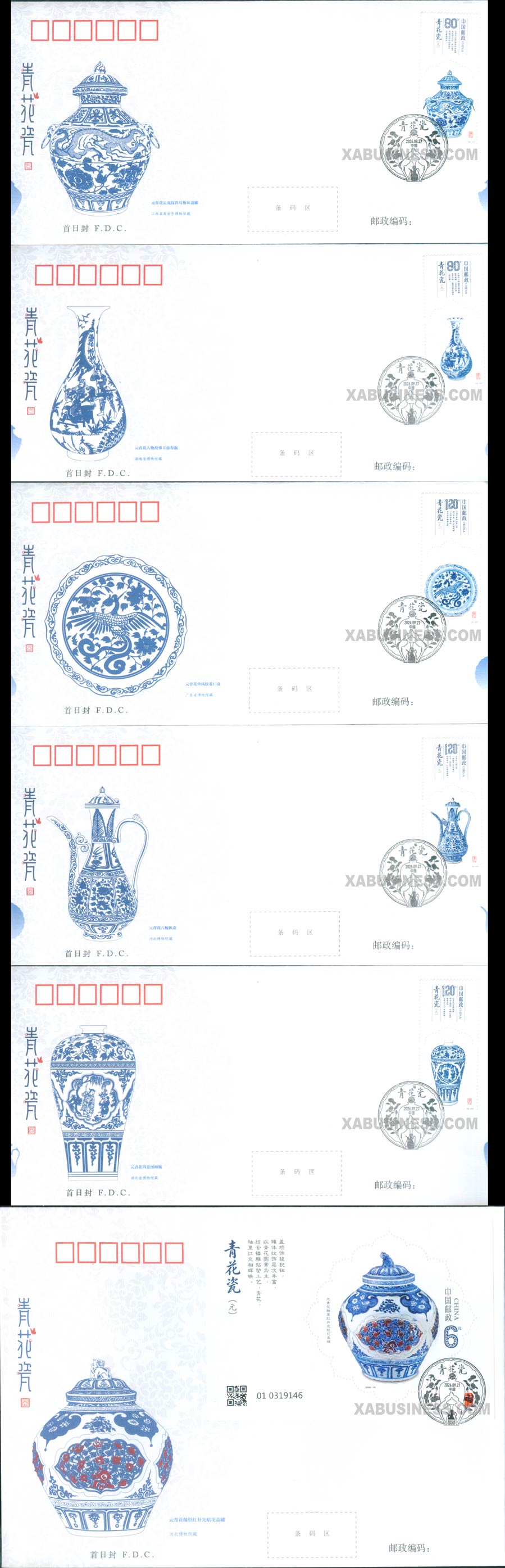
 (5-1), Yuan Blue-and-White Lidded Jar with Cloud-dragon Patterns and Animal-head Ring Handles, 80 fen, 27 * 60 mm
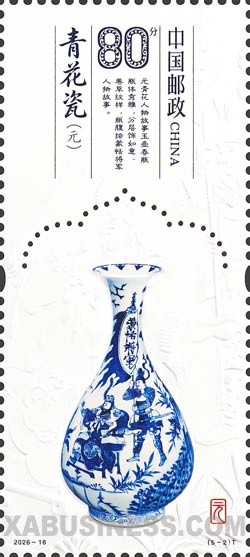 (5-2), Yuan Blue-and-White Jade Spring Vase with a Figure Story, 80 fen, 27 * 60 mm
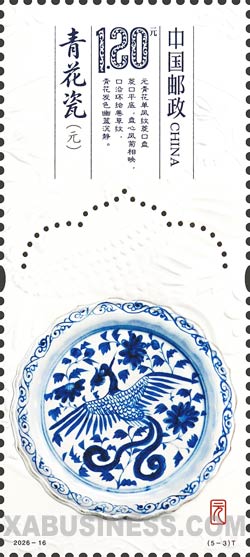 (5-3), Yuan Blue-and-White Lobed Dish With a Single Phoenix Pattern, 120 fen, 27 * 60 mm
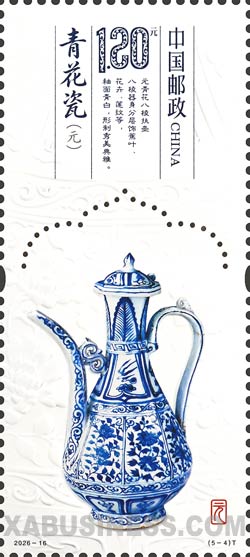 (5-4), Yuan Blue-and-White Octagonal Handled Pitcher, 120 fen, 27 * 60 mm
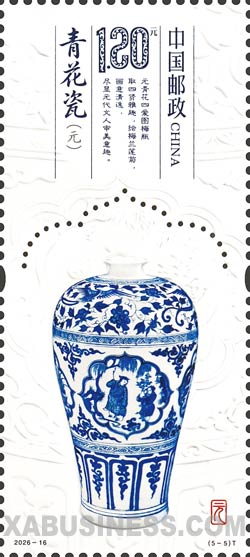 (5-5), Yuan Blue-and-White Plum Vase with the Four Loves Pattern, 120 fen, 27 * 60 mm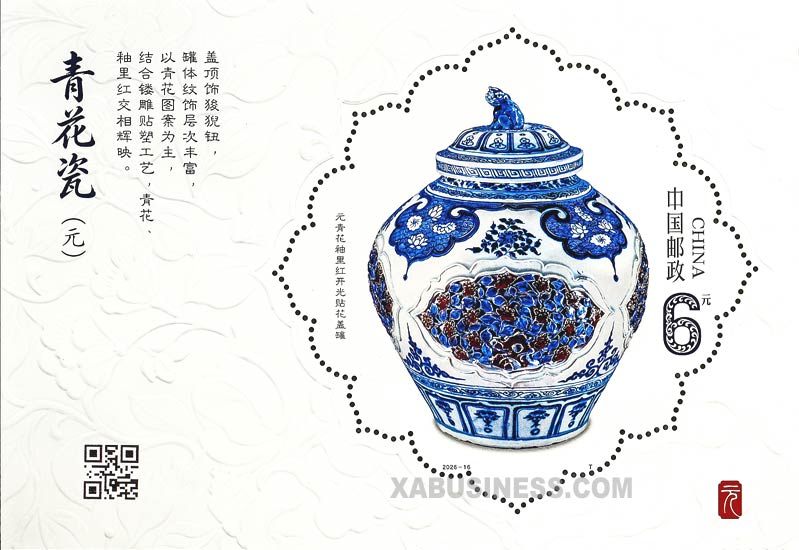

Technical details
Scott No: -Serial number: 2026-16
Values in set: 5
Date of issue: September 27th, 2026
Denomination: 520 fen
Designer: Yu Xue
Size of stamps: 27 * 60 mm
Perforation: 13.5 * 13
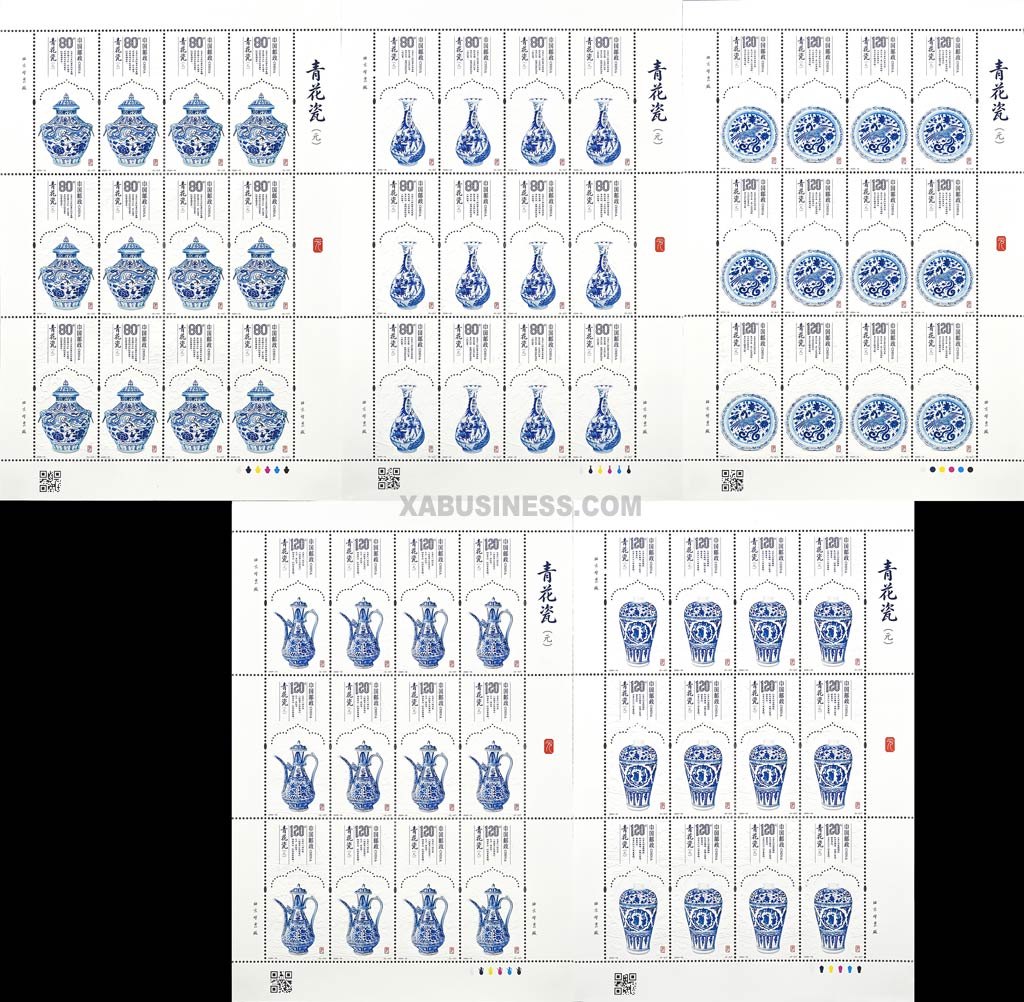
Sheet composition:
12 for Sheet I;
10 for Sheet II (2 sets)
142 * 210 mm for Sheet I;
180 * 145 mm for Sheet II
Size of S/S: 130 * 90 mm
Size of S/S stamp: 78 * 78 mm
S/S Perforation: 13.5
Printing process: Offset
Printing House: Beijing Postage Stamp Printing Works
Background
China Post will issue a set of five special stamps and one souvenir sheet titled Blue-and-White Porcelain (Yuan Dynasty) on September 27, 2026. The set features six national treasure-level Yuan blue-and-white porcelain pieces from five cultural and museum institutions across the country. Through a single sheet of stamps, it links together a porcelain legend spanning time and space, transforming these deep-hidden national treasures into tangible "national calling cards."The birth of Yuan blue-and-white porcelain was an artistic miracle jointly driven by technological breakthroughs and cultural integration. Its subjects are all-encompassing, ranging from dragons, phoenixes, and auspicious omens to historical stories, and from flowers, birds, and landscapes to market scenes. It carries the spiritual core of traditional Central Plains culture while also incorporating the era's imprint of multi-ethnic cultural integration and overseas trade. Currently, complete surviving Yuan blue-and-white porcelain pieces are rare and mostly scattered among major collection institutions at home and abroad. This special stamp set covers three major categories: hoard excavations, royal tomb burials, and handed-down collections. It includes classic vessel forms such as large jars, plum vases, jade spring vases, handled pitchers, and dishes, comprehensively showcasing the artistic height, craftsmanship level, and historical weight of Yuan blue-and-white porcelain.
The first stamp features a Yuan blue-and-white lidded jar with cloud-dragon patterns, animal-head ring handles. It is now housed in the Gao'an Museum in Jiangxi Province and was unearthed from a hoard in Gao'an in 1980. As a massive and majestic piece among hoard-excavated Yuan blue-and-white wares, it stands nearly half a meter tall. Its lid is helmet-shaped with a lotus-bud knob. Symmetrical animal-head ring handles are applied to the shoulder, blending with traditional Central Plains dragon decorations. It is a typical physical evidence of multi-ethnic cultural integration in the Yuan Dynasty. The jar body has as many as twelve layers of decoration, arranged from top to bottom with lotus petals, miscellaneous treasures, scrolling grass, interlocking peonies, and other patterns. The main cloud-dragon pattern has vigorous brushwork and dynamic leaping forms, intricate yet orderly, fully displaying the majestic and substantial character of Yuan blue-and-white porcelain.
The second stamp features a Yuan blue-and-white jade spring vase with a figure story. It is now housed in the Hunan Museum and was unearthed in Changde, Hunan, in 1956. The jade spring vase is a classic Yuan Dynasty wine vessel form, with a flared mouth, long neck, drooping belly, and ring foot. Its lines ripple like spring water, graceful and elegant. The main decorative band on the belly depicts the historical story of Meng Tian, a famous general of the Qin Dynasty. The general sits majestically, soldiers have varied postures, and the scene is complemented by strange rocks, banana plants, and bamboo fences. The composition is full and the narrative is clear. During the Yuan Dynasty, zaju drama flourished, and historical figure stories were widely popular among the common people. Porcelain craftsmen painted stage narratives onto the unglazed body, allowing daily wine vessels to carry the function of cultural transmission. This vase is a representative work of Yuan blue-and-white figure subjects.
The third stamp features a Yuan blue-and-white lobed dish with a single phoenix pattern. It is now housed in the Guangdong Museum. It has a lobed foliate rim, everted lip, shallow belly, and flat base. This type of lobed vessel form is commonly found in Yuan Dynasty export porcelain and was influenced by Western Asian gold and silverware styles. The entire piece is covered with a warm bluish-white glaze. The center of the dish is painted with a single phoenix among chrysanthemums, with the phoenix spreading its wings powerfully and the chrysanthemum branches and leaves rendered boldly. The rim is decorated with a band of scrolling grass patterns, with flowing and lively lines. The blue-and-white color is a deep, quiet blue, creating an elegant contrast with the white ground. Such vessels were exported in large quantities overseas along the Maritime Silk Road. They are both physical evidence of the flourishing trade between China and foreign countries during the Yuan Dynasty and early carriers of Eastern aesthetics going global.
The fourth stamp features a Yuan blue-and-white octagonal handled pitcher. It is now housed in the Hebei Museum and was unearthed in 1964 from a Yuan Dynasty hoard at Yonghua South Road Primary School in Baoding. The octagonal form is tall, elegant, regular, and dignified. The entire body is decorated in layers with banana leaves, lotus petals, broken-branch flowers, scrolling grass, and other patterns, intricate yet orderly with clear layers. The spout and handle are symmetrically arranged. An S-shaped floral ornament is placed between the spout and neck, and a scrolling cloud pattern is applied to the top of the handle, with exquisite details. The body is dense and fine, and the glaze is lustrous and deep, making it a fine piece among Yuan Dynasty porcelain.
The fifth stamp features a Yuan blue-and-white plum vase with the Four Loves pattern. It is now housed in the Hubei Provincial Museum and was unearthed in 2006 from the tomb of Prince Yingjing in Zhongxiang, Hubei. The plum vase is a classic Yuan Dynasty wine storage vessel form, with a small mouth, full shoulder, tapering belly, and ring foot, with a steady and grand form. The belly features four groups of begonia-shaped cartouches, depicting four literati allusions: Wang Xizhi loving orchids, Tao Yuanming loving chrysanthemums, Zhou Dunyi loving lotuses, and Lin Hejing loving plum blossoms and cranes. The figures are free and easy, and the scenes have a distant artistic conception. The "Four Loves" theme carries the noble character of Confucian gentlemen and literati ideals. It is a continuation and elevation of Han cultural traditions on Yuan Dynasty porcelain, integrating traditional painting and calligraphy artistic conceptions into the porcelain glaze, fully displaying the aesthetic taste and spiritual pursuits of Yuan Dynasty literati.
The souvenir sheet features a Yuan blue-and-white underglaze red lidded jar with openwork and applied decoration as its main subject. It was also unearthed from the Baoding Yuan Dynasty hoard and is now housed in the Hebei Museum. This jar represents the culmination of Yuan Dynasty porcelain-making techniques. The lid is topped with a crouching lion knob. The shoulder of the jar is decorated with ruyi cloud-head patterns. On the belly, within four lobed cartouches, seasonal flowers and rocks are molded and applied in relief. Branches and leaves are outlined in blue-and-white, while flowers are dotted with underglaze red. The red and blue complement each other, creating a three-dimensional, lifelike effect. Both blue-and-white and underglaze red are high-temperature underglaze colors. Their firing temperatures and kiln atmosphere requirements are very different, making it extremely difficult to fire them together in one kiln session, with an extremely low success rate. In addition, multiple techniques such as mold-impressed appliqué and openwork cartouches are superimposed, representing the highest technical barrier of Jingdezhen kiln industry in the Yuan Dynasty.
Blue-and-White Porcelain (Yuan Dynasty) special stamps were designed by Yu Xue, edited by Wang Jing, and printed by Beijing Stamp Printing Co., Ltd. The design of the entire stamp set deeply aligns with the cultural character of Yuan blue-and-white porcelain. It adopts a vertical elongated format, drawing on the style of traditional Chinese scrolls. It possesses both scholarly elegance and echoes the tall, slender form of Yuan blue-and-white vessels, making it uniquely recognizable among cultural relic stamps. The design team based the work on actual photographs of the artifacts, faithfully reproducing the vessel forms, glaze colors, and decorative details. With a calm and elegant blue-and-white main color palette, it accurately reproduces the true beauty of Yuan blue-and-white porcelain: "plain body, blue material, brilliance under the glaze." In terms of printing technology, multiple advanced techniques are integrated: for the first time, a second-generation anti-counterfeiting porcelain-texture white special stamp paper is used, greatly improving the paper's whiteness and better highlighting the warm texture of the porcelain itself. The main porcelain patterns use three-dimensional embossing with added porcelain-quality varnish, three-dimensionally reproducing the warm glaze texture and decorative layers of the vessels. The decorative hole shape extracts the iconic ruyi cloud-head pattern of Yuan blue-and-white, using a 0.6 mm micro-hole decorative hole technique, symbolizing auspiciousness and smoothness. The background decoration is supplemented with three-dimensional embossing, creating a layered effect of virtual and real through light refraction, echoing the Eastern aesthetics of reserved white space and freehand brushwork in Yuan blue-and-white. The text on the stamps uses a special blue ink, creating a visual echo with the Yuan blue-and-white patterns, combining texture and ancient charm. The souvenir sheet constructs its image with three colors: blue-and-white blue, underglaze red, and plain white. The main porcelain pattern uses three-dimensional embossing with added porcelain-quality varnish. The border decoration, which adopts the shallow relief flower patterns of the vessels, also uses three-dimensional embossing supplemented with colorless fluorescent white. It is paired with calligraphic titles and red seal engravings. The composition draws on the vertical scroll format of traditional painting and calligraphy, fully displaying the elegant charm of ancient porcelain and the cultural heritage of intangible cultural heritage.
Share: 
Price List
Item location: China
Ships to: Worldwide
*Shipping (via registered air mail) is based on subtotal of order. See detials below.
* 1) for special items shipping and handling cost may be included. 2) Other fast shipping is available.
To special order, please let us know what you are looking for. We will help you to meet your unique interests.
Ships to: Worldwide
*Shipping (via registered air mail) is based on subtotal of order. See detials below.
| Order Subtotal | S & H |
| $0.01---$15.00 | US $5.00 |
| $15.01---$50.00 | US $6.00 |
| $50.01---$100.00 | US $7.00 |
| $100.01---$180.00 | US $8.00 |
| $180.01---over | US $9.00 |
To special order, please let us know what you are looking for. We will help you to meet your unique interests.


