

2020-15 Astronomical Phenomena
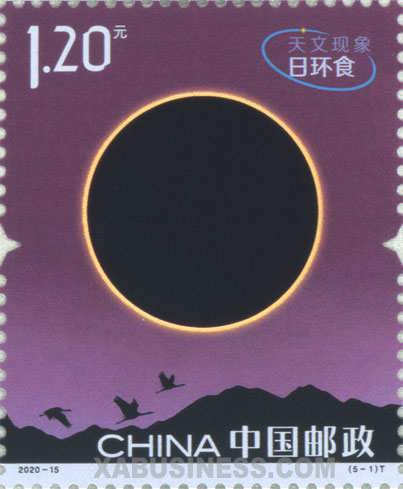
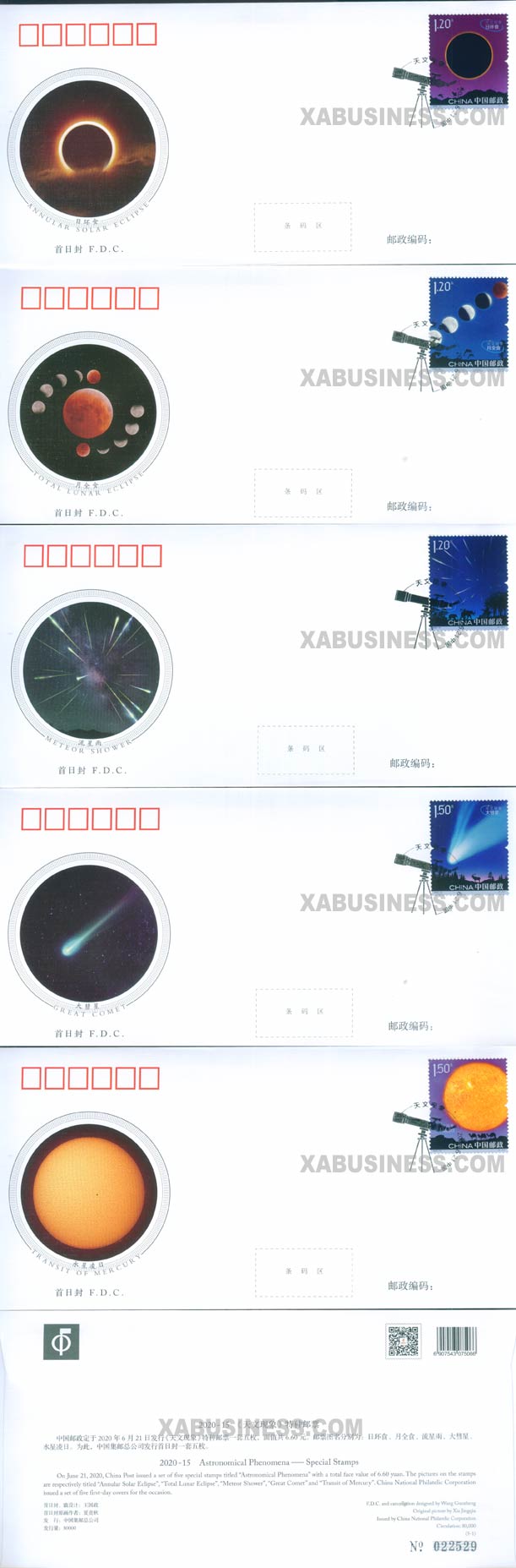
 (5-1), Annular Eclipse, 120 fen, 33 * 40 mm
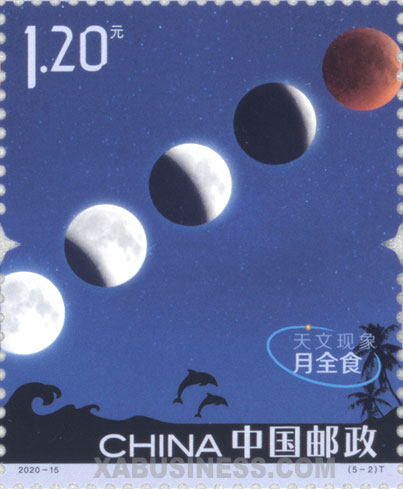 (5-2), Total Lunar Eclipse, 120 fen, 33 * 40 mm
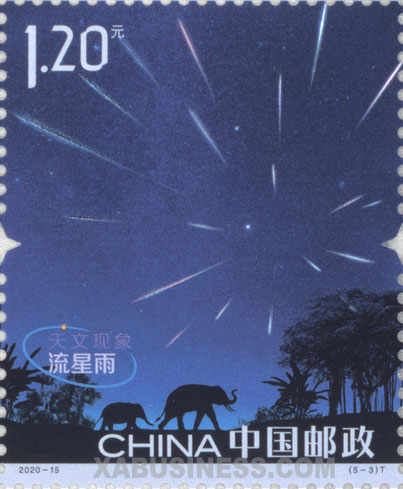 (5-3), Meteor Shower, 120 fen, 33 * 40 mm
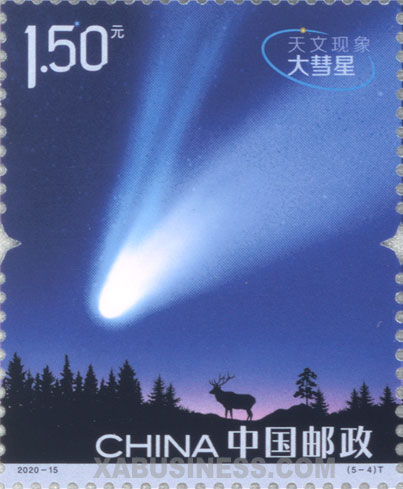 (5-4), Great Comet, 150 fen, 33 * 40 mm
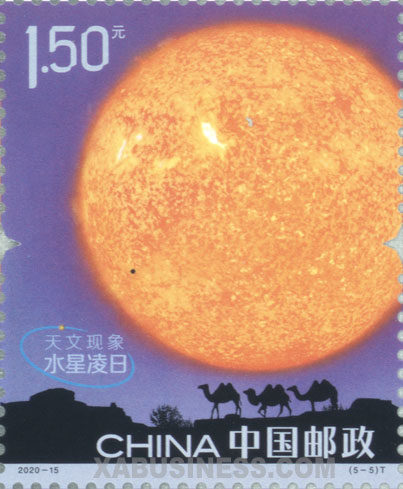 (5-5), Transit of Mercury, 150 fen, 33 * 40 mm

Technical details
Scott No: -Serial number: 2020-15
Values in set: 5
Date of issue: June 21, 2020
Denomination: 660 fen
Designer: Yuan Yishan
Size of stamps: 33 * 40 mm
Perforation: 13.5 * 13
Sheet composition: 12
Size of sheet: 125 * 210 mm
Printing process: Offset
Printing House: Henan Provincal Post Printing Works
Background
China Post is scheduled to issue a set of 5 special stamps themed "Astronomical Phenomena" on June 21, 2020. The total face value of the complete set is 6.60 yuan, with a planned circulation of 8.3 million sets.Astronomical phenomena refer to special occurrences caused by celestial bodies reaching specific positions (objective locations) or states. The impact of astronomy on the progress of human society exceeds the understanding of many of us. For instance, astronomy is humanity's oldest natural science—agricultural civilizations emerged only when humans mastered the laws of celestial cycles. Thanks to the advanced astronomy in ancient China, the country created the world's most splendid agricultural civilization.
A solar eclipse occurs when the Sun, the Moon, and the Earth align in a straight line, with the Moon between the other two. Solar eclipses happen almost every year, but they are not always visible due to factors such as time, location, and weather conditions. Solar eclipses are classified into total eclipses, annular eclipses, and partial eclipses. The first stamp, "Annular Solar Eclipse," depicts a phenomenon that occurred in China on June 21 of the same year.
The principle of a lunar eclipse is similar to that of a solar eclipse. On the 15th or 16th day of the lunar calendar, the Moon moves to a position opposite the Sun. If the centers of the Earth and the Moon are roughly aligned in a straight line at this time, the Moon will enter the Earth's umbra, resulting in a total lunar eclipse. The second stamp, "Total Lunar Eclipse," reproduces the process of a lunar eclipse through five phases of the Moon, from crescent to full.
Meteors form when tiny dust particles in interplanetary space rush into the Earth's atmosphere at high speed, generating incandescent light due to friction with atmospheric molecules. As a meteor streaks across the sky, it leaves a brief bright trail. The third stamp, "Meteor Shower," recreates the magnificent scene of a meteor shower from an opposing angle.
Like planets, comets are celestial bodies orbiting the Sun. The reason comets have tails is that highly active substances are released from their surfaces. A comet's nucleus consists of active materials such as water, ice, and dust combined with rock. Under the heat of the Sun, these active substances volatilize to form an extremely thin atmosphere known as the coma. The fourth stamp, "Great Comet," was also called "broom star" in ancient China, as its descending form resembles a broom. The comet in the image features a nucleus, coma, and tail.
A transit of Mercury occurs when Mercury passes between the Earth and the Sun, aligning the three celestial bodies in a straight line. The Sun's light is blocked by Mercury, creating a small black dot on the Sun as observed from Earth. The fifth stamp, "Transit of Mercury," captures the black silhouette of Mercury through a telescope perspective, recreating the process of Mercury passing across the Sun.
At the bottom of each of the five stamps, to reflect the profoundness of astronomical phenomena and enhance the vividness of the images, silhouettes of certain animals and landforms are designed based on the regular characteristics of each astronomical phenomenon, adding an element of interest.
Designed by Yuan Yishan and printed by Henan Post and Telecommunications Printing House, the set utilizes various printing technologies to present different "astronomical" concepts. The Annular Solar Eclipse stamp innovatively adopts high-brightness material to create the bright, radiant effect of the annular eclipse's edge. For the Total Lunar Eclipse stamp, luminous ink is used to depict the varying brightness of moonlight during the transition from a full moon to a total lunar eclipse. The three-dimensional iridescent material of the Meteor Shower stamp highlights the effect of meteor showers—sometimes pouring down like a river, sometimes fleeting in an instant. The special material of the Great Comet stamp showcases the comet's rich layers, as if shining with charming light in the night sky. The deep blue background of the Transit of Mercury stamp uses original depth-transparent material to enhance the three-dimensional layered visual effect of the stamp. Under ultraviolet light, the fluorescent effect of the black silhouette lines on the entire set of stamps is clearly visible.
Share: 
Price List
Item location: China
Ships to: Worldwide
*Shipping (via registered air mail) is based on subtotal of order. See detials below.
* 1) for special items shipping and handling cost may be included. 2) Other fast shipping is available.
To special order, please let us know what you are looking for. We will help you to meet your unique interests.
Ships to: Worldwide
*Shipping (via registered air mail) is based on subtotal of order. See detials below.
| Order Subtotal | S & H |
| $0.01---$15.00 | US $5.00 |
| $15.01---$50.00 | US $6.00 |
| $50.01---$100.00 | US $7.00 |
| $100.01---$180.00 | US $8.00 |
| $180.01---over | US $9.00 |
To special order, please let us know what you are looking for. We will help you to meet your unique interests.


