

2002-14, Scott 3214 Desert Plants
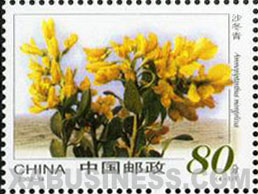
 (4-1), Ammopiptanthus mongolicus, 80 fen, 40*30 mm
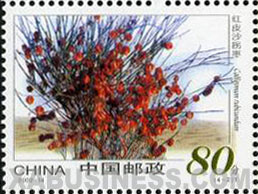 (4-2), Calligonum rubicandum, 80 fen, 40*30 mm
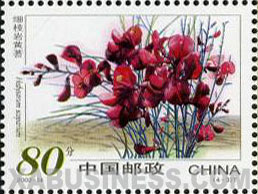 (4-3), Hedysarum scoparium, 80 fen, 40*30 mm
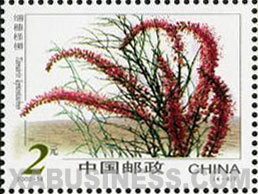 (4-4), Tamarix leptostachys, 200 fen, 40*30 mm
Technical details
Scott No: 3214Serial number:2002-14
Values in set: 4
Denomination: 4.40 yuan
Date of issue: 29th June 2002
Designer: Guo Zhenshan
Size of stamps: 40*30 mm (se-tenant)
Perforation: 12
Sheet composition: 20
Printing process: photogravure
Printer: Beijing Postage Stamp Printing House
Background
The stamp set is cataloged as 2002-14, titled Desert Plants. It was issued on June 29, 2002. The set consists of four stamps in a photogravure edition printed by Beijing Stamp Printing Works. The designer is Guo Zhenshan, with photography by Pan Borong and Liu Jiaqiong. The total face value is 4.4 yuan. Each stamp measures 40×30 mm, with a perforation gauge of 12 degrees. Each sheet contains 20 stamps, printed in a continuous vertical strip of four.China has vast desert regions, and land desertification is an important ecological issue. Desert plants are drought-tolerant and wind-resistant, making them core species for sand fixation and maintaining desert ecosystems. This stamp set features four typical sand-fixing shrubs from the deserts of Northwest China, showcasing the tenacious vitality of life in harsh environments and raising public awareness of desertification control and desert vegetation protection.
Stamp Designs and Historical Background
Ammopiptanthus mongolicus (Mongolian Ammopiptanthus)
Ammopiptanthus mongolicus is the only evergreen broadleaf shrub in China's desert regions. It is a nationally protected rare and endangered plant, mainly distributed in the desert areas of Inner Mongolia, Ningxia, and Gansu. The stamp shows golden inflorescences clustered on the branches, with thick, tenacious, glossy green leaves. With a well-developed root system, it can retain water in arid deserts. It is cold-resistant and drought-tolerant, making it a precious evergreen species in desert ecosystems. It is of great significance for soil and water conservation in desert areas and provides food and habitat for desert animals.
Red-Barked Calligonum
Red-barked Calligonum is an excellent pioneer sand-fixing plant, widely growing in the mobile and semi-mobile dune areas of the northwest. The stamp shows reddish-brown branches spreading out, covered with dense red fruit clusters. The fruits have wing-like appendages that help disperse seeds by wind. It is resistant to sand burial and wind erosion. Even after being buried by shifting sand, it can still sprout new branches, taking root first on mobile dunes and fixing the sand. It is a commonly used afforestation species in desert control projects.
Hedysarum scoparium (Fine-Branched Sweetvetch)
Hedysarum scoparium, commonly known as Huabang, is a well-known sand-fixing shrub in the deserts of Northwest China, mostly growing in the Tengger and Badain Jaran desert regions. The stamp shows numerous rose-red butterfly-shaped flowers blooming, with slender branches. Huabang has a massive root system and extremely strong water absorption capacity. It is drought-tolerant and resistant to sand burial. In addition to sand fixation, its tender branches are a favorite forage for cattle, sheep, and camels, and its seeds are edible. It combines ecological and economic value, making it a high-quality desert plant for comprehensive utilization in desert areas.
Tamarix ramosissima (Slender-Spiked Tamarisk)
Tamarix ramosissima, also known as Hongliu, is widely distributed in the Gobi and saline-alkali sandy lands of Northwest China. The stamp shows slender branches densely covered with tiny pink flower spikes, spreading in the wind. Tamarisk is resistant to salinity and drought, with extremely strong root penetration. It can draw water from deep sandy soil and grow normally in saline-alkali deserts. It is an important tree species for improving saline-alkali land and fixing sand. Desert residents also often use its branches to weave utensils, making it widely useful in desert production and daily life.
Artistic and Design Features
The stamps use the photogravure process, with delicate color reproduction, accurately capturing the textures of the flowers, branches, and leaves. The stamps use a vertical format, with four stamps printed in a continuous vertical strip. The background uses a pale desert sand color, simple and clean, highlighting the main subjects of the desert plants. The designs are based on realistic botanical photography and painting. The four plants have distinct flower shapes and colors, arranged in sequence—golden yellow, crimson, rose red, and pale pink—standing out against the desert background and highlighting their vibrant vitality. The stamp set showcases the beauty of desert life in a small format, conveying the theme of sand fixation and ecological environmental protection.
Share: 
Price List
Item location: China
Ships to: Worldwide
*Shipping (via registered air mail) is based on subtotal of order. See detials below.
* 1) for special items shipping and handling cost may be included. 2) Other fast shipping is available.
To special order, please let us know what you are looking for. We will help you to meet your unique interests.
Ships to: Worldwide
*Shipping (via registered air mail) is based on subtotal of order. See detials below.
| Order Subtotal | S & H |
| $0.01---$15.00 | US $5.00 |
| $15.01---$50.00 | US $6.00 |
| $50.01---$100.00 | US $7.00 |
| $100.01---$180.00 | US $8.00 |
| $180.01---over | US $9.00 |
To special order, please let us know what you are looking for. We will help you to meet your unique interests.


