

2002-13, Scott 3209-12 Dazu Rock Carvings
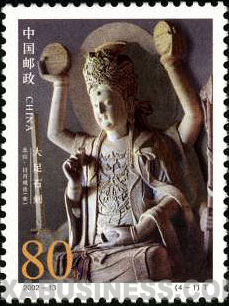
 (4-1), Avalokitesvara of the Sun and Moon in the North Mountain (Song Dynasty), 80 fen, 40*30 mm
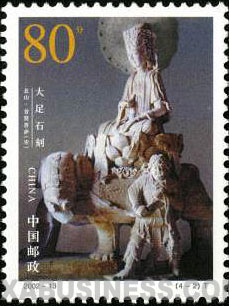 (4-2), Samantabhadra in the North Mountain (Song Dynasty), 80 fen, 40*30 mm
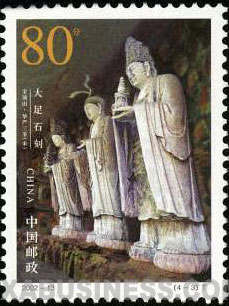 (4-3), Three Avatamasaka Sages in the Holy Summit Mountain (Song Dynasty), 80 fen, 40*30 mm
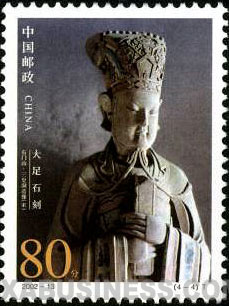 (4-4), Statues in the Cave of the Three Emperors in the Stone Gate Mountain (ibid), 80 fen, 40*30 mm


Technical details
Scott No: 3209-12Serial number: 2002-13
Values in set: 4
Souvenir Sheet: 1
Denomination: 3.20 yuan
Denomination of S/S: 8 yuan
Date of issue: 18th June 2002
Designer: Ren Guoen
Size of stamps: 40*30 mm
Size of S/S : 130*95 mm
Size of S/S stamp : 40*60 mm
Perforation: 12
Sheet composition: 20
Printing process: offset for the stamps; photogravure for the S/S
Printer: Shenyang Post & Telecommunication Printing Works for the stamps; Beijing Postage Stamp Printing House for the S/S
Background
The stamp set is cataloged as 2002-13, titled Dazu Rock Carvings. It was issued on June 18, 2002. The set consists of four stamps and one souvenir sheet. The stamps are printed using offset printing by Shenyang Post and Telecommunications Printing Factory in Liaoning Province; the souvenir sheet is printed using photogravure by Beijing Stamp Printing Works. The designer is Ren Guoen, with photography by Ren Guoen and Yuan Xuejun. The total face value of the stamps is 3.2 yuan, and the souvenir sheet has a face value of 8 yuan. Each stamp measures 30×40 mm, with a perforation gauge of 12 degrees. Each sheet contains 20 stamps. The souvenir sheet measures 130×95 mm, and the stamp within the souvenir sheet measures 40×60 mm.The Dazu Rock Carvings are located in Dazu, Chongqing. They were first created in the early Tang Dynasty and flourished during the Song Dynasty. They are a representative of China's late cave art, integrating Buddhist, Taoist, and Confucian sculptures. They were inscribed on the World Heritage List in 1999. This stamp set features Song Dynasty carving masterpieces from Beishan, Baodingshan, and Shimenshan, showcasing the delicate and expressive artistic style of cave sculptures in southwestern China.
Stamp Designs and Historical Background
Beishan – Sun-Moon Guanyin (Song Dynasty)
This sculpture is from Cave 136, the Zhuanlun Sutra Repository Cave at Beishan Fowan, and is a model of Song Dynasty Guanyin sculptures. In the image, Sun-Moon Guanyin wears a jeweled crown, with a full and gentle face. Her six arms each hold a ritual object, and her posture is relaxed and composed. The carving is delicate, with flowing and elegant robes and a gentle, refined figure. The Zhuanlun Sutra Repository Cave is known as the finest cave at Beishan. The sculptures inside are well-preserved and finely carved, reflecting the shift in Song Dynasty stone carving from grandeur to a gentle, realistic aesthetic.
Beishan – Samantabhadra Bodhisattva (Song Dynasty)
This sculpture is also from the Zhuanlun Sutra Repository Cave at Beishan. Samantabhadra sits on a lotus platform carried by a white elephant, wearing an ornate jeweled crown and draped in necklaces, holding a ruyi scepter. The bodhisattva has a calm, reserved expression with a subtle smile, a delicate and elegant face, and intricately carved clothing. Samantabhadra symbolizes the virtues of principle and practice and is paired with Manjusri. This carving captures the bodhisattva's compassionate and serene character in fine detail, making it a classic work of Song Dynasty bodhisattva sculpture.
Baodingshan – Three Saints of Huayan (Song Dynasty)
The sculptures are located in Niche 5 of the Great Buddha Bend at Baodingshan and depict a group of Vairocana Buddha, Manjusri Bodhisattva, and Samantabhadra Bodhisattva from the Avatamsaka Sutra. The three sculptures are tall and carved against the cliff, with their bodies leaning slightly forward as if looking down at the world. The sculptures cleverly use the mechanical structure of the rock, with the bodhisattvas' robes connecting to the lotus pedestals to support the rock mass, demonstrating the wisdom and creativity of ancient stone carvers. The Three Saints of Huayan is a landmark large-scale group sculpture at Baodingshan, with a solemn and grand presence.
Shimenshan – Sculptures of the Three Sovereigns Cave (Song Dynasty)
The sculptures are from Cave 10, the Three Sovereigns Cave at Shimenshan. The Shimenshan caves are primarily Taoist sculptures and represent the integration of the three religions at Dazu. The stamp features a guardian deity dressed as a civil official, wearing a crown and ceremonial robes, with simple and antique lines. The Three Sovereigns Cave enshrines the Heavenly Sovereign, Earthly Sovereign, and Human Sovereign, gathering Taoist deities and guardian deities in one cave, reflecting the social trend of the integration of Confucianism, Buddhism, and Taoism during the Song Dynasty. It differs from other caves that are primarily Buddhist in subject matter.
Baodingshan – Thousand-Hand Guanyin (Souvenir Sheet)
The Thousand-Hand Guanyin sculpture is located in Niche 8 of the Great Buddha Bend at Baodingshan. The entire sculpture is carved with over a thousand hands, spreading outward like a peacock displaying its feathers. Each palm is carved with an eye. The form is intricate and magnificent. The sculpture is carved from a single cliff face and is the most famous sculpture at Dazu, symbolizing the observation of the world and the salvation of all beings. After a thousand years of weathering, some color remains. It showcases the superb carving skills of Southern Song stone carving and serves as the centerpiece of the entire stamp set.
Artistic and Design Features
The main stamps use offset printing, while the souvenir sheet uses photogravure, faithfully reproducing the texture of the rock and the detailed layers of the stone carvings, preserving the original tones of the sculptures. The stamps use a vertical format, with each stamp focusing on a single sculpture or group. The background uses the dim environment of the caves to set off the solemnity of the main subjects. The designs use re-created photography of the actual scenes, faithfully reproducing the expressions, clothing lines, and colors of the cave sculptures without excessive artistic exaggeration. The stamp set covers both Buddhist and Taoist subjects, fully presenting the unique cultural significance of the coexistence of the three religions at Dazu and showcasing the distinctive charm of China's late cave art.
Share: 
Price List
Item location: China
Ships to: Worldwide
*Shipping (via registered air mail) is based on subtotal of order. See detials below.
* 1) for special items shipping and handling cost may be included. 2) Other fast shipping is available.
To special order, please let us know what you are looking for. We will help you to meet your unique interests.
Ships to: Worldwide
*Shipping (via registered air mail) is based on subtotal of order. See detials below.
| Order Subtotal | S & H |
| $0.01---$15.00 | US $5.00 |
| $15.01---$50.00 | US $6.00 |
| $50.01---$100.00 | US $7.00 |
| $100.01---$180.00 | US $8.00 |
| $180.01---over | US $9.00 |
To special order, please let us know what you are looking for. We will help you to meet your unique interests.


