

2016-12 Ancient Towns in China (2)
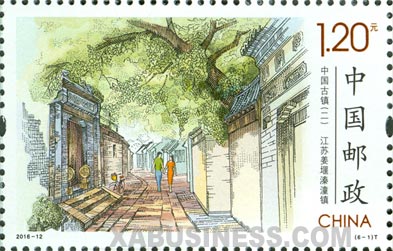
 (6-1), Zhentong (Jiangyan, Jiangsu), 120 fen, 50 * 30 mm
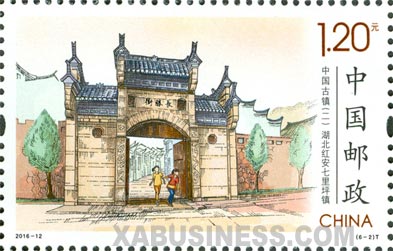 (6-2), Qiliping (Hong'an, Hubei ), 120 fen, 50 * 30 mm
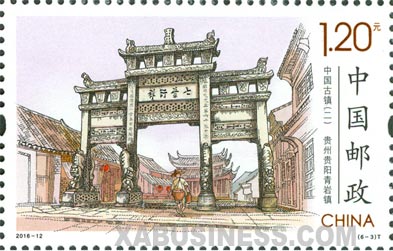 (6-3), Qingyan (Guiyang, Guizhou), 120 fen, 50 * 30 mm
 (6-4), Zhujiajiao (Zhupu, Shanghai), 120 fen, 50 * 30 mm
 (6-5), Sanhe (Feixi, Anhui), 120 fen, 50 * 30 mm
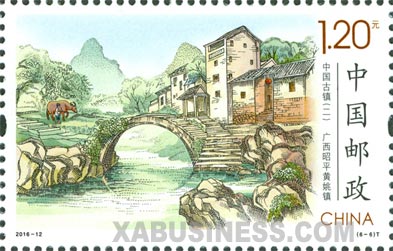 (6-6), Huangyao (Zhaopin, Guangxi), 120 fen, 50 * 30 mm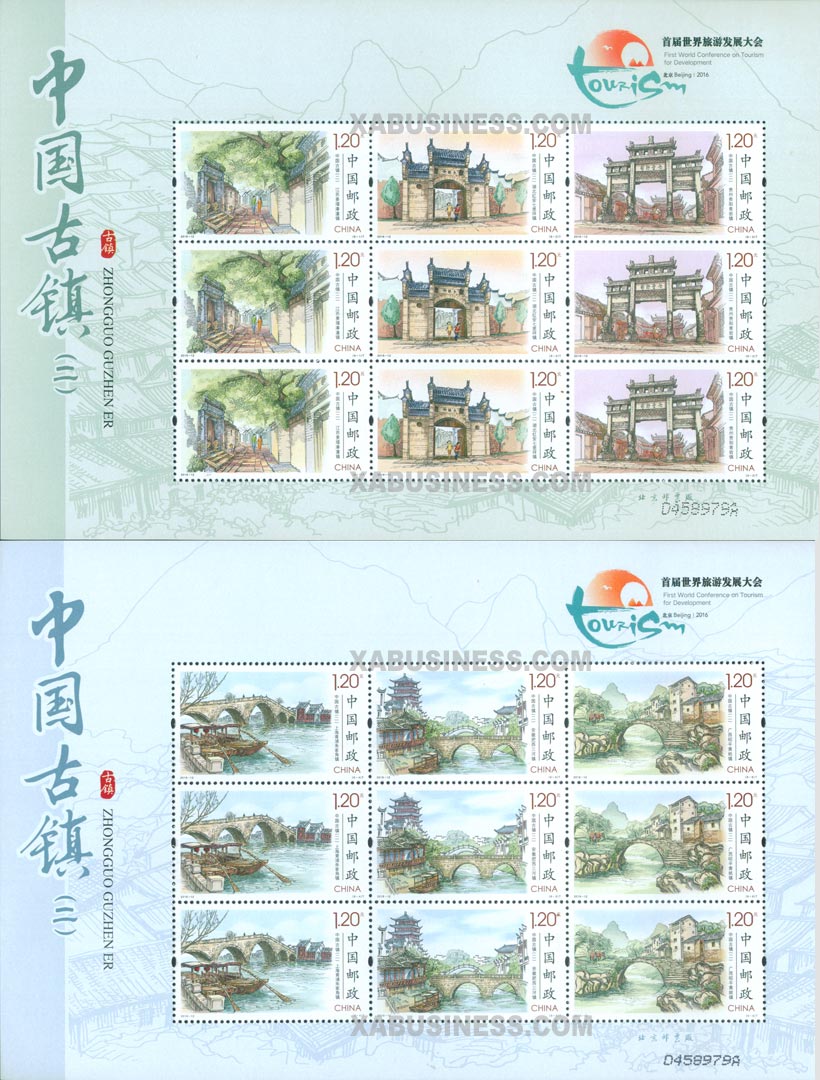

Technical details
Scott No: -Serial number: 2016-12
Values in set: 6
Date of issue: May 19, 2016
Denomination: 720 fen
Designer: Zhang Hongbin
Size of stamps: 50 * 30 mm
Perforation: 13
Sheet composition:
16 for Sheet I (6 Values);
9 for Sheet II (2 Values, 2 Stamp Sets)
Size of sheet:
240 * 150 mm for Sheet I;
210 * 136 mm for Sheet II
Printing process: Offset and Engraving
Printing House: Beijing Postage Stamp Printing Works
Themes: Architecture, Cities,
Background
"Ancient Towns in China (Series II)" is a special stamp issued by China Post on May 19, 2016, consisting of 6 stamps with a total face value of 7.20 yuan. The set features six ancient towns, namely Qintong Town in Jiangyan, Jiangsu (a water town surrounded by rivers and lakes), Qiliping Town in Hong'an, Hubei (featuring architectural styles of the Jingchu region), Qingyan Town in Guiyang, Guizhou (a military fortress in central Guizhou), Zhujiajiao Town in Qingpu, Shanghai (a model of water towns in the south of the Yangtze River), Sanhe Town in Feixi, Anhui (a complex of traditional buildings in the Jianghuai area), and Huangyao Town in Zhaoping, Guangxi (a karst ancient town in Lingnan). Designed with pen outline and light color techniques, the stamps present the architectural characteristics of each place through the offset and intaglio combination process. The first-day ceremony of the stamps was held in Qingyan Ancient Town, Guiyang, including supporting activities such as engraver signature sessions, marking the first time that Guiyang scenery was featured on a stamp.Qintong Town, located in Jiangyan District, Taizhou City, Jiangsu Province, is an "island town" surrounded by water on all sides in the Lixiahe area, with a history of over a thousand years since its founding. The ancient town is well-preserved, boasting a large number of architectural complexes from the Ming and Qing dynasties, such as Xiaoqinhu Lane and Baxianqiao Lane. The streets, paved with granite stones, wind and turn. Scenic spots like the King of Chinese Camellia, Folk Custom Museum, Former Residence of Academicians, and Ancient Pagoda Tree in the Zen Courtyard are scattered throughout the town. Qintong is rich in cultural resources, having nurtured more than 100 successful candidates in the imperial examinations in history. Chu Juan, Minister of Personnel in the Ming Dynasty, and Jiang Lutang, a great ci poet in the Qing Dynasty, left their marks here. Every Qingming Festival, the town hosts China's only "water temple fair" - the Qintong Boat Festival. Thousands of boats and tens of thousands of boatmen gather on Qinhu Lake to row festival boats and race dragon boats. As one of China's top ten folk festivals, it has been listed as a national intangible cultural heritage.
Qiliping Town is situated at the southern foot of the Dabie Mountains in Hong'an County, Hubei Province. It is rich and unique in political resources, known as "the oldest among the old revolutionary base areas". It is the birthplace of the famous Huangma Uprising and the center of the Hubei-Henan-Anhui Revolutionary Base Area. It witnessed the birth of the Fourth Front Red Army, one of the three main forces of the Chinese Workers' and Peasants' Red Army, and the reconstruction of the 25th and 28th Red Armies. Veteran proletarian revolutionaries such as Liu Bocheng, Deng Xiaoping, Li Xiannian, and Xu Xiangqian left their combat footprints here. In 1930, the Hubei-Henan-Anhui Soviet Government named Qiliping Town "Lenin City". It is also a renowned "cradle of generals", being the hometown of 143 generals of the People's Republic and leading cadres at or above the provincial and ministerial levels, including Qin Jiwei, Zheng Weisan, and Xu Shenji. The town houses nearly 40 national key cultural relics protection units, such as Changsheng Street and the birthplace of the Fourth Front Red Army. Changsheng Street, the main street of Qiliping, is an ancient street from the Ming and Qing dynasties and the central area of the Hubei-Henan-Anhui Revolutionary Base Area during the Great Revolution. On both sides of the stone-paved street, revolutionary relics such as the former residence of Zheng Weisan, the Soviet Bank, the Red Army Canteen, the Economic Commune, the Chinese-Western Medicine Bureau, the headquarters of the Fourth Front Red Army, the former site of Pengpai Street in Lenin City, and the Revolutionary Court are well-preserved to this day.
Qingyan Town lies in the southern suburbs of Guiyang City, Guizhou Province. Founded in the 10th year of the Hongwu reign in the Ming Dynasty (1378), it was originally a military fortress with a history of over 600 years. Nestled among mountains, the ancient town has city gates and walls all built of stone. Within its 3-square-kilometer area, there are numerous ancestral halls and ancient buildings from the Ming and Qing dynasties, including 9 temples, 8 shrines, 5 pavilions, 2 ancestral halls, 1 academy, and 1 palace. Qingyan is a town of outstanding people; it produced Guizhou's first top scorer in the imperial examination in history and is now known as the "Hometown of Chinese Poetry". It has unique religious cultural resources, with Buddhism, Taoism, Catholicism, and Christianity coexisting here. Famous scenic spots in the town include the former residence of Top Scorer Zhao, Qingyan Academy, the site of the Qingyan Incident, the former headquarters of the Red Army during the Long March, Wenchang Pavilion, Ciyun Temple, Wanshou Palace, Yingxiang Temple, Shuixing Tower, and ancient memorial archways from the Ming and Qing dynasties. Qingyan has a profound connection with "postal services". As early as 1888, an "agency post office" was established here, delivering letters for Catholic churches, officials, and ordinary people. This postal institution predates the agency offices of the Qing Post, and its former site is located at No. 56 North Street of the ancient town. On August 15, 2014, relying on its top scorer culture, the town set up the "Top Scorer Post Office" in the tourist service center at the South Gate, which is Guiyang's first themed post office.
Zhujiajiao Town is located in the western part of Shanghai, an international metropolis. Surrounded by Dianshan Mountain and Dianshan Lake, it enjoys a quiet environment amid the hustle and bustle, embodying the serene and elegant charm of water towns in the south of the Yangtze River. Nine ancient streets in the town run alongside rivers, and more than a thousand residential buildings stand by the water. Scenic spots like the Town God's Temple, Guanwang Temple, Yuanjin Zen Courtyard, Cimen Temple, the Hall of the Xi Family, the Memorial Hall of Wang Chang, and the Villa of Liu Yazi are scattered throughout the town. Due to its dense water network, numerous ancient bridges are a major feature of the town. The most famous one is the Fangsheng Bridge, the largest five-arched stone bridge in the south of the Yangtze River. North Street in the town, also known as "One-Line Street", is the best-preserved ancient street from the Ming and Qing dynasties in the suburbs of Shanghai. Stretching over 300 meters from Fangsheng Bridge in the east to Meizhou Lane in the west, it is a typical ancient street in the south of the Yangtze River. The town also houses the only remaining site of the Qing Post Office in East China - the Zhujiajiao Qing Post Office, founded in 1903 (located south of the Town God's Temple on Caohe Road in the ancient town). As one of the earliest postal institutions in Shanghai, it still offers postal services and has become a scenic spot in the town.
Sanhe Town is situated on the shores of Chaohu Lake in the southwest of Feixi County, Hefei City, Anhui Province, with a history of over 2,000 years since its establishment. Formerly known as Quezhu, it got its current name because three rivers, namely Fengle River, Hangbu River, and Xiaonan River, flow through it. Located at the junction of Feixi, Shucheng, and Lujiang counties, the town is known as "crossing three counties in one step and hearing cocks crowing in three counties". Historically, famous battles took place here, such as the "Battle of Que'an" between the Wu and Chu states and the "Great Victory at Sanhe" where the Taiping Army defeated the Xiang Army. The town now features eight ancient landscapes: ancient rivers, ancient bridges, ancient dikes, ancient streets and lanes, ancient city walls, ancient temples, ancient fortresses, and ancient teahouses. It also has natural and cultural attractions including a 10-kilometer lakeshore line, a 10,000-mu lotus pond, Taohua Island, Gushan Island, the former residence of Yang Zhenning, Liutongxing Longzhuang, Helu, the former residence of Sun Liren, the National Essence Building, the Immortal Lady Building, the Doctor's Mansion, the Moon-Watching Pavilion, and the Li Mansion Granary. The contiguous ancient dwellings in the town, with overhanging eaves, carved beams, and painted rafters, form a rare complex of late Qing Dynasty buildings in central Anhui.
Huangyao Town is located in the northeast of Zhaoping County, Hezhou City, Guangxi. Flourishing during the Song Dynasty, it has a history of nearly a thousand years, where rich cultural heritage and beautiful natural scenery complement each other. Covering an area of 3.6 square kilometers, the ancient town features karst landforms, surrounded by nine mountains including Jigong Mountain, Tianma Mountain, and Niuyan Mountain. Three small rivers, namely Yao River, Xiaozhu River, and Xingning River, converge here. The town boasts eight major scenic spots and twenty-four minor scenic spots. It preserves more than 20 temples and shrines, and over 10 pavilions and towers, most of which are buildings from the Ming and Qing dynasties. Famous attractions include the former site of the Guangxi Provincial Party Committee Work Committee, the ancient stage, Anle Temple, Carp Street, the Immortal Ancient Well, the Statue of Martyr Qian Xing, the Watchtower, and the Sima Mansion. Most of the residential buildings in the town were constructed by the same surname centered around ancestral halls and radiated outward. Currently, there are eight major surnames, nine ancestral halls, and two family shrines in the town. At the post office near the entrance of the ancient town, tourists can exchange their tickets for free Huangyao-themed postcards with pre-printed stamps for on-site mailing, and also purchase some local characteristic tourist postcards.
Share: 
Price List
Item location: China
Ships to: Worldwide
*Shipping (via registered air mail) is based on subtotal of order. See detials below.
* 1) for special items shipping and handling cost may be included. 2) Other fast shipping is available.
To special order, please let us know what you are looking for. We will help you to meet your unique interests.
Ships to: Worldwide
*Shipping (via registered air mail) is based on subtotal of order. See detials below.
| Order Subtotal | S & H |
| $0.01---$15.00 | US $5.00 |
| $15.01---$50.00 | US $6.00 |
| $50.01---$100.00 | US $7.00 |
| $100.01---$180.00 | US $8.00 |
| $180.01---over | US $9.00 |
To special order, please let us know what you are looking for. We will help you to meet your unique interests.


