

2004-27 Famous pavilions of China
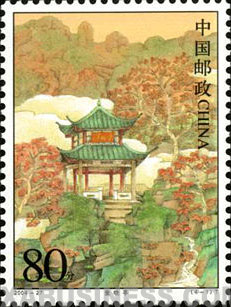
 (4-1), Aiwan pavilion, 80 fen, 30*40 mm
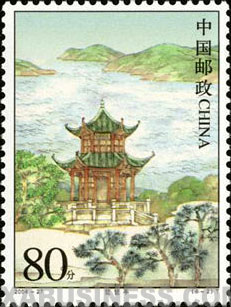 (4-2), Pipa pavilion, 80 fen, 30*40 mm
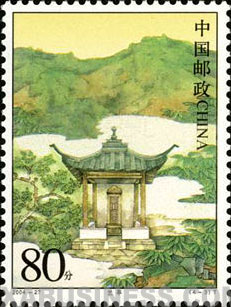 (4-3), Lan pavilion, 80 fen, 30*40 mm
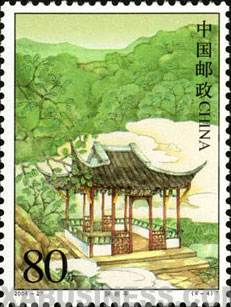 (4-4), Zuiweng pavilion, 80 fen, 30*40 mm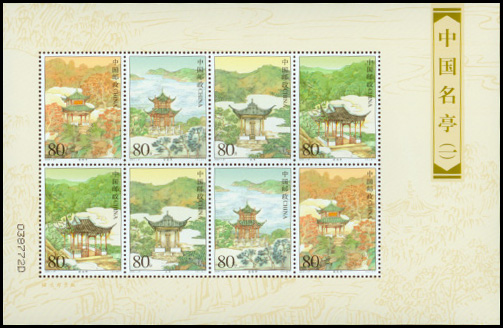

Technical details
Serial number: 2004-27Values in set: 4
Denomination: 320 fen
Date of issue: November 6, 2004
Designer: Ru Feng
Size of stamp: 30*40mm
Perforation: 13.5*13
Sheet composition:
16 for Sheet I;
8 for Sheet II(2 sets)
Printing process: Gravure
Printer: Beijing Postage Stamp Printing House
Themes: Architecture, Culture,
Background
This special stamp set, Famous Pavilions of China (I), was issued on November 6, 2004. It consists of four stamps with a total face value of 3.20 yuan, with both large sheet and miniature sheet formats issued concurrently. The stamp designs were painted by Ru Feng, with border design for the miniature sheet by Hao Xudong, Tong Liying serving as the responsible editor, and printed by Beijing Stamp Printing Works using the photogravure process. This stamp set features four famous classical pavilions, each associated with timeless poetry and literary allusions, launching the series of Chinese pavilion stamps and integrating classical architecture with literary imagery.The pavilion is a representative open-style small building in classical Chinese gardens. Its light and elegant form allows for flexible placement, whether to enhance the beauty of a landscape or to serve as a rest stop for viewing the scenery. Throughout history, literati and poets would often stop at pavilions to compose poetry, giving rise to countless masterpieces. These pavilions have thus become not just architectural structures, but also tangible carriers of poetry and literary history. The four pavilions featured in this set—Aiwan Pavilion in Hunan, Pipa Pavilion in Jiangxi, Lanting Pavilion in Zhejiang, and Zuiweng Pavilion in Anhui—are each associated with Tang poetry, calligraphic masterpieces, and Song Dynasty prose. They are located in different regions of southern China and each possesses its own unique architectural style and cultural story. This stamp set serves as the opening of the series, using the miniature canvas to showcase the beauty of traditional Chinese architecture and the fusion of literature, poetry, and landscape.
Stamp Designs and Historical Background
Aiwan Pavilion (Pavilion of Love for the Evening)
Located in Qingfeng Gorge on Yuelu Mountain in Changsha, Hunan, the pavilion's name is derived from Du Mu's poem: "I stop my carriage to enjoy the maple grove in the evening." Featuring double eaves, green tiles, and red railings, it is surrounded by crimson maple leaves in autumn. The stamp uses the red autumn foliage as a backdrop, highlighting the pavilion's elegant form and the poetic atmosphere of the mountain in autumn.
Pipa Pavilion
Located on the banks of the Yangtze River in Jiujiang, Jiangxi, the pavilion was built to commemorate Bai Juyi's poem "Song of the Pipa Player." It is a multi-story pavilion with double eaves. The stamp features a vast river and distant mountains in the background, creating a broad and serene atmosphere, evoking a sense of ancient nostalgia.
Lanting Pavilion (Orchid Pavilion)
Located at the foot of Lanzhu Mountain in Shaoxing, Zhejiang, this site is renowned as the setting for Wang Xizhi's famous gathering and his masterpiece, the Preface to the Orchid Pavilion. The stamp features a stone square pavilion, framed by lush bamboo and misty mountains. The soft, elegant tones create a serene and refined atmosphere, evoking the spirit of the Wei and Jin literati.
Zuiweng Pavilion (Pavilion of the Old Tippler)
Hidden in the Langya Mountains in Chuzhou, Anhui, this pavilion gained fame through Ouyang Xiu's essay "The Story of the Old Tippler's Pavilion." The pavilion is small and elegant, built against the mountain. Surrounded by green hills and lush trees, the stamp captures the mountain scenery described in the essay, conveying the literati spirit of enjoying nature and finding solace in the landscape.
Artistic and Design Features
The vertical format uses a light ink landscape painting style. Each stamp places the pavilion within its corresponding landscape environment, with the architecture as the visual center and the distant mountains and trees as the backdrop. The color tones reflect the unique atmosphere of each pavilion—the red maples, the vast river, the green bamboo—each with its own distinct mood. The photogravure printing provides soft, elegant colors and smooth transitions. The stamps incorporate multiple anti-counterfeiting features, including security paper, security ink, and fluorescent spray codes. The miniature sheet features the four stamps in a horizontal layout, with simple ink decorations on the border, creating a poetic and elegant overall design, combining architectural beauty with literary value.
This stamp set is a special issue on the theme of classical garden architecture and cultural heritage, including a miniature sheet, suitable for thematic collections on Chinese ancient architecture, landscape, and poetry.
Share: 
Price List
Item location: China
Ships to: Worldwide
*Shipping (via registered air mail) is based on subtotal of order. See detials below.
* 1) for special items shipping and handling cost may be included. 2) Other fast shipping is available.
To special order, please let us know what you are looking for. We will help you to meet your unique interests.
Ships to: Worldwide
*Shipping (via registered air mail) is based on subtotal of order. See detials below.
| Order Subtotal | S & H |
| $0.01---$15.00 | US $5.00 |
| $15.01---$50.00 | US $6.00 |
| $50.01---$100.00 | US $7.00 |
| $100.01---$180.00 | US $8.00 |
| $180.01---over | US $9.00 |
To special order, please let us know what you are looking for. We will help you to meet your unique interests.


