

2022-22 Famous Pavilions of China (2)
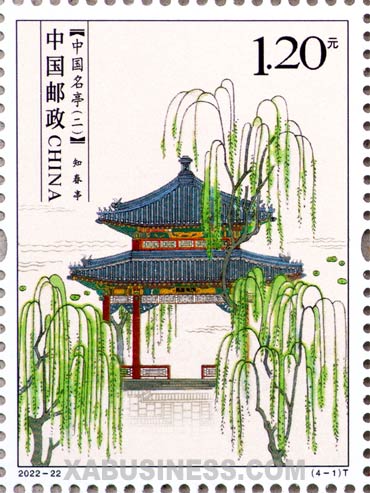
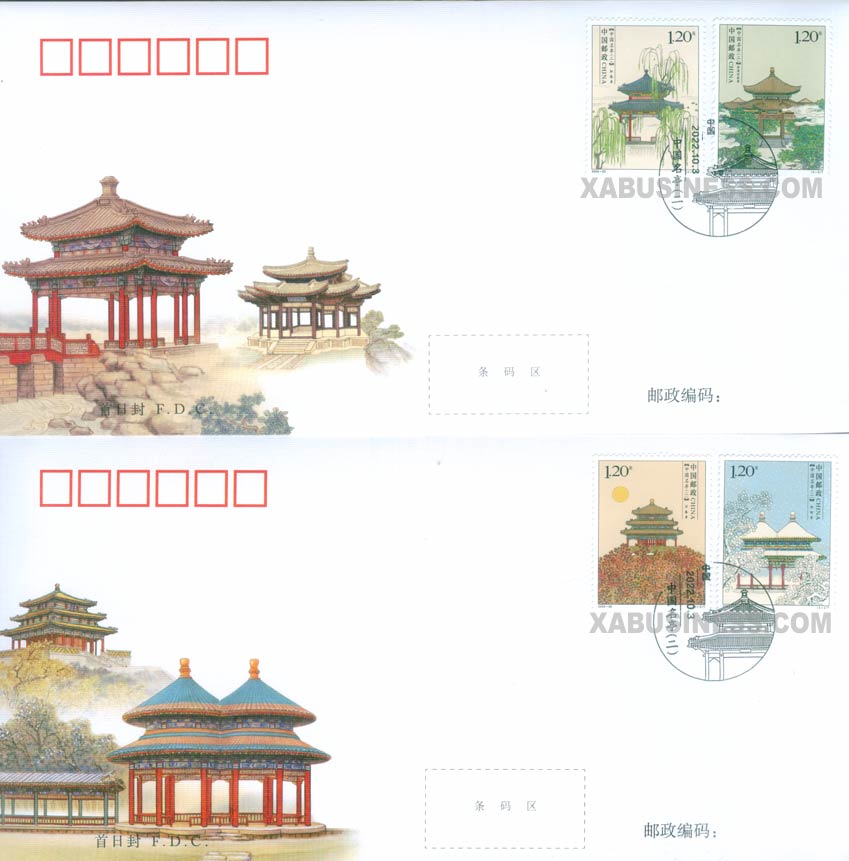
 (4-1), Zhichun Pavilion, 120 fen, 30 * 40 mm
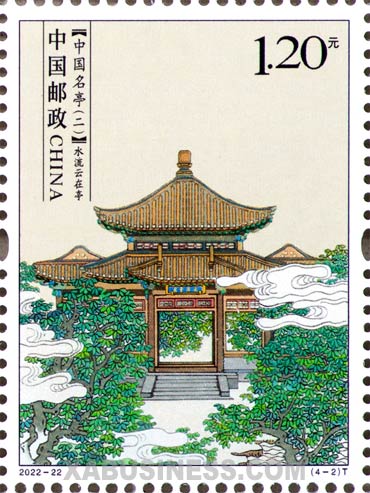 (4-2), Shuiliu Yunzai Pavilion, 120 fen, 30 * 40 mm
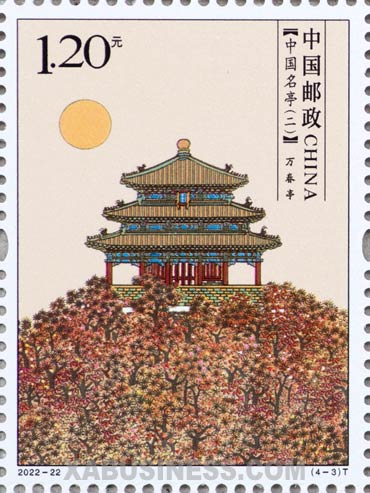 (4-3), Wanchun Pavilion, 120 fen, 30 * 40 mm
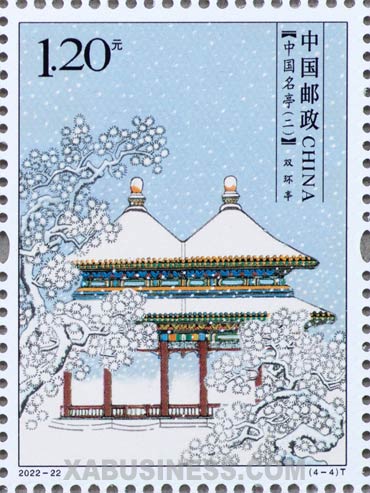 (4-4), Shuanghuan Pavilion, 120 fen, 30 * 40 mm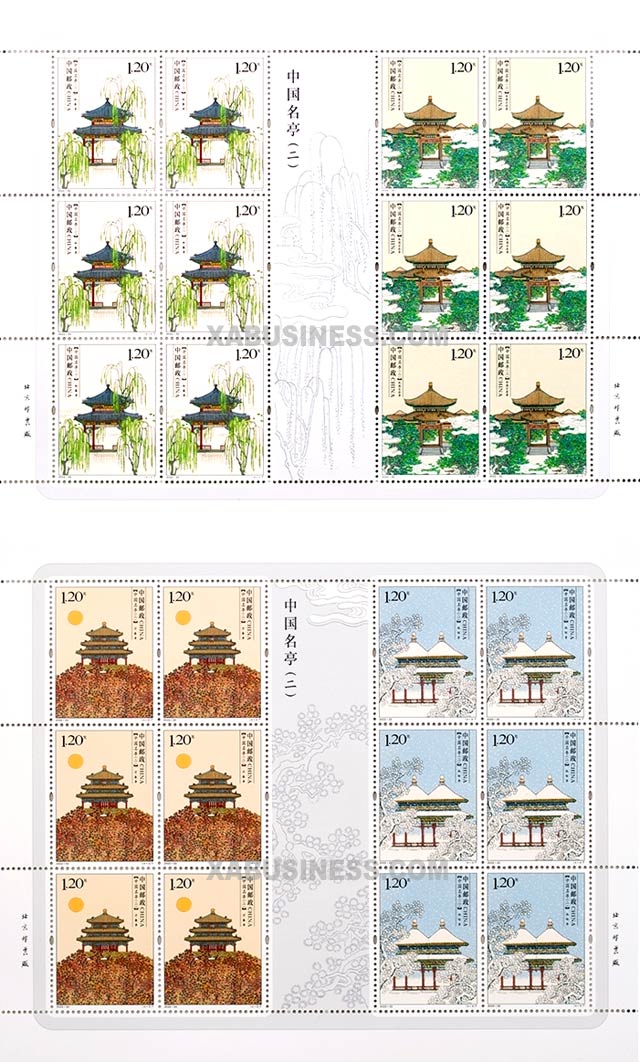

Technical details
Scott No: -Serial number: 2022-22
Values in set: 4
Date of issue: October 3rd, 2022
Denomination: 480 fen
Designer: Jiao Yang
Size of stamps: 30 * 40 mm
Perforation: 13.5
Sheet composition: 12 (Value 1, 2 in Sheet 1; Value 3, 4 in Sheet 2)
Size of sheet: 180 * 150 mm
Printing process: Photogravure
Printing House: Beijing Postage Stamp Printing Works
Themes: Architecture, Culture,
Background
China Post scheduled the issuance of a set of 4 special stamps themed "Famous Pavilions of China (II)" on October 3, 2022. The stamps are respectively titled "Zhichun Pavilion", "Shuiliuyunzai Pavilion", "Wanchun Pavilion" and "Shuanghuan Pavilion". The total face value of the complete set is 4.80 yuan, with a planned circulation of 6.6 million sets.Ancient Chinese architecture comes in diverse forms, rich and colorful, with both artistic and practical values. It is an important part of the traditional culture of the Chinese nation. Among various types of ancient architecture, the "pavilion" (ting) is one with the most varied shapes, wide distribution and flexible styles. In architectural complexes such as palaces, altars and temples, monasteries, and gardens, pavilions often play a finishing touch role. This set of stamps is the second group of the "Famous Pavilions of China" series.
Zhichun Pavilion is located on a small island on the east bank of Kunming Lake in the Summer Palace. First built during the Qianlong period of the Qing Dynasty, it is said that the name "Zhichun" (meaning "perceiving spring") comes from a line in a Song Dynasty poem: "Ducks are the first to know when the river warms in spring". It is a square pavilion with a double-eaved pyramidal roof, connected to the shore by a bridge-causeway. The banks around the pavilion are stacked with stones, and peach trees and willows are planted nearby. When winter fades and spring arrives, the ice here melts first and greenery emerges early, making it an ideal spot in the Summer Palace for enjoying spring scenery and sightseeing.
Shuiliuyunzai Pavilion stands on the north bank of Cheng Lake in Chengde Mountain Resort. It is an open pavilion with a double-eaved square pyramidal roof and roll-up eaves verandas extending from all four sides. The main body of the pavilion is square; the upper floor has four overhanging eaves corners, while the lower floor has twelve overhanging eaves corners from the verandas, totaling sixteen eaves corners for the double floors—an architectural form with a unique style. The plaque of the pavilion bears the name "Shuiliuyunzai", which is derived from the artistic conception of a line in the poem River Pavilion by Du Fu of the Tang Dynasty: "The water flows, yet my mind remains unrushed; the clouds drift, and my thoughts linger slowly".
Wanchun Pavilion is situated on the central peak of Jingshan Park. It stands 17.4 meters high, with a triple-eaved square pyramidal roof covered with yellow glazed tiles and trimmed with green edges, exuding a majestic momentum. As the highest and best viewing spot on Beijing's north-south central axis, Wanchun Pavilion offers a panoramic view of the Forbidden City and the entire capital city below, bringing a sense of relaxation and joy to visitors.
Shuanghuan Pavilion, also known as Shuanghuan Wanshou Pavilion (meaning "Double-Ring Longevity Pavilion"), was originally located in Zhongnanhai and moved to Temple of Heaven Park in 1976. It is composed of two interlocking circular pavilions, each with a double-eaved roof supported by eight columns. The upper eave is covered with peacock-blue glazed tiles trimmed with yellow, while the lower eave uses yellow glazed tiles—making it the only remaining example of such an architectural form in China. The cross-section of Shuanghuan Pavilion resembles two interlocking rings or two longevity peaches, symbolizing harmony, auspiciousness and longevity.
This set of stamps was designed by Jiao Yang, an associate professor at the School of Chinese Painting, Central Academy of Fine Arts. Using traditional Chinese meticulous painting techniques, the stamps depict the four famous pavilions in the four seasons—spring, summer, autumn and winter. The painted pavilions are depicted with exquisite detail, and the scenes convey a clear, vast and simple artistic conception. Each of the four stamps is rendered in a different color tone, creating a strong decorative effect that enriches the composition and highlights the magnificence and delicacy of these famous pavilions in imperial gardens.
The set of stamps was printed by Beijing Stamp Printing Co., Ltd. using the photogravure printing process.
Share: 
Price List
Item location: China
Ships to: Worldwide
*Shipping (via registered air mail) is based on subtotal of order. See detials below.
* 1) for special items shipping and handling cost may be included. 2) Other fast shipping is available.
To special order, please let us know what you are looking for. We will help you to meet your unique interests.
Ships to: Worldwide
*Shipping (via registered air mail) is based on subtotal of order. See detials below.
| Order Subtotal | S & H |
| $0.01---$15.00 | US $5.00 |
| $15.01---$50.00 | US $6.00 |
| $50.01---$100.00 | US $7.00 |
| $100.01---$180.00 | US $8.00 |
| $180.01---over | US $9.00 |
To special order, please let us know what you are looking for. We will help you to meet your unique interests.


