

2022-16 Chinese Seal Engraving
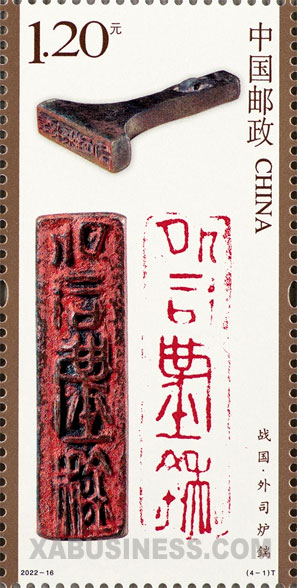
 (4-1), Seal of Waisilu - Warring States Period, 120 fen, 30 * 60 mm
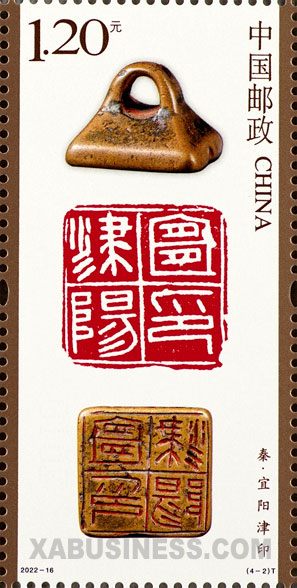 (4-2), Yiyangjin Seal - Qin Dynasty, 120 fen, 30 * 60 mm
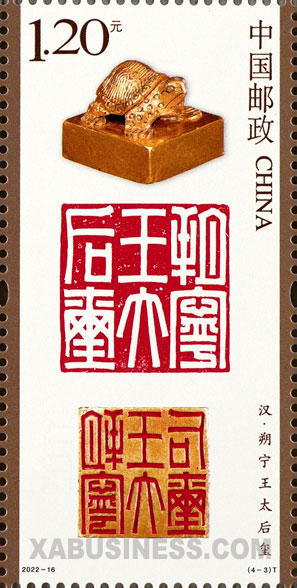 (4-3), Seal of Prince Shuoning's Mother - Han Dynasty, 120 fen, 30 * 60 mm
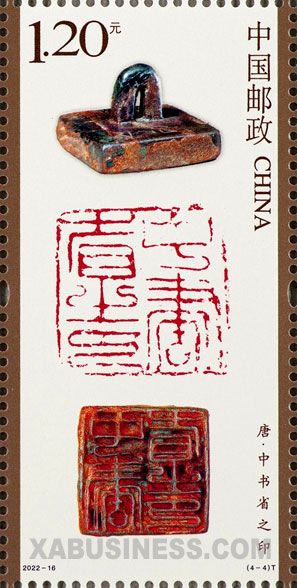 (4-4), Seal of the Palace Secretariat - Tang Dynasty, 120 fen, 30 * 60 mm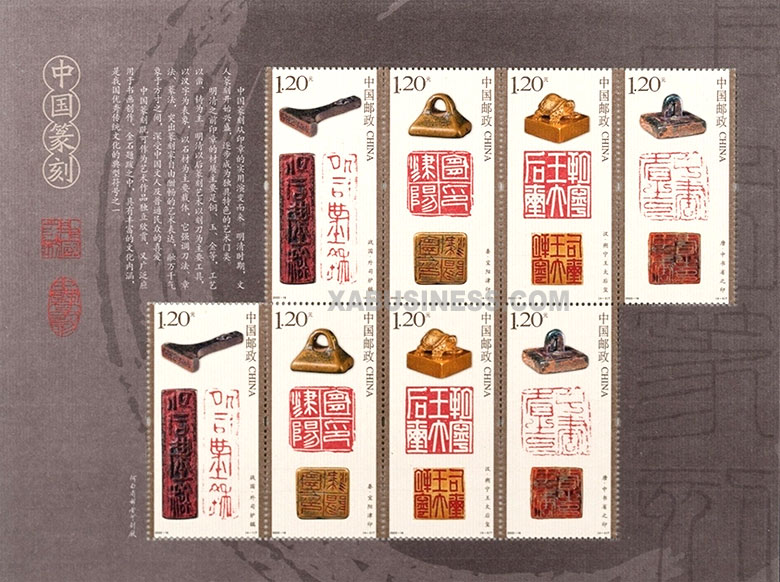

Technical details
Scott No: -Serial number: 2022-16
Values in set: 4
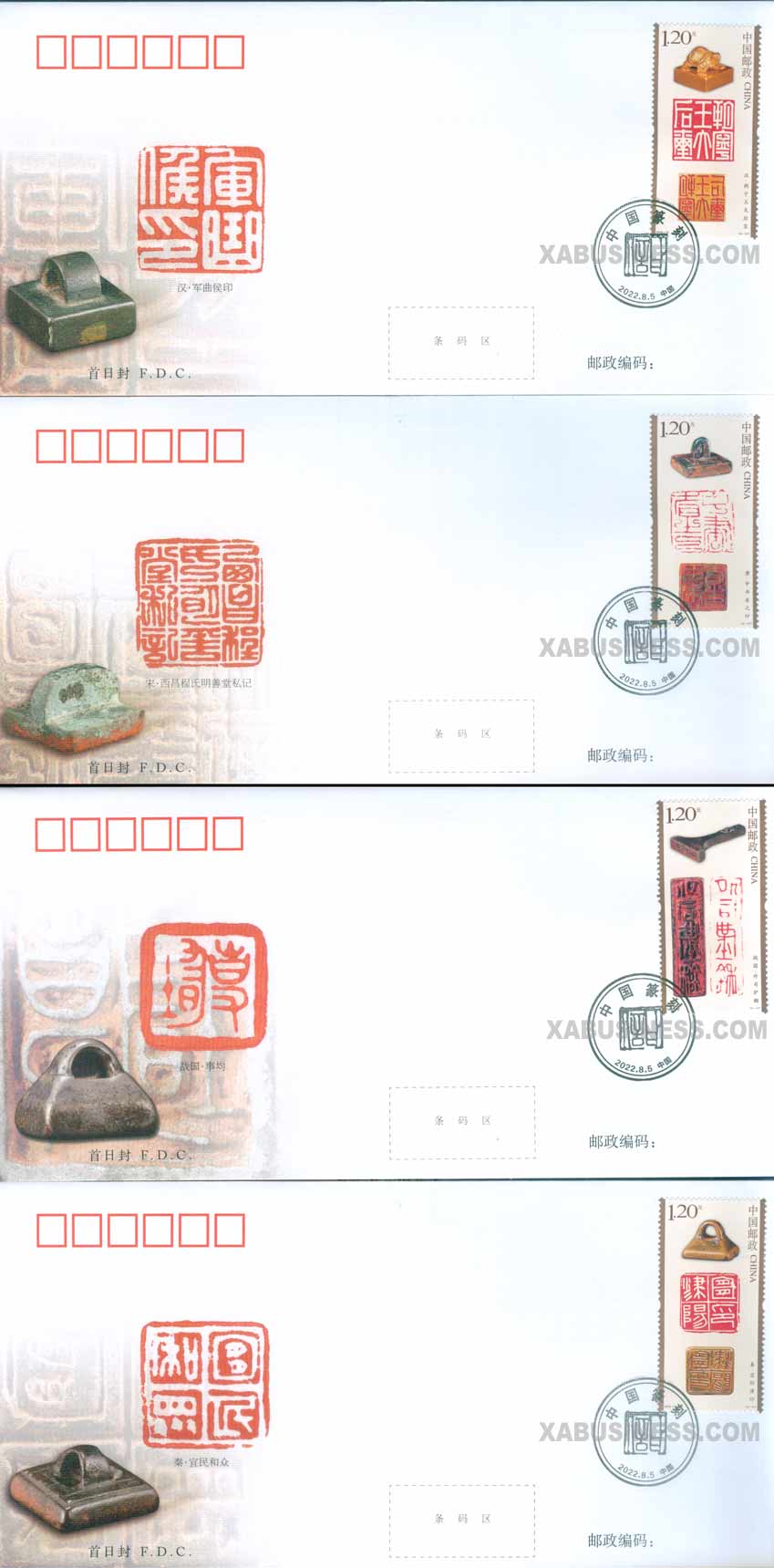
Date of issue: August 5th, 2022
Denomination: 480 fen
Designer: Rong Tie
Size of stamps: 30 * 60 mm
Perforation: 13.5 * 13
Sheet composition:
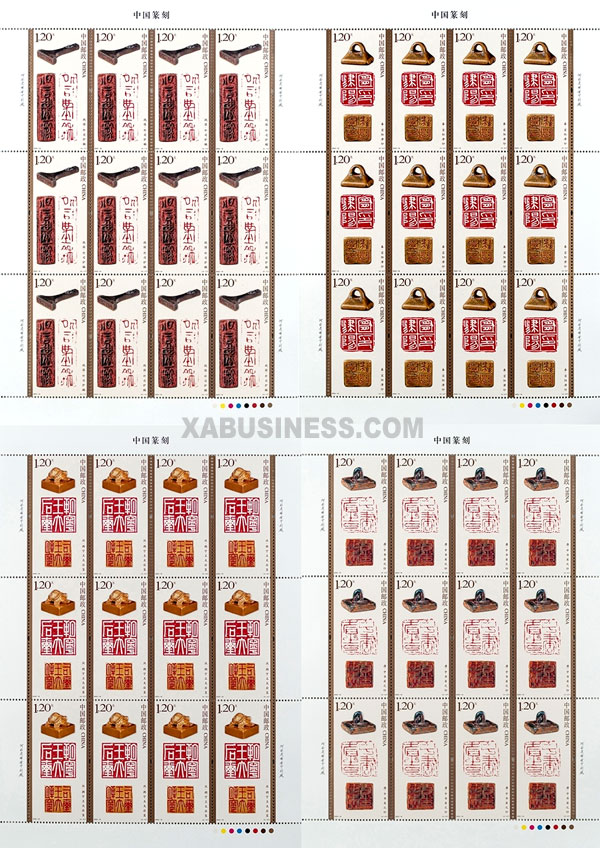
12 for Sheet I;
8 for Sheet II (2 sets, rice paper)
Size of sheet:
150 * 210 mm for Sheet I;
200 * 150 mm for Sheet II
Printing process: Offset
Printing House: Henan Provincal Post Printing Works
Background
China Post scheduled the release of a set of 4 special stamps themed "Chinese Seal Carving" on August 5, 2022. The names of the stamp designs are respectively: Seal of the Outer Foundry Office (Warring States Period), Seal of Yiyang Ferry (Qin Dynasty), Imperial Seal of the Queen Mother of King Shuoning (Han Dynasty), and Seal of the Zhongshu Sheng (Tang Dynasty). The total face value of the complete stamp set is 4.80 yuan, and the planned circulation quantity is 7.7 million sets.Chinese seal carving evolved from the ancient Chinese seal-making technique that combines calligraphy (mainly seal script) and engraving (including chiseling and casting), with a history of over 3,000 years to date. Ancient seals, with their unique style and high artistic value, laid a solid foundation for the art of seal carving. During the Ming and Qing dynasties, scholar seal carving began to flourish and gradually developed into a distinctive art form. Before the Ming and Qing dynasties, the materials used for seals were mainly copper, jade, and gold, with chiseling and casting as the primary crafting techniques. After the Ming and Qing dynasties, seal carving art took the carving knife as the main tool, Chinese characters as the expressive form, and stone as the main carrier. It emphasizes knife technique, composition, and seal script rules, highlighting the seal carver's free and unrestrained artistic expression, and condenses a vast array of artistic conceptions within the small space of a seal. This art form is deeply loved by both Chinese scholars and the general public. Chinese seal carving can be appreciated independently as a work of art and is also widely used in calligraphy and painting creation, as well as in inscriptions on bronze and stone artifacts. It carries rich cultural connotations and is one of the typical symbols of China's excellent traditional culture. In 2009, Chinese seal carving was included in the Representative List of the Intangible Cultural Heritage of Humanity by UNESCO.
This set of stamps was designed by Rong Tie, who serves as the Chairman of the Seal Collection and Research Committee of the China Collectors Association, a Council Member of the Chinese Calligraphers Association, a Council Member of the Chinese Artists Association, and a Council Member of the Xiling Seal Engravers' Society. The stamps adopt a vertical and elongated format, comprehensively displaying three parts of a seal: the seal body, the printed impression, and the seal face. They use the simple and elegant color of rice paper as the background, creating a three-dimensional visual hierarchy and rich picture details, which highlight the profound and strong cultural charm of Chinese seal carving art.
The first stamp features the Seal of the Outer Foundry Office (Warring States Period), a bronze seal with a total height of 9.5 cm. It is an official seal of the Yan State during the Warring States Period; some views suggest it was the official seal of the official in charge of coin casting, and it is collected in the Palace Museum in Beijing.
The second stamp presents the Seal of Yiyang Ferry (Qin Dynasty), a bronze seal with a seal face of 2.3 cm in both length and width. It was the official seal of the official managing the ferry in Yiyang County during the Qin Dynasty and is collected in the Shanghai Museum.
The third stamp shows the Imperial Seal of the Queen Mother of King Shuoning (Han Dynasty), a gold seal with a side length of 2.4 cm and a height of 2 cm. It was carved by King Shuoning, one of the leaders of the rebel army against Wang Mang at the end of the Western Han Dynasty, for his mother, and is collected in the China Three Gorges Museum in Chongqing.
The fourth stamp displays the Seal of the Zhongshu Sheng (Tang Dynasty), a bronze seal with a seal face of 5.7 cm × 5.6 cm and a total height of 3.9 cm. It was an official seal of the central government agency in the Tang Dynasty and is collected in the Palace Museum in Beijing.
This set of stamps was printed by Henan Post and Telecommunications Technology Co., Ltd. using a multi-color offset printing process. The first sheet format of the stamps specially incorporates a 3D embossing process, which three-dimensionally presents the seals to highlight the characteristics of seal carving art, achieving a perfect combination of stamp printing technology and seal carving art. The second sheet format uses anti-counterfeiting handmade rice paper, giving the pictures a simple and elegant style. It inherits Chinese culture in a subtle way and showcases the treasure of traditional seal carving art within the small space of stamps.
Share: 
Price List
Item location: China
Ships to: Worldwide
*Shipping (via registered air mail) is based on subtotal of order. See detials below.
* 1) for special items shipping and handling cost may be included. 2) Other fast shipping is available.
To special order, please let us know what you are looking for. We will help you to meet your unique interests.
Ships to: Worldwide
*Shipping (via registered air mail) is based on subtotal of order. See detials below.
| Order Subtotal | S & H |
| $0.01---$15.00 | US $5.00 |
| $15.01---$50.00 | US $6.00 |
| $50.01---$100.00 | US $7.00 |
| $100.01---$180.00 | US $8.00 |
| $180.01---over | US $9.00 |
To special order, please let us know what you are looking for. We will help you to meet your unique interests.


