Stamp Search 
Categories 
Architecture
Animals
Anniversary
Bird
stamps
for Kids
China
jointly issued
Chinese
new year
Flower
Landscape
Mao
Zedong
Mountain
Olympic
Portrait
River
Sports
World
Heritage
The Art of War of Sunzi
Item location: China
Ships to: Worldwide
Terms of sale
To special order, please let us know what you are looking for. We will help you to meet your unique interests.
Technical details:
Scott No: 2636-40
Serial number: 1995-26
Values in set: 5
Date of issue: December 4, 1995
Designers: Chen Quansheng
Size: 30*50mm
Perforation: 12
Sheetcomposition: 32
Printing process: offset
Scott No: 2636-40
Serial number: 1995-26
Values in set: 5
Date of issue: December 4, 1995
Designers: Chen Quansheng
Size: 30*50mm
Perforation: 12
Sheetcomposition: 32
Printing process: offset
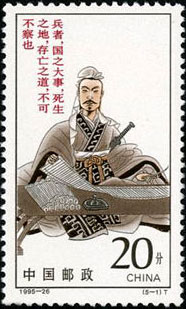
SN: (5-1) Title: Portrait of Sunzi Values: 20 fen Size: 30*50mm Type: T(Mint) | |
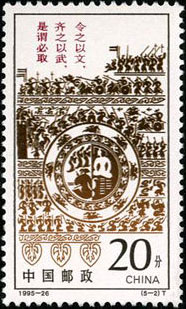
SN: (5-2) Title: Teaching how to fight in Palace of Wu Country Values: 20 fen Size: 30*50mm Type: T(Mint) | |
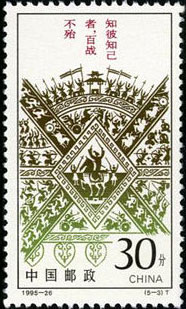
SN: (5-3) Title: Enter Ying City after Five Battles Values: 30 fen Size: 30*50mm Type: T(Mint) | |
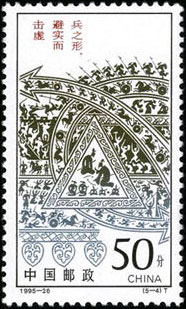
SN: (5-4) Title: Battle at Ailing Values: 50 fen Size: 30*50mm Type: T(Mint) | |
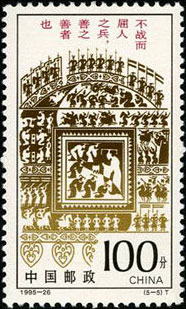
SN: (5-5) Title: Meetings of Sovereigns to Form Alliances at Huangchi Values: 100 fen Size: 30*50mm Type: T(Mint) |
Background info
Sun Wu, author of "The Art of war of Sunzi", courtesy - named Changqing, was a native of Le An of State Qi (Huimin county, Shandong Prov.) in the later years of Spring and Autumn Period (770-476 B.C.). At Wu Zixu's seventh recommendation, he was received in audience by King He Lu of State Wu for his military theories and was immediately made a general. As he showed up in the conquering wars, Sun Wu quickly proved himself of great strength in military affairs. Due to his remarkable command, State Wu took over the overlord place of State Jin.
"The Art of War of Sunzi" is not only an illustrious martial classics in ancient China, but one of the oldest writings on war art in the world. It consists of 13 chapters. They are: Laying Plan; Waging War; Attack by Stratagem; Tactical Dispositions; Energy; Weak Points and Strong; Manoeuvring; Variation of Tavtics; The Army on the March; Terrain; The Nine Varieties of Ground; The Attack by Fire and The Use of Spies. There are only about 5 thousand more characters, but the intelligence they contain is immeasurable. It presents exquisite discussions on various aspects of antique military theories, nevertheless touching, as one sees, almost all the categories and branches of modern military science. Since its appearance, "The Art of War of Sunzi" has been highly appreciated and resorted to by strategists throughout the history and was honored as "the Greatest Martial Classics". Noticeable in this book are also many dictums and aphorisms of rich understanding that reveals the universal principles of the war, such as: "if you know the enemy and know yourself, you need not fear the result of a hundred battles"; "attack him where he is unprepared, appear where you are not expected"; "to wait at ease while the enemy is toiling and struggling"; "avoid the strong, attack the weak", and so on. All these statements echo with sophisticated philosophy.
Today, the enduring masterpiece of "The Art of War of Sunzi", bearing an age of 25 hundred years, with versions of more than a dozen foreign languages, witnesses its influence everywhere. It passed through boundaries and made fame around the world. Results of researches based upon the book have been applied to other fields beyond military sphere, as to politics, diplomatic affairs, economy and sports, etc.. As further exploration goes on, "The Art of War of Sunzi" will sure have much more to offer to us mankind.
Sun Wu, author of "The Art of war of Sunzi", courtesy - named Changqing, was a native of Le An of State Qi (Huimin county, Shandong Prov.) in the later years of Spring and Autumn Period (770-476 B.C.). At Wu Zixu's seventh recommendation, he was received in audience by King He Lu of State Wu for his military theories and was immediately made a general. As he showed up in the conquering wars, Sun Wu quickly proved himself of great strength in military affairs. Due to his remarkable command, State Wu took over the overlord place of State Jin.
"The Art of War of Sunzi" is not only an illustrious martial classics in ancient China, but one of the oldest writings on war art in the world. It consists of 13 chapters. They are: Laying Plan; Waging War; Attack by Stratagem; Tactical Dispositions; Energy; Weak Points and Strong; Manoeuvring; Variation of Tavtics; The Army on the March; Terrain; The Nine Varieties of Ground; The Attack by Fire and The Use of Spies. There are only about 5 thousand more characters, but the intelligence they contain is immeasurable. It presents exquisite discussions on various aspects of antique military theories, nevertheless touching, as one sees, almost all the categories and branches of modern military science. Since its appearance, "The Art of War of Sunzi" has been highly appreciated and resorted to by strategists throughout the history and was honored as "the Greatest Martial Classics". Noticeable in this book are also many dictums and aphorisms of rich understanding that reveals the universal principles of the war, such as: "if you know the enemy and know yourself, you need not fear the result of a hundred battles"; "attack him where he is unprepared, appear where you are not expected"; "to wait at ease while the enemy is toiling and struggling"; "avoid the strong, attack the weak", and so on. All these statements echo with sophisticated philosophy.
Today, the enduring masterpiece of "The Art of War of Sunzi", bearing an age of 25 hundred years, with versions of more than a dozen foreign languages, witnesses its influence everywhere. It passed through boundaries and made fame around the world. Results of researches based upon the book have been applied to other fields beyond military sphere, as to politics, diplomatic affairs, economy and sports, etc.. As further exploration goes on, "The Art of War of Sunzi" will sure have much more to offer to us mankind.
Related items
1995-27 Opening of China-Korea Cable System
R28 Scott 2611-13 The Great Wall
1995-2 Scott 2552-53 Rime in Jilin
1995-3 Scott 2554-57 The Dinghu Mountain
1995-4 Scott 2558 Promote Social Development, Better Our Future
1995-5 Scott 2559-62 Owls
1995-27 Opening of China-Korea Cable System
R28 Scott 2611-13 The Great Wall
1995-2 Scott 2552-53 Rime in Jilin
1995-3 Scott 2554-57 The Dinghu Mountain
1995-4 Scott 2558 Promote Social Development, Better Our Future
1995-5 Scott 2559-62 Owls China stamps indexed by year
2008 | 2007 | 2006 | 2005 | 2004 | 2003 | 2002 | 2001 | 2000 | 1999 | 1998 | 1997 | 1996 | 1995 | 1994 | 1993 | 1992 | 1991 | 1990 | 1989 | 1988 | 1987 | 1986 | 1985 | 1984 | 1983 | 1982 | 1981 | 1980 | 1979 | 1978 | 1977 | 1976 | 1975 | 1974 | 1973 | 1972 | 1971 | 1970 | 1969 | 1968 | 1967 | 1966 | 1965 | 1964 | 1963 | 1962 | 1961 | 1960 | 1959 | 1958 | 1957 | 1956 | 1955 | 1954 | 1953 | 1952 | 1951 | 1950 | 1949
Send to friends - | -
Print this page
2008 | 2007 | 2006 | 2005 | 2004 | 2003 | 2002 | 2001 | 2000 | 1999 | 1998 | 1997 | 1996 | 1995 | 1994 | 1993 | 1992 | 1991 | 1990 | 1989 | 1988 | 1987 | 1986 | 1985 | 1984 | 1983 | 1982 | 1981 | 1980 | 1979 | 1978 | 1977 | 1976 | 1975 | 1974 | 1973 | 1972 | 1971 | 1970 | 1969 | 1968 | 1967 | 1966 | 1965 | 1964 | 1963 | 1962 | 1961 | 1960 | 1959 | 1958 | 1957 | 1956 | 1955 | 1954 | 1953 | 1952 | 1951 | 1950 | 1949
Terms of sale | Directory | Site Map | About us | Contact us
Copyrights (c) 2008 Reserved by Xabusiness.com