

T150, Scott 2283-86 Dunhuang Murals (3th Series)
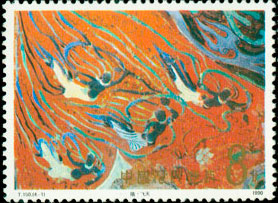
 (4-1), Sui Dynasty, flying Apsaras, 8 fen, 54*40 mm
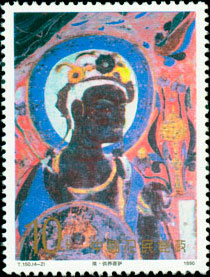 (4-2), (4-2) Sui Dynasty, Bodhisattva, 10 fen, 40*54 mm
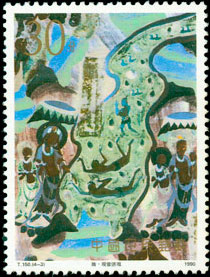 (4-3), Sui Dynasty, Avalokitesvara, 30 fen, 40*54 mm
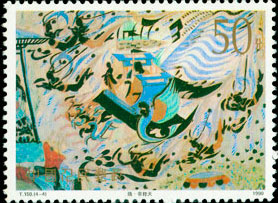 (4-4), Sui Dynasty, Sakyamuni, 50 fen, 54*40 mm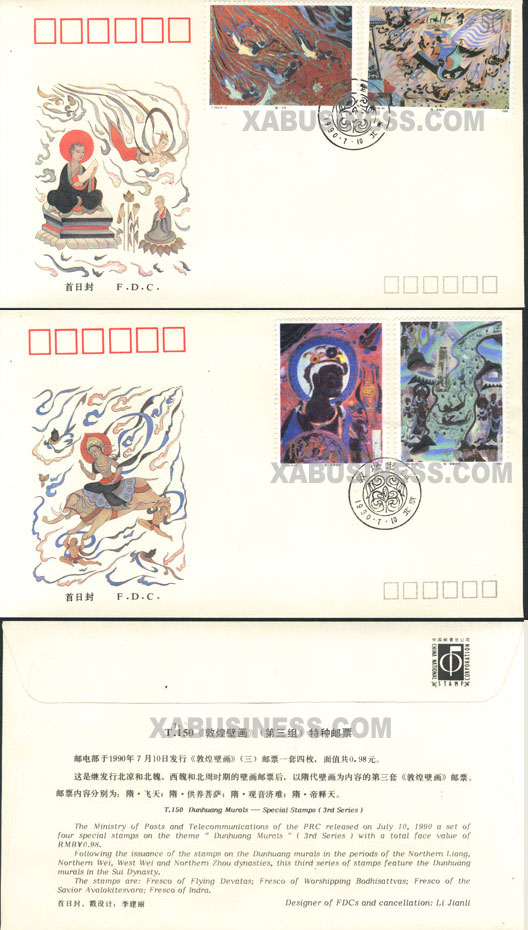

Technical details
Scott No: 2283-86Serial number: T150
Values in set: 4
Date of issue: July 10, 1990
Denomination: 98 fen
Designers: Wu Jiankun, Ren Yu
Size of stamps:
54*40mm for Value 1, 4
40*54mm for Value 2, 3
Perforation: 11
Sheet composition:
20 (4*5) for Value 1, 4
20 (5*4) for Value 2, 3
Printing process: Photogravure
Printing House: Beijing Postage Stamp Printing Works
Background
Dunhuang grottoes art is a solid art combining architecture, sculpture, and mural. Although Dunhuang murals only play a role of decoration, and a supplementary role to the sculptures in the Grottoes, but they feature the greatest number, the largest scale, the finest art skills and the richest content, providing very valuable information and material for research on ancient Chinese politics, economy, culture, military, geography, communication, social life, national relationship, religious history, art history, and exchanges with foreign countries and history of cultural exchanges. It is indeed a classic art heritage of great value. In the 577 grottoes with Mogao grottoes as the principal one, there are more than 45,000 square meters of colorful murals. It was called the biggest museum of fine arts in the world. According research findings, Dunhuang murals can be divided into the following classes:
Buddha Figures: They refer to all kinds of gods and spirits, such as Buddha, Bodhisattva, and Buddha Guards, etc. worshiped by Buddhists. Most of them are painted in the pictures of Teaching Doctrine. In Mogao grottoes alone there are 12,208 figures of Buddha with different expressions and postures in 933 pictures of Teaching Doctrine.
Jingbian Painting: They refer to an art form that employs paintings and literature to make abstract Buddha sutra easy to understand. A drawing that explains abstract sutra is called Bianxiang, and the method of explaining sutra with words and singing is called Bianwen.
Legendary Mural: Its subject maters are traditional Chinese legends, which refer to the contents or subjects of Taoist thought appearing in the Northern Wei Dynasty (386-534). Occurrence of Taoist thoughts in Buddha grottoes reflects the combination of the Buddhist meditative absorption and Taoist Xujing (quiet and calm). It is also the influence of Buddhist thought and art on Chinese culture.
Almsgivers' Figures: Almsgivers refer to those who believe in Buddhism and finance the building of grottoes. To show their sincere belief in Buddhism and leave fame in the future, they painted themselves, their family members and servants inside the grottoes when building the grottoes.
Decorative Painting: Rich and colorful decorative paintings are mainly used to decorate the construction of grottoes, and desk covers, clothes and containers. The pattern kept changing along with time, revealing outstanding painting skills and rich imagination of the artists. The patterns mainly include sunken panel, rafter, and edge decoration, etc.
Story Painting: To attract more and more people and spread Buddhism with great efforts, it is necessary to transmit the abstract and profound Buddhist sutra to ordinary people in simple words and vivid form. Therefore plenty of story paintings were painted in grottoes, which have exerted an imperceptible influence on people when they saw the murals. The stories are full of rich content and moving plot with strong life atmosphere and great charm.
Except the above-mentioned murals, there are also murals on buildings, containers, flowers and birds, animals, etc. Dunhuang Murals systematically reflect changes and art exchange history between China and western countries in respect of the art style of various periods in arrangement, figure, outline, and color, etc.
Share: 
Price List
Item location: China
Ships to: Worldwide
*Shipping (via registered air mail) is based on subtotal of order. See detials below.
* 1) for special items shipping and handling cost may be included. 2) Other fast shipping is available.
To special order, please let us know what you are looking for. We will help you to meet your unique interests.
Ships to: Worldwide
*Shipping (via registered air mail) is based on subtotal of order. See detials below.
| Order Subtotal | S & H |
| $0.01---$15.00 | US $5.00 |
| $15.01---$50.00 | US $6.00 |
| $50.01---$100.00 | US $7.00 |
| $100.01---$180.00 | US $8.00 |
| $180.01---over | US $9.00 |
To special order, please let us know what you are looking for. We will help you to meet your unique interests.


