


Festivals of China
China is a country with many ethnic groups and a rich cultural heritage Of all the traditional festivals, perhaps the most popular ones are the Spring Festival, the Lantern Festival, the Dragon Boat Festival, and the Mid-autumn Festival.
The Spring Festival
The Spring Festival, also known as the Lunar New Year, is the
most important traditional festival in China, Which takes place
in late January or early February. The historital reason for beginning
the year during cold weather is that it is the time between the
"autumn harvest and winter torage" and "spring
plowing and surnmer weeding". In other words, this is the
time for rest and relaxation after a year's toil, and for celebration
as well.
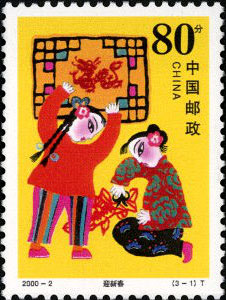
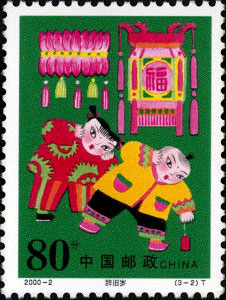
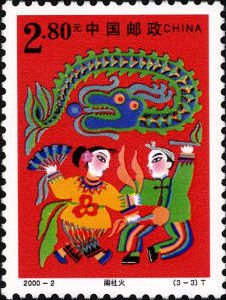
In addition to the practical reasons of having the Spring Festival
during the cold months, a Chinese folklore offers another explanation.
According to Chinese legends, a demon called Nian would torment
people once a year during the winter. The people gathered to discuss
how to deal with Nian. Some people suggested that the demon was
for of the red colour, flames and loud noises. So they put red
coiplets on their gates, set off firecrackers and beat gongs and
drums to
drive Nian away. Their ideas worked and Nian fled. Thus, the customs
of celebrating the Spring Festival were born and passed down.
During the month of January or February, Chinese families clean
their houses, set off firecrackers, post pictures of the Door
God and couplets on their gates. On the eve of the Spring Festival,
it is a folk custom to stay up late or all night to pray for peace
and prosperity in the coming year. The new year is ushered in
at midnight. A get-together banquet is usually a must for every
Chinese family. The most popular food enjoyed by both the rich
and poor is Jiaozi, or dumplings, which is supposed to bring good
fortune. On the first day of the new year, everybady wear new
clothes and greets relatives and friends with bows and gongxi
(congratulations), wishing each other the best during the new
year.
In recent years, the Spring Festival has become a public holiday.
People usually have several free days for attending family dinners,
traveling, going to the movies or concerts or just watching
holiday special TV programmes.
The Lantern Festival
The fifteenth day of the first lunar month is also an impotant
traditional festival in China where various types of lanterns
are exhibited. Lanerns are in different shapes and colors. They
are made of paper, gauze, silk or plastic in the shapes of fish,
frog, horses, rabbits, roses, lotus flowers, or even gods. Each
year's lantern exhibition takes one animal as the theme, the animal
which is designated by the Chinese lunar calendar for the year.
For examle, in the Year of Dragon, the dragon-theme lanterns are
seen everywhere. The lantern exhibition is a custom that has persisted
throughout history. In recent years, the increase in living standards
has led to various splendid lantern exhibitions all over the country.
Such occasions are colourful and present picture-perfect-scenes
with the bright moon shining down on hundreds of colourful lanterns.
In addition to lantern exhibitions, the Lantern Festival includes
plays, firework displays, acrobatics and dances. The dances are
always Chinese and traditional: dragon dances, lion dances, boat
dances and lotus dances.
Traditionally, every family eats yuanxiao on the night of the
Lantern Festival. Yuanxiao, a symbol of family unity, affection
and happiness, is a glutinous, rice-flour dough stuffed with sweet
stuffings such as sugar and bean paste. Therefore, the Lantern
Festival is also called the Yuanxiao Festival. Apart from yuanxiao,
people have a grand dinner to mark the end of the Spring Festival
celebrations.
The Dragon Boat Festival
The Dragn Boat Festival, or the Duanwu Festival, falls on the
fifth day of the fifth lunar month. This Festival is widely accepted
as a day to commernorate Qu Yuan, China's greatest poet of
the Warring States Period(475B.C. - 221 B.C.). People respected
Qu Yuan for his efforts to make State of Chu strong and prosperous
and for his dedication to such ideals. However, he became frustrated
with the status quo and ultimately committed suicide by drowning
himself in the Miluo River. On the day of Qu Yuan's death, people
rushed from all over, rowing boats on the river in an
atteinpt to find his remains, which were thought to have drifted
downstream, never to be recovered. But people never give up their
hope. This time every year, rowing a fast stroke, they wanted
to be the first one to find him. As the result, beat-racing has
become very popular along the waterways in many southern and eastern
cities and towns. On the day of the festival, boats are decorated
in the shape of a dragon, with a drum and a gong on each boat
to set the pace.
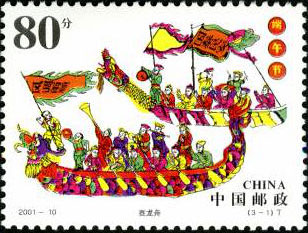
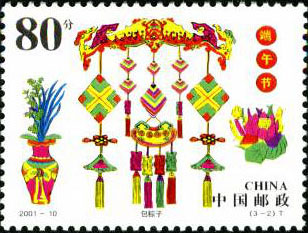
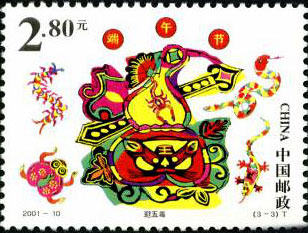
Dragon Boat Festival ( Duan Wu Festival)
Sometimes foreign friends would come to compete with the Chinese
team in strength, teamwork and rowing skills. As part of the festival,
people throw rice-filled bambo tubes into the river as an offering.
During the Duanwu Festival, it is also a common practice to eat
zongzi, which is a rice pudding wrapped up with reed leaves. The
reed leaves give a special flavour to the food.
Commoration of Qu Yuan during the Duanwu FeStival shows his popularity
as a poet and man who made great contributions to his motherland.
In l957, Qu Yuan was selected by the
World Peace Council as one of the four cultural figures to be
memorized by the world.
The Mid-autumn Festival
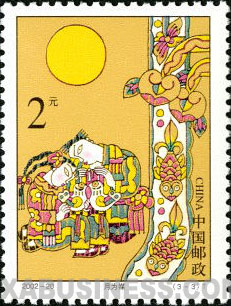
The Mid-autumn Festival falls on the fifteenth day of the eighth
lunar month because the eighth lunar month is mid-autumn and the
fifteenth is the middle of that month. On that night the
moon is supposed to be brighter and fuller than any other night.
In China, a full moon is symbolic of family reunion, which is
why that day is also known as the "Day of Reunion".
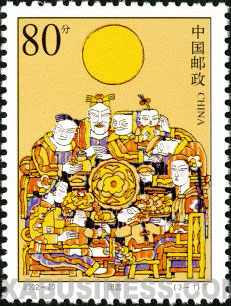
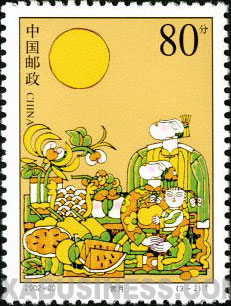
In ancient China, the moon was considered by scholars as a symbol
of brightness, purity, and goodness. Poets of the past wrote many
beautiful odes to the moon. Not only was the moon an inspiration
to writers but it was also a source of many myths and legends.
The most popular myth was a story about a woman named Chang E
who flew to the moon and lived about Moon Palace with treesand
flowers around. It is believed that she is now happy about the
leisure and tranquility on the moon. But from time to time she
is missing the earthly life.
During this festival, people eat the moon cake, which is made
of wheat flour and sweet stuffings such as sugar and lotus seed
powder. The festival is a time for families to gather to burn
incense and eat fruits in addition to the moon cake. The cake
is tranditionally cut into pieces that equal the number of people
in the family. Watching the moon is an important part of the Mid-autumn
Festival celebrations. At night, people stay out and admire the
beauty of the full moon, eating the Moon cakes. Delighted by the
serenity and tranquillity, some peonle begin to sing classic songs
and recite well-known verses. While tradition abounds during this
festival, the
essence of this festival is the harmony and happiness of family
life, which is somthins that can be understood by all.