

1996-20, Scott 2704-08 Dunhuang Murals (6th series)
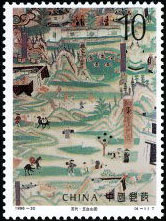
 (4-1), Illustration of Mount Wutai, 10 fen, 40*54mm
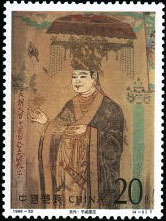
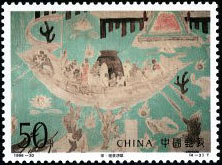
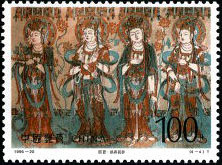

Technical details
Scott No: 2704-08Serial number: 1996-20
Values in set: 4
Souvenir sheet: 1
Date of issue: August 15, 1996
Designers: Wu Jiankun; Ren Yu
Size of stamp:
40*54mm , 54*40mm
Size of S/S: 96*135 mm
Size of S/S stamp: 40*102 mm
Perforation: 12
Sheet composition: 40
Printing process: gravure
Background
Located on the west edge of the Hexi Corridor in western Gansu, China, Dunhuang Grottoes, always known as a "Buddhist art treasury", is one of the country's largest ancient grotto group, a key cultural relics unit under State protection. The Dunhuang Grottoes in a broad sense include the Dunhuang Mogao Grottoes, the Xi Qianfodong Grottoes, Yulin Grottoes in Ansi, Qianfodong Grottoes in Shuikouxia, which are usually referred to as Mogao Grottoes. The Mogao Grottoes were inaugurated in the 2nd year of Jian Yuan of the early Qin Dynasty (AD 366), but the earliest grottoes extant were dug during the sixteen Kingdoms of Bei Ling (421 to 439 AD). The construction of the grottoes continued in dynasties including Northern Wei (386-534), Western Wei (535-556), Northern Zhou (557-581), Sui, Tang, Five Dynasties and Ten Kingdoms (907-960), Song, Western Xia (1038-1227) and Yuan. The number of grottoes extant totaled 492, and the murals within the grottoes cover an area of about 45,000 square meters; besides there are 2,400 clay sculptures in the Dunhuang Grottoes.What the Dunhuang murals mainly depict fall into four categories: The Jing Bian, stories illustrating Buddhist scripture; The Ben Sheng story, the previous incarnation life stories of Sakyamuni (the founder of Buddhism); The Buddha, arhat and little Qianfo; and the portraits (with real names )of those who had contributed to the construction of the grottoes or offered sacrifices to the Buddhas. The murals in Northern Wei period, representatives of the early style murals, were drawn in bold and vigorous lines, which looked natural and flowing. However, most lines have already peeled off, and the colors, faded, The mural style in the Sui Dynasty became smooth and vivid, with rich and yet soft colors, The Dunhuang mural art reached its climax in the Tang Dynasty, when lines became thicker and smoother, colors ,richer and more sophisticated. Generally the murals were magnificent, picturing vast ranging subjects. The murals in the Five Dynasties and Ten Kingdoms and early Song Dynasties followed Tang, with natural folk art styles. And in the Yuan Dynasty, murals were painted with dark and gloomy, and seldom red colors. The wet mural style in slight ink and wash made the murals look mysterious.
The Dunhuang murals, the representatives of Chinese arts in the 4th to 13th centuries, have provided many precious materials for the research materials for the research of the history of Buddhist art.
Share: 
Price List
Item location: China
Ships to: Worldwide
*Shipping (via registered air mail) is based on subtotal of order. See detials below.
* 1) for special items shipping and handling cost may be included. 2) Other fast shipping is available.
To special order, please let us know what you are looking for. We will help you to meet your unique interests.
Ships to: Worldwide
*Shipping (via registered air mail) is based on subtotal of order. See detials below.
| Order Subtotal | S & H |
| $0.01---$15.00 | US $5.00 |
| $15.01---$50.00 | US $6.00 |
| $50.01---$100.00 | US $7.00 |
| $100.01---$180.00 | US $8.00 |
| $180.01---over | US $9.00 |
To special order, please let us know what you are looking for. We will help you to meet your unique interests.


