

1995-9, Scott 2571-74 Chinese Shadow Play
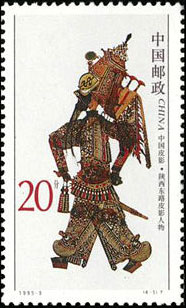
 (4-1), Leather-silhouette Figure in Donglu, Shanxi, 20 fen, 31*52mm
Technical details
Scott No: 2571-74Serial number: 1995-9
Values in set: 4
Date of issue: June 8, 1995
Designers: Wang Huming; Yan Bingwu
Size: 31*52mm
Perforation: 12
Sheet composition: 40
Printing process: offset
Background
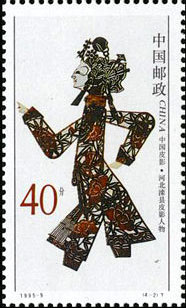
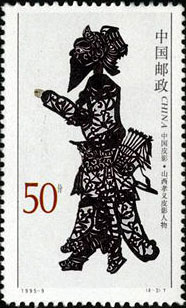
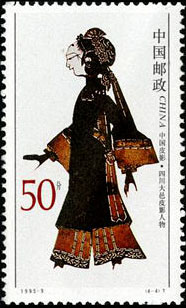
The Chinese shadow play is a kind of puppet show as well as an ancient Chinese play. It is said that the play stated in the Han Dynasty (206 BC-AD 220), becoming popular in the Song Dynasty (960-1279) and spreading across the country in the Late Qing Dynasty (1644-1911). The "figures" on performance are made of donkey skin, oxhide and sheep skin. After tanning and flattening, the skins will be carved, colored, ironed flat and bound into different shapes, which are controlled and played on the screen by artists through lights. Accompanied with music and singing, they become very interesting artistic images, which can "tell stories of hundreds of dynasties" and directed millions of soldiers by hands". The Chinese shadow play has close ties with other Chinese arts. It is a flat carving art, which is similar to the folk paper-cutting. From the modeling of figures, stage property, horses and carts and buildings of the shadow play, it is similar to the figures of local operas. The figure of a shadow play can be carved only from the front side. And the modeling of the shadow play stesses on empty instead of solid, forming a contrast between the empty and solid and projecting the image.The shadow play spreads widely among the Chinese and is different from place to place, habits and aesthetic standards. The shadow play can be classified into Donglu and Xilu in Shanxi and Sichuan, Longdong and Longxi in Gansu, and Dingcheng and Xicheng in Beijing.
Share: 
Price List
Item location: China
Ships to: Worldwide
*Shipping (via registered air mail) is based on subtotal of order. See detials below.
* 1) for special items shipping and handling cost may be included. 2) Other fast shipping is available.
To special order, please let us know what you are looking for. We will help you to meet your unique interests.
Ships to: Worldwide
*Shipping (via registered air mail) is based on subtotal of order. See detials below.
| Order Subtotal | S & H |
| $0.01---$15.00 | US $5.00 |
| $15.01---$50.00 | US $6.00 |
| $50.01---$100.00 | US $7.00 |
| $100.01---$180.00 | US $8.00 |
| $180.01---over | US $9.00 |
To special order, please let us know what you are looking for. We will help you to meet your unique interests.


