Stamp Search 
Categories 
Architecture
Animals
Anniversary
Bird
stamps
for Kids
China
jointly issued
Chinese
new year
Flower
Landscape
Mao
Zedong
Mountain
Olympic
Portrait
River
Sports
World
Heritage
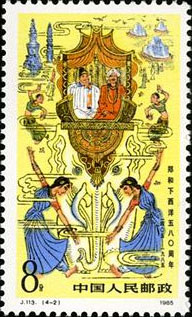
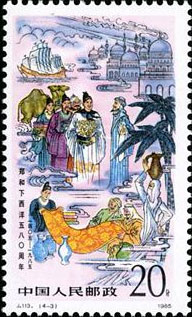
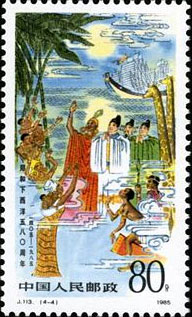
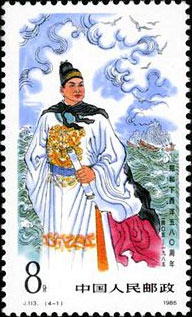
580th Anniv. of Zheng He's Expedition to Seas
Item location: China
Ships to: Worldwide
Terms of sale
To special order, please let us know what you are looking for. We will help you to meet your unique interests.
Technical details:
Scott No: 1992-1995
Serial number: J113
Values in set: 4
Date of issue: July 11, 1985
Denomination: 116 fen
Designers: Li Dawei
Size of stamps: 31*52mm
Perforation: 11.5
Sheet composition: 40(10*4)
Printing process: Photogravure
Printing House: Beijing Postage Stamp Printing Works
Scott No: 1992-1995
Serial number: J113
Values in set: 4
Date of issue: July 11, 1985
Denomination: 116 fen
Designers: Li Dawei
Size of stamps: 31*52mm
Perforation: 11.5
Sheet composition: 40(10*4)
Printing process: Photogravure
Printing House: Beijing Postage Stamp Printing Works
![]() Great navigator Zhen He | SN: (4-1) Title: Great navigator Zhen He Values: 8 fen Size: 31*52 mm Type: J(Mint) |
![]() Emissary of peace | SN: (4-2) Title: Emissary of peace Values: 8 fen Size: 31*52 mm Type: J(Mint) |
![]() Trade and culture communication | SN: (4-3) Title: Trade and culture communication Values: 20 fen Size: 31*52 mm Type: J(Mint) |
![]() Great emprise in navigation history | SN: (4-4) Title: Great emprise in navigation history Values: 80 fen Size: 31*52 mm Type: J(Mint) |
Background info
During the reign of the emperor Zhu Di the Ming Empire became stronger and the its economy flourished. To make China's strength known to the world and to spread Chinese culture, Zhu Di sent Zheng He with his ship team on oversea voyages. Zheng He was a eunuch from a family of Hui nationality. From 1405 to 1433 Zheng made seven voyages and performed miracles in the history of ocean£going navigation.
Zheng He's ocean going team had a hundred vessels and a crew of 30,000. It was the largest one in the world at that time.
The Ming Dynasty was a golden age of ship building. China then had large shipyards.
The large vessel Zheng He used was 120 metres long and 45 metres wide. The twelve sails on the ship could be adjusted in accordance with the wind directions. The ship had separate water£tight cabinets to keep the ship afloat. Because the cabinets were separated and water£tight, even if the ship stroke a reef at some cabinet, the whole ship would not sink. In the 18th century, this structure arrested the Westerners' attention and was gradually adopted by them.
Zheng He's team used the compass, the most advanced navigation instrument of the world of his day. They detected directions by the compass and located geographical positions by observing the altitude of stars. The combined application of nautical astronomy and compass navigation greatly increased the accurateness of their position fixing during the voyages. This technical advancement offered Zheng's ship team greater freedom.
The Route Chart of Zheng He's Voyages included 30 Asian and African countries and regions, 530 places, and topographical features like mountains, islands, reefs and so on. Directions in the compass and the depth of water were signed at important points on the navigation lines. This is the first ocean£going voyage chart in China, and one of the earliest in the world.
Zheng's ship team made seven voyages through untold hardships. It went through the South China Sea, the Java Sea, the Strait of Malacca, the Persian Gulf, the Red Sea and the Indian Ocean and reached the eastern coast of Africa. It visited 30 Asian and African countries including Vietnam and Indonesia. The route totaled to 500,000 kilometres. This was unprecedented in the history of ocean navigation.
Zheng reached India 90 years earlier than Vasco da Gama's arrival there by way of Good Hope Cape, and 80 years earlier than Christopher Columbus' arrival at America, the so£called New Continent.
Wherever Zheng He went, he brought gifts and granted titles from the Ming emperor to the local rulers, meaning to establish a broad tribute£paying circle. At the same time, Chinese calendar and ritual system were introduced to those countries.
Zheng's ship team also did trade and exchanged goods with other countries. The ship team was equipped with strong arms, which however was seldom used. Zheng was more like a good will ambassador than a war ship commander or a boss of a merchant group.
Zheng's voyages enriched the humankind's knowledge about navigation. They opened up the traffic route on the Asian and African seas, and promoted economic and cultural interchange. They created the brilliant record in Chinese people's adventures in conquering the seas.
During the reign of the emperor Zhu Di the Ming Empire became stronger and the its economy flourished. To make China's strength known to the world and to spread Chinese culture, Zhu Di sent Zheng He with his ship team on oversea voyages. Zheng He was a eunuch from a family of Hui nationality. From 1405 to 1433 Zheng made seven voyages and performed miracles in the history of ocean£going navigation.
Zheng He's ocean going team had a hundred vessels and a crew of 30,000. It was the largest one in the world at that time.
The Ming Dynasty was a golden age of ship building. China then had large shipyards.
The large vessel Zheng He used was 120 metres long and 45 metres wide. The twelve sails on the ship could be adjusted in accordance with the wind directions. The ship had separate water£tight cabinets to keep the ship afloat. Because the cabinets were separated and water£tight, even if the ship stroke a reef at some cabinet, the whole ship would not sink. In the 18th century, this structure arrested the Westerners' attention and was gradually adopted by them.
Zheng He's team used the compass, the most advanced navigation instrument of the world of his day. They detected directions by the compass and located geographical positions by observing the altitude of stars. The combined application of nautical astronomy and compass navigation greatly increased the accurateness of their position fixing during the voyages. This technical advancement offered Zheng's ship team greater freedom.
The Route Chart of Zheng He's Voyages included 30 Asian and African countries and regions, 530 places, and topographical features like mountains, islands, reefs and so on. Directions in the compass and the depth of water were signed at important points on the navigation lines. This is the first ocean£going voyage chart in China, and one of the earliest in the world.
Zheng's ship team made seven voyages through untold hardships. It went through the South China Sea, the Java Sea, the Strait of Malacca, the Persian Gulf, the Red Sea and the Indian Ocean and reached the eastern coast of Africa. It visited 30 Asian and African countries including Vietnam and Indonesia. The route totaled to 500,000 kilometres. This was unprecedented in the history of ocean navigation.
Zheng reached India 90 years earlier than Vasco da Gama's arrival there by way of Good Hope Cape, and 80 years earlier than Christopher Columbus' arrival at America, the so£called New Continent.
Wherever Zheng He went, he brought gifts and granted titles from the Ming emperor to the local rulers, meaning to establish a broad tribute£paying circle. At the same time, Chinese calendar and ritual system were introduced to those countries.
Zheng's ship team also did trade and exchanged goods with other countries. The ship team was equipped with strong arms, which however was seldom used. Zheng was more like a good will ambassador than a war ship commander or a boss of a merchant group.
Zheng's voyages enriched the humankind's knowledge about navigation. They opened up the traffic route on the Asian and African seas, and promoted economic and cultural interchange. They created the brilliant record in Chinese people's adventures in conquering the seas.
Related items
J114 Scott 1996-97 90th Anniv. of Birth of Xu Beihong
J115 Scott 1998-99 200th Anniv. of Birth of Lin Zexu
J116 Scott 2000-02 20th Anniv. of Founding of Tibet Autonomous Region
J117 Scott 2003-04 40th Anniv. of Victory over War of Resistance against Japan and the World Anti-Fascist War
J118 Scott 2005-06 2nd National Workers' Games
J119 Scott 2007-09 30th aniv. of Founding of Xin-jiang Uygur Autonomous Region
J114 Scott 1996-97 90th Anniv. of Birth of Xu Beihong
J115 Scott 1998-99 200th Anniv. of Birth of Lin Zexu
J116 Scott 2000-02 20th Anniv. of Founding of Tibet Autonomous Region
J117 Scott 2003-04 40th Anniv. of Victory over War of Resistance against Japan and the World Anti-Fascist War
J118 Scott 2005-06 2nd National Workers' Games
J119 Scott 2007-09 30th aniv. of Founding of Xin-jiang Uygur Autonomous Region China stamps indexed by year
2008 | 2007 | 2006 | 2005 | 2004 | 2003 | 2002 | 2001 | 2000 | 1999 | 1998 | 1997 | 1996 | 1995 | 1994 | 1993 | 1992 | 1991 | 1990 | 1989 | 1988 | 1987 | 1986 | 1985 | 1984 | 1983 | 1982 | 1981 | 1980 | 1979 | 1978 | 1977 | 1976 | 1975 | 1974 | 1973 | 1972 | 1971 | 1970 | 1969 | 1968 | 1967 | 1966 | 1965 | 1964 | 1963 | 1962 | 1961 | 1960 | 1959 | 1958 | 1957 | 1956 | 1955 | 1954 | 1953 | 1952 | 1951 | 1950 | 1949
Send to friends - | -
Print this page
2008 | 2007 | 2006 | 2005 | 2004 | 2003 | 2002 | 2001 | 2000 | 1999 | 1998 | 1997 | 1996 | 1995 | 1994 | 1993 | 1992 | 1991 | 1990 | 1989 | 1988 | 1987 | 1986 | 1985 | 1984 | 1983 | 1982 | 1981 | 1980 | 1979 | 1978 | 1977 | 1976 | 1975 | 1974 | 1973 | 1972 | 1971 | 1970 | 1969 | 1968 | 1967 | 1966 | 1965 | 1964 | 1963 | 1962 | 1961 | 1960 | 1959 | 1958 | 1957 | 1956 | 1955 | 1954 | 1953 | 1952 | 1951 | 1950 | 1949
Terms of sale | Directory | Site Map | About us | Contact us
Copyrights (c) 2008 Reserved by Xabusiness.com