


Chinese Lunar New Year and 12 animals
China uses the Gregorian calendar for civil purposes, but the Chinese lunar calendar is also important in China. The Chinese Lunar New Year - known as Spring Festival today in China - is the biggest holiday in China. The Chinese lunar calendar is the longest chronological record in history dating back to 2,600 BC Like the Gregorian calendar, the Chinese Lunar Calendar is a yearly one, but the start of the lunar year is based on the cycles of the moon so that New Year Day can fall anywhere between late January and the middle of February. Each lunar year is associated with one of 12 zodiac animals.
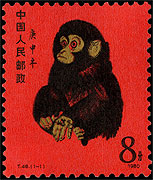
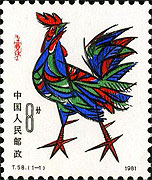
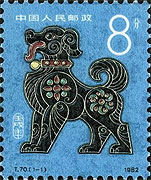
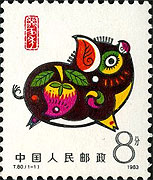
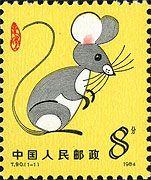
The mouse, or rat, is the first in the cycle of l2 animals representing
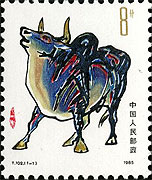
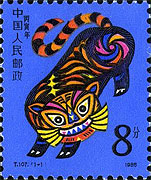
years. The others are, chronologicaIly, the ox, the tiger, the
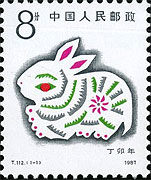
rahbit, the dragon, the snake, the horse, the sheep, the
monkey, the rooster, the dog and the pig. How come animals, specific
animals, designate years? Why l2, no more, no less? And why these
specific animals are chosen?
There are different explanations about their origin. A popular
legend says, long long ago, a certain god ordered all the animals
to pay him a visit on New Year's Day, that is, the first day of
the first month. He said he would give the first 12 animals to
come the title "King of the Animal World" and let each
hold the title for one year.
The l2 winners happened to be those mentioned above. Another theory
holds that the animals originated from the 28 constellations,
or the Lunar Mansions, which are named after animals. Every two
or three constellations stand for a year, and the most commonly
known animal in each group was chosen for that year. Thus we have
the l2 animals.
A more convincing theory maintains that using animals to symbolize
years began from totems of minority peoples in ancient times.
Different tribes had different animals as their totems; gradually,
these animals were used as a means to remember the years. Alongside
the increasing exchanges between the hinteriand and the border
regions, the custom of using animals to designate years made its
way to the hinterland and was adopted by the Han people, the largest
national group in China.
At that time, the Hans were using the 10 Heavenly Stems and
the 12 Earthly Branches to designate years. They took one from
each series to make a pair for one year and developed a system
based on a 60 year cycle. It is back to square one and the cycle
begins again.
When the method of using animals to represent years was introduced
into the hinterland, the ancient Chinese married them to the l2
Earthly Branches, one to each. So 12 animals were used. And animals
officially began to be used to designate years during the Later
Han of the Five Dynasties Period a little more than 1,000 years
ago.
The New Year visit-to-the-god story explains how the unpleasant
Mouse managed to become the first of the 12. As the story goes,
when the Ox heard of the God's decree, he said to himself: "It's
a long journey to visit that God. I am not a fast traveler and
I'd better start early." So he set out on the eve of the
Lunar New year. The Mouse heard the Ox and jumped onto his back,
without being noticed. The Ox, sweating all over, was so glad
to be the first to arrive at the God's place. But just as he was
about to express his New Year greetings to the God, the mouse
jumped down over the Ox's head and became the first to kowtow
to the God. So he was appointed the first King of the Animals
and consequently, the first of the l2 animals to designate years.
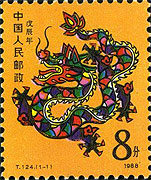
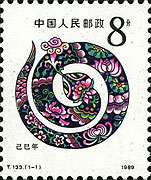
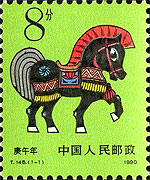
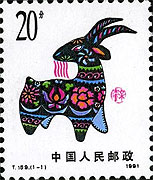
A more authentic explanation says, the Earthly Branches are
divided into two categories: yin and yang. Each of them is paired
with an animal of the same "gender". The gender of the
animal is
determined by the number of a specific part of its body. Odd numbers
are yang and even numbers are yin. The tiger, the dragon the monkey
and the dog, all have five toes on each foot or paw, and the horse
has one hoof. So we know they are yang animals. The cloven-hoofed
species such as the ox, the goal and the pig fall into the yin
category because their hoofs are divided into two parts. The rooster
is also yin since it has four toes on each foot. The rabbit has
two upper lips and the snake has a two-point forked tongue. So
they are yin, too. The mouse had been a problem. It has four toes
on each fore leg and five on each hind leg. It has both yin and
yang qualities and there seemed to be no pace to put it. Fortunately,
the first of the Earthly Branches, Zi can be considered both yin
and yang. The branches were also used to designate days and hours,
and when symbolizing the hours, this branch covers a period from
eleven in the evening to one o'clock in the morning. PM is yin
and Am is yang. So the mouse goes together with this first branch.
It is this double gender feature, a kind of split personality,
you might say, that makes the little mouse the leader among his
colleagues.
Now you may be wondering why there is no Year of the Cat, especially
since cats have been popular as pets for thousands of years in
China as well as in many other countries. Well, in the legend,
the cat failed to be chosen because he was a day late getting
to the God's place. The Mouse had played a trick on him. He lied
to the Cat, telling him the wrong date for the competition. The
cat was not pleased and has hated the Mouse ever since.
Chinese new year stamps
Stamps of Wuqiang Woodprint
New Year Pictures
Stamps of Yangjiabu Woodprint
New Year Pictures
Stamps of Taohuawu Woodprint
New Year Pictures
Stamps of Yangliuqing Woodprint
New Year Pictures