

2010-20 The Cowherd and the Weaving Maid
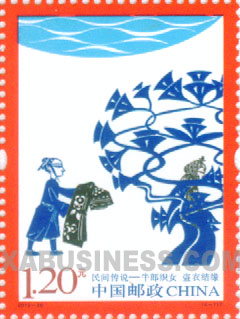
 (4-1), Dress-Linked Affection, 120 fen, 30 * 40 mm
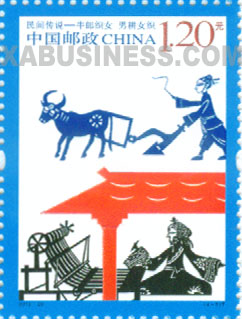 (4-2), Happy Lovers, 120 fen, 30 * 40 mm
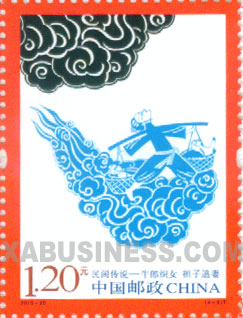 (4-3), Carrying Children to Chase Wife, 120 fen, 30 * 40 mm
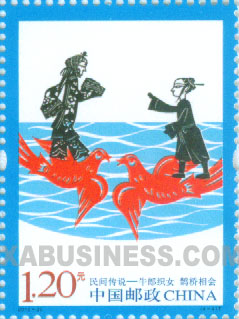 (4-4), Heavenly Reunion, 120 fen, 30 * 40 mm
Technical details
Scott No: -Serial number: 2010-20
Values in set: 4
Denomination: 480 fen
Date of issue: August 16, 2010
Designer: Li Xin
Size of stamp: 30 * 40 mm
Perforation: 13.5
Sheet composition: 20
Size of sheet: 150 * 240 mm
Printing process: photogravure
Printer: Beijing Postage Stamp Printing House
Themes: Culture, Literature,
Background
On August 16, 2010 (the seventh day of the seventh lunar month, Qixi Festival), the special stamp "Folk Tale – The Cowherd and the Weaver Girl" (catalog number 2010-20) was officially issued. The set consists of four stamps, each with a face value of 1.20 yuan, for a total face value of 4.80 yuan, with a stamp booklet (catalog number 41-2010) issued concurrently. The stamps were designed by Li Xin and printed by Beijing Stamp Printing Works using the photogravure process.The legend of the Cowherd and the Weaver Girl is a national intangible cultural heritage and ranks among the four great Chinese folk love stories, along with the tales of Meng Jiangnu, Liang Shanbo and Zhu Yingtai, and the Legend of the White Snake. It is also the cultural origin of the Qixi Festival. Following the narrative arc of the story, the stamps depict four classic scenes: the meeting of the mortal cowherd and the celestial weaver girl, their marriage and life together, their forced separation, and their annual reunion on the Qixi Festival. Within these stamps, the ancient concept of faithful love is presented, the romantic significance of the Qixi Festival is interpreted, and the series of Chinese folk tale stamps is enriched.
Stamp Designs and Historical Background:
Stealing the Garment to Forge a Bond
Image: In a paper-cut style, the scene depicts the cowherd obtaining the weaver girl's celestial garment by the lake, where they first meet.
History: Guided by the old ox, the cowherd takes the weaver girl's garment while she bathes, leading to their initial encounter. This marks the beginning of their love story.
Significance: The iconic moment that begins the romantic fate of the Cowherd and the Weaver Girl.
Plowing and Weaving
Image: On one side, the cowherd plows the field; on the other, the weaver girl weaves at home, presenting a picture of a peaceful family life.
History: After marrying, the couple lives a stable life on earth, raising two children, embodying a simple and warm domestic scene.
Significance: A portrayal of a happy life where husband and wife are together, living in peace and contentment.
Chasing After His Wife
Image: The cowherd carries their two children in a carrying pole, chasing through the clouds, surrounded by layers of mist.
History: Upon learning that the weaver girl has secretly descended to earth, the Queen Mother of the West takes her back to heaven. The old ox, before his death, gives his horn to the cowherd, which transforms into a flying vessel, allowing him to chase after his wife.
Significance: The tragic turning point where the couple is forcibly separated.
Meeting on the Magpie Bridge
Image: Two magpies form a bridge across the Milky Way, with the cowherd and weaver girl on opposite banks, gazing at each other.
History: Their faithful love moves heaven and earth. Every year on the seventh day of the seventh lunar month, a flock of magpies forms a bridge to allow the couple to meet once a year—this is the origin of the Qixi Festival tradition.
Significance: The climax of the legend, expressing the hope for reunion and happiness.
Artistic and Design Features:
Format: Uniform vertical stamp format, using traditional Chinese paper-cut art throughout the set, creating a highly unified style.
Color Design: Each stamp features different border colors (red and blue) to distinguish the mood of each scene. The lines are simple and rustic, with strong folk artistic flavor.
Narrative Structure: The four stamps form a continuous narrative, clearly presenting the complete story.
Release Date: The stamp set was issued on the Qixi Festival, closely linking the legend with traditional seasonal culture.
This stamp set is an important modern issue in the folk tale series. It covers the four great Chinese folk love stories, Qixi Festival customs, and the intangible cultural heritage of traditional paper-cutting. Available in multiple formats, it is often collected together with other folk tale stamps, making it an essential addition to any folk tale thematic collection.
Share: 
Price List
Item location: China
Ships to: Worldwide
*Shipping (via registered air mail) is based on subtotal of order. See detials below.
* 1) for special items shipping and handling cost may be included. 2) Other fast shipping is available.
To special order, please let us know what you are looking for. We will help you to meet your unique interests.
Ships to: Worldwide
*Shipping (via registered air mail) is based on subtotal of order. See detials below.
| Order Subtotal | S & H |
| $0.01---$15.00 | US $5.00 |
| $15.01---$50.00 | US $6.00 |
| $50.01---$100.00 | US $7.00 |
| $100.01---$180.00 | US $8.00 |
| $180.01---over | US $9.00 |
To special order, please let us know what you are looking for. We will help you to meet your unique interests.


