

2010-17 Ancient City of Loulan
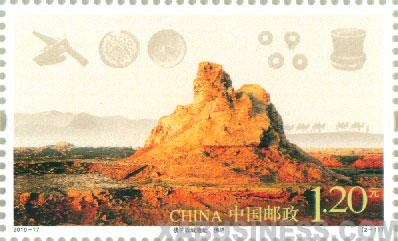
 (2-1), Loulan Monument, 120 fen, 50 * 30 mm
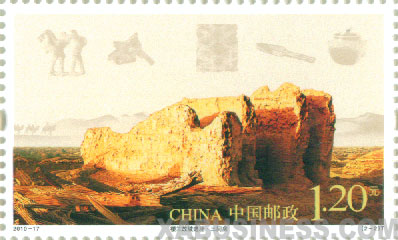 (2-2), Ruins of Loulan, 120 fen, 50 * 30 mm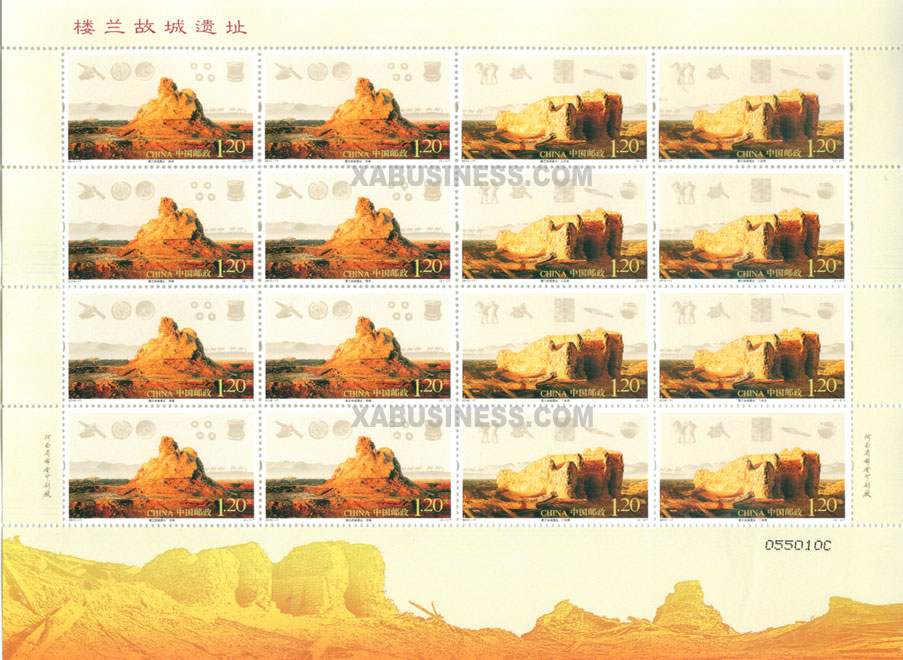

Technical details
Scott No: -Serial number: 2010-17
Values in set: 2
Denomination: 240 fen
Date of issue: July 3, 2010
Designer: Jiang Weijie
Size of stamp: 50 * 30 mm
Perforation: 13
Sheet composition: 16 (8 sets)
Size of sheet: 230 * 170 mm
Printing process: Offset
Printer: Henan Postage Stamp Printing House
Themes: Architecture, Culture,
Background
On July 3, 2010, the special stamp "Ruins of the Ancient City of Loulan" (catalog number 2010-17) was officially issued, marking the 110th anniversary of the discovery of the Loulan ruins. The set consists of two stamps, each with a face value of 1.20 yuan, for a total face value of 2.40 yuan. The stamps were designed by Jiang Weijie, with photography by Yang Hong, and printed by Henan Post and Telecommunications Printing Factory using offset printing.The ruins of the ancient city of Loulan are located on the northwestern shore of Lop Nur in Ruoqiang County, Xinjiang. Listed as a key national cultural heritage site in 1988, Loulan was a world-renowned transportation hub on the ancient Silk Road and the core city of the Loulan Kingdom, one of the 36 kingdoms in the Western Regions during the Western Han Dynasty. The stamps feature two iconic remnants of the ancient city: the Buddhist pagoda and the "Three Rooms," complemented by patterns from artifacts unearthed at the site. Within the stamp space, the ruins of the ancient city in the Gobi Desert are presented, offering a glimpse into the past prosperity of Loulan, showcasing the civilization of the Western Silk Road, and recording the historical imprints of cultural exchange between East and West, while raising public awareness about the preservation of ancient sites in the Northwest and the history of the Silk Road.
Stamp Designs and Historical Background:
Buddhist Pagoda
Image: The main subject is the remaining Buddhist pagoda at the eastern part of the Loulan ruins, with Gobi mountains in the background. The stamp features subtle bas-relief patterns of unearthed artifacts such as bronze mirrors, coins, and wooden objects, with a distant camel caravan in the desert.
History: This pagoda is the most prominent landmark of the Loulan ruins, representing early Buddhist architecture in the Western Regions. During the Wei and Jin dynasties, Buddhism spread to Loulan along the Silk Road, and the pagoda bears witness to the religious and cultural development of the Western Regions, serving as an important cultural landmark for merchants traveling along the route.
Significance: A tangible representation of Loulan's religious culture and Silk Road commercial civilization.
Three Rooms
Image: The main subject is the rammed earth ruins of the "Three Rooms" in the northeastern part of the ancient city, with desert dunes in the background, accompanied by patterns of Kharosthi wooden tablets and pottery artifacts.
History: The "Three Rooms" is a large rammed earth building complex in the city, believed by archaeologists to have been the office of the Western Regions Commandant during the Wei and Jin dynasties. Numerous precious documents and wooden tablets were unearthed here, providing the most important physical evidence for studying Loulan's history.
Significance: Historical evidence of Loulan as a military and administrative center of the Western Regions.
Artistic and Design Features:
Format: Uniform horizontal stamp format, with consistent tones across the two stamps, using warm Gobi yellow to create a vast and desolate atmosphere.
Technique: A combination of actual site photography and subtle artifact patterns, with the site and artifacts complementing each other, balancing visual appeal with historical education.
Atmosphere: Warm sunset light enhances the rammed earth ruins, highlighting the sense of millennia of erosion and the mysterious character of Loulan's history.
Narrative Logic: The pairing of religious remains with administrative buildings provides a comprehensive picture of the diverse functions of the ancient city.
This stamp set is a rare themed issue on the ancient cities of the Western Regions and Silk Road archaeological sites, commemorating the 110th anniversary of the discovery of Loulan. It is characterized by its distinct regional identity. Available in large sheet format, it is suitable for thematic collections on Silk Road culture, Western Regions archaeology, ancient sites, and Xinjiang regional themes, often collected together with other Silk Road-related stamps such as Dunhuang and Kucha.
Share: 
Price List
Item location: China
Ships to: Worldwide
*Shipping (via registered air mail) is based on subtotal of order. See detials below.
* 1) for special items shipping and handling cost may be included. 2) Other fast shipping is available.
To special order, please let us know what you are looking for. We will help you to meet your unique interests.
Ships to: Worldwide
*Shipping (via registered air mail) is based on subtotal of order. See detials below.
| Order Subtotal | S & H |
| $0.01---$15.00 | US $5.00 |
| $15.01---$50.00 | US $6.00 |
| $50.01---$100.00 | US $7.00 |
| $100.01---$180.00 | US $8.00 |
| $180.01---over | US $9.00 |
To special order, please let us know what you are looking for. We will help you to meet your unique interests.


