

2002-4, Scott 3176-80 Ethnic Musical Instruments – Bowed String Instruments

 (5-1), Yaqin, 60 fen, 30*40 mm
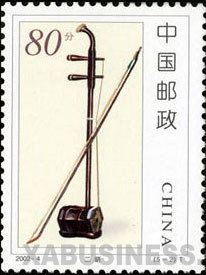 (5-2), Erhu, 80 fen, 30*40 mm
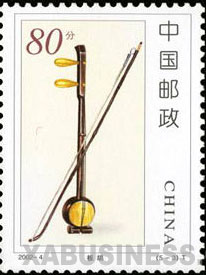 (5-3), Banhu, 80 fen, 30*40 mm
 (5-4), Satar, 80 fen, 30*40 mm
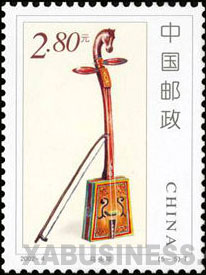 (5-5), Morin Khuur, 280 fen, 30*40 mm
Technical details
Scott No: 3176-80Serial number: 2002-4
Values in set: 5
Denomination: 5.80 yuan
Date of issue:23rd February 2002
Designer: Yin Huili
Size of stamps: 30*40 mm
Perforation:12
Sheet composition: 20
Printing process: offset
Printer: Shenyang Post & Telecommunication Printing Works
Themes: Culture,
Background
The stamp set is cataloged as 2002-4, titled Ethnic Musical Instruments – Bowed String Instruments. It was issued on February 23, 2002. The set consists of five stamps in a photogravure edition printed by Beijing Stamp Printing Works. The designer is Wang Huming. The total face value is 5.8 yuan. Each stamp measures 30×40 mm, with a perforation gauge of 12 degrees. Each sheet contains 20 stamps.Bowed string instruments are an important category in Chinese ethnic instrumental music. They produce sound by drawing a bow across strings. They are widely used among various ethnic groups, both as solo instruments and in opera and ensemble music. This stamp set features five of the most representative bowed string instruments, showcasing China's rich and diverse ethnic music culture.
Stamp Designs and Historical Background
Huqin
Huqin is a general term for Chinese bowed string instruments and the origin of various types of huqin instruments. It was introduced to the Central Plains from the Western Regions in ancient times. Over a thousand years of evolution, it gave rise to many branches, including the erhu, banhu, and jinghu. The stamp presents the traditional form of the huqin, with the neck, sound box, and bow fully depicted. The introduction and development of the huqin promoted changes in ancient Chinese music and played an important role in folk dance and vocal accompaniment for a long time. It is the foundation of the ethnic bowed string instrument system.
Erhu
The erhu is the most widely circulated Han Chinese bowed string instrument and a branch of the huqin family. Its sound box is usually made of wood or bamboo, with one end covered in snake skin. It has two strings and a soft, rich tone with rich expressiveness. The erhu matured in modern times. Famous pieces such as Moon Reflected on Second Spring made this instrument renowned at home and abroad. It can play both deep and sorrowful melodies and lively, passionate tunes. It is a core voice in ethnic orchestras and is widely used among the people.
Banhu
The banhu, also known as the banghu, has a sound box covered with a thin wooden board. Its tone is high-pitched, bright, and highly penetrating. The banhu originated in the late Ming and early Qing dynasties and was first used to accompany northern bangzi opera, which is how it got its name. It is an important accompanying instrument in northern opera and folk dance, serving as the lead instrument in styles such as Qinqiang, Hebei Bangzi, and Shanxi Bangzi. Its passionate and unrestrained tone is full of northern rustic flavor.
Jinghu
The jinghu is the lead instrument of Peking opera. It was created in the Qing Dynasty and was modified from the huqin. Its neck and sound box are short and small, mainly made of bamboo. Its tone is high-pitched, bright, vigorous, and crisp. The jinghu is specifically suited to Peking opera vocal styles and developed alongside Peking opera. It closely coordinates with the singing, recitation, acting, and acrobatics of Peking opera, making it an indispensable part of the art form with distinct operatic characteristics.
Morin Khuur
The morin khuur is a representative bowed string instrument of the Mongolian ethnic group, known in Mongolian as the chuur. The top of the neck is carved with a horse-head shape, and the sound box is covered with horsehide. It has two strings and a vast, deep, desolate, and distant tone. The morin khuur has a long history of grassland heritage and is often used to accompany Mongolian long songs and folk narrative songs. Its music can depict grassland scenery and carries Mongolian nomadic culture. It is a cultural symbol of the grassland ethnic groups.
Artistic and Design Features
The stamps use the photogravure process, delicately reproducing the wood grain and skin textures of the instruments, with antique and elegant colors. The stamps use a vertical format, with each instrument presented individually against a clean, simple background, highlighting the instrument's form. The designs use realistic still-life painting, fully displaying the structural details of the instruments. The uniform, elegant background has no extraneous decoration. The set has a strong series identity, bringing together five bowed string instruments from different regions and ethnic groups into a small format, showcasing the beauty of ethnic instrument design and the depth of musical culture.
Share: 
Price List
Item location: China
Ships to: Worldwide
*Shipping (via registered air mail) is based on subtotal of order. See detials below.
* 1) for special items shipping and handling cost may be included. 2) Other fast shipping is available.
To special order, please let us know what you are looking for. We will help you to meet your unique interests.
Ships to: Worldwide
*Shipping (via registered air mail) is based on subtotal of order. See detials below.
| Order Subtotal | S & H |
| $0.01---$15.00 | US $5.00 |
| $15.01---$50.00 | US $6.00 |
| $50.01---$100.00 | US $7.00 |
| $100.01---$180.00 | US $8.00 |
| $180.01---over | US $9.00 |
To special order, please let us know what you are looking for. We will help you to meet your unique interests.


