

J130, Scott 2042-43 80th Anniv. of Birth of Wang Jiaxiang
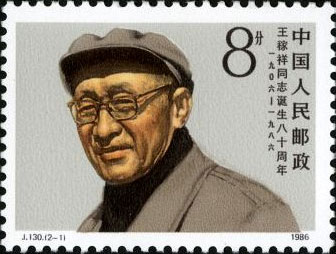
 (2-1), Portrait of Wang Jiaxiang, 8 fen, 40*30 mm
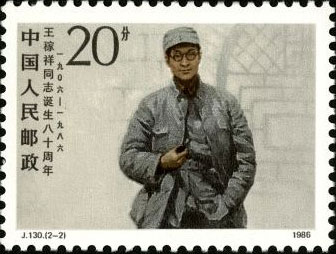 (2-2), Wang Jiaxiang in Yan'an, 20 fen, 40*30 mm
Technical details
Scott No: 2042-43Serial number: J130
Values in set: 2
Date of issue: August 15, 1986
Denomination: 28 fen
Designers: Sun Weimin
Size of stamps: 40*30mm
Perforation: 11*11.5
Sheet composition: 50(5*10)
Printing House: Beijing Postage Stamp Printing Works
Themes: Anniversary, Portraits,
Background
Born in Jing County, Anhui Province, Wang Jiaxiang went to the Soviet Union and studied in the Sun Yat-sen University in Moscow. In 1928, he joined the Communist Party of China in the Soviet Union. He returned home in 1930 and after that he served as Director of the Propaganda Department of the CPC Central Committee, Secretary General of the Committee of Newspapers of the Central Committee of the Party, and Editor in chief of two newspapers, "Red Flag" and "Truth." In 1931, he went to the Revolutionary Base of the Central Committee of the Communist Party and served as member of the Central Bureau of the Soviet Area, and Director General of the General Political Department of the Chinese Workers' and Peasants' Red Army. He was elected member of the Central Executive Commission of the Chinese Soviet Republic, Vice Chairman of the Central Military Commission, Member of the People's Commission in charge of foreign affairs, and Director General of the General Political Department of the Red Army. In 1934, he was elected member of the Central Committee of the CPC, Alternate Member of the Political Bureau of the Central Committee of CPC, and then member of the Political Bureau. In the course of the Long March, he was member the three-person military commanding group of the Central Committee. He served as Representative of the Central Committee of the CPC in the Communist International from 1937 to 1938. In 1938, he returned to Yan'an and served as Vice Chairman of the Central Military Commission, Director General of the General Political Department, President of the Military and Political Institute of the Eighth Route Army, Member of the North East China Bureau of the Central Committee of the CPC, Director General of the Department of Urban Work, and Acting Director General of the Propaganda Department. During this period, he was elected Alternate Member of the Central Committee, and member of the Central Committee. In July 1949, he took part in the delegation of the Central Committee to the Soviet Union, led by Liu Shaoqi to talk on the establishment of embassies. After the founding of the People's Republic, he was the first Ambassador to the Soviet Union (1949-1951) and Minister of the International Liaison Department (1951-1966). During his tenure of the two positions, he took part in the making of many important decisions on foreign affairs by the Central Committee and the State Council. He attended the negotiations and conclusion of the Sino-Soviet Treaty of Friendship, Alliance and Mutual Assistance. He was member of the delegation of the CPC headed by Liu Shaoqi to attend the 19th Congress of the Communist Party of the Soviet Union. In 1953 he concurrently held the position of Chief of the Guiding Committee on the International Activities of the Central Committee of the CPC. In 1954, he attended the Geneva Conference on Korea and Indo-China. He attended the 20th Congress of the Communist Party of the Soviet Union. In 1956, he was elected member of the Central Committee and Secretary General of the Secretariat of the Central Committee of the CPC. At the beginning of the 1960s, based on the domestic and international situations, he put forward four proposals on the adjustment of foreign policies and tactics, i.e. 1) to release a statement to expound accurately and comprehensively that our foreign policies are peaceful; 2) it was necessary to take an approach of relaxation in foreign policy so as to avoid the increase of tension; 3) to pay attention to tactics in the international struggles and keep highly vigilant against schemes to isolate and separate China; and 4) we must take a realistic attitude to foreign assistance so as not to overstrain ourselves.Share: 
Price List
Item location: China
Ships to: Worldwide
*Shipping (via registered air mail) is based on subtotal of order. See detials below.
* 1) for special items shipping and handling cost may be included. 2) Other fast shipping is available.
To special order, please let us know what you are looking for. We will help you to meet your unique interests.
Ships to: Worldwide
*Shipping (via registered air mail) is based on subtotal of order. See detials below.
| Order Subtotal | S & H |
| $0.01---$15.00 | US $5.00 |
| $15.01---$50.00 | US $6.00 |
| $50.01---$100.00 | US $7.00 |
| $100.01---$180.00 | US $8.00 |
| $180.01---over | US $9.00 |
To special order, please let us know what you are looking for. We will help you to meet your unique interests.


