

W7, Scott 967-980 Poems of Chairman Mao
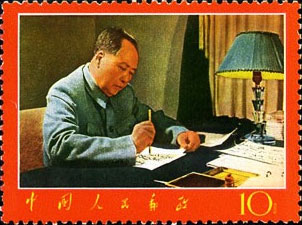
 (14-1), Chairman Mao at Work, 10 fen, 54*40 mm
 (14-2), Spring in a Pleasure Garden — Changsha, 10 fen, 54*40 mm
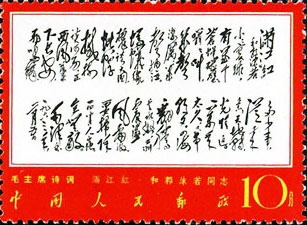 (14-3), The River All Red — Reply to Guo Moruo, 10 fen, 54*40 mm
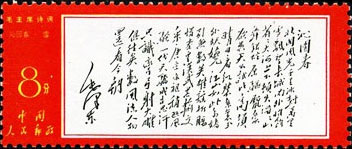 (14-4), Spring in a Pleasure Garden — Snow, 8 fen, 62*26 mm
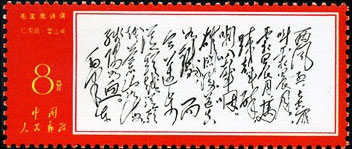 (14-5), Recalling Qin E — Loushan Pass, 8 fen, 62*26 mm
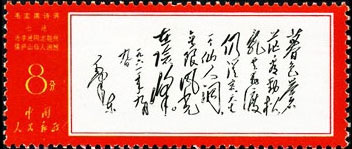 (14-6), A Quatrain: Inscription on a Photograph of the Immortal's Cave on Mount Lu Taken by Comrade Li Jin, 8 fen, 62*26 mm
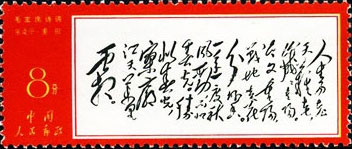 (14-7), Picking Mulberry Seeds — The Double Ninth, 8 fen, 62*26 mm
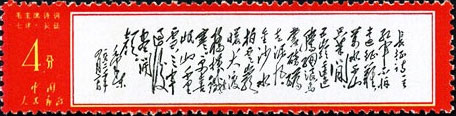 (14-8), The Long March — a Seven-Character Regulated Verse, 4 fen, 81*20 mm
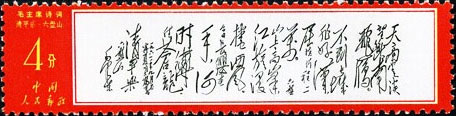 (14-9), Pure Serene Music — Mount Liupan, 4 fen, 81*20 mm
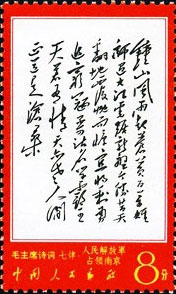 (14-10), The People's Liberation Army Captures Nanjing — a Seven-Character Regulated Verse, 10 fen, 31*52 mm
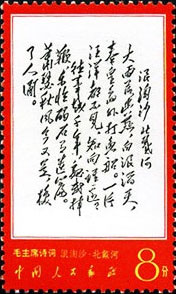 (14-11), Waves Washing the Sand — Beidaihe, 8 fen, 31*52 mm
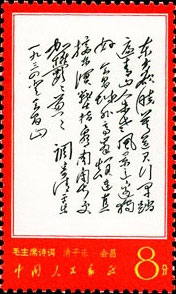 (14-12), Pure Serene Music — Huichang, 8 fen, 31*52 mm
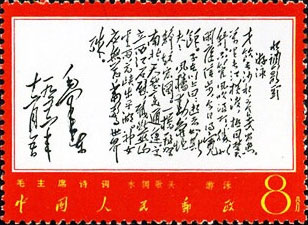 (14-13), Water Melody — Swimming, 8 fen, 54*40 mm
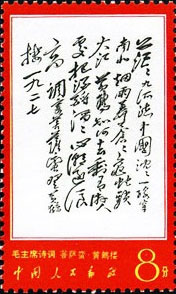 (14-14), Buddhist Dancers — Yellow Crane Tower, 8 fen, 31*52 mm
Technical details
Scott No: 967-980Serial number: W7
Values in set: 14
Date of issue: October 1, 1967
Denomination: 102 fen
Designer: Sun Chuanzhe
Engraver: Kong Shaohui, Sun Hongnian, Gao Pinzhang
Size of stamps:
54*40mm for Value 1, 2, 3, 13;
62*26mm for Value 4, 5, 6, 7;
81*20mm for Value 8, 9;
31*52mm for Value 10, 11, 12, 14;
Perforation:
11 for Value 1, 2, 3, 8, 9, 13;
11.5 for Value 4, 5, 6, 7, 10, 11, 12, 14
Sheet composition:
28(4*7) for Value 1;
35(5*7) for Value 2, 3, 13;
50(5*10) for Value 4, 5, 6, 7;
45(3*15) for Value 8, 9;
50(10*5) for Value 10, 11, 12, 14
Printing process:
Photogravure for Value 1;
Engraving and photogravure for Value 2, 3, 4, 5, 6, 7, 8, 9, 10, 11, 12, 13, 14
Printing House: Beijing Postage Stamp Printing Works
Themes: Art, Mao zedong,
Background
Issued in three batches, on 1 October 1967, 6 October 1967 and 1 May 1968, the set contains fourteen stamps, designed by Sun Chuanzhe, with stamp 1 printed by photogravure and the other thirteen by combined photogravure and engraved recess printing, all produced by Beijing Stamp Factory. Four sizes are used — 54mm × 40mm, 62mm × 26mm, 81mm × 20mm and 31mm × 52mm — with perforations of 11 and 11.5 respectively, and sheet compositions of 28, 35, 50 and 45. Face values are 4 fen, 8 fen and 10 fen, with a total set face value of 1.10 yuan, and print runs of 7 million to 10 million.Main Theme of the Set
Over his long revolutionary career Mao Zedong wrote dozens of classical-style poems. These works are both literary creations and a record of his thinking and mood. From 1967 onward the Ministry of Posts and Telecommunications put the manuscripts of thirteen of these poems onto stamps, opening the set with a photograph of him at work, and issued them in three successive batches. The three batches span almost eight months: stamps 1, 6 and 7 were issued on 1 October 1967, stamps 9 and 12 on 6 October, and the remaining nine on 1 May 1968. The manuscripts brought together in the set range from *Spring in a Pleasure Garden — Changsha* and *Buddhist Dancers — Yellow Crane Tower* of the 1920s to *The River All Red — Reply to Guo Moruo* of the 1960s, a span of nearly forty years, so that a single set of stamps traces a chronological anthology of Mao Zedong's poetry. It is also China's first set of stamps taking the calligraphy of a celebrated hand as the principal subject, with the original calligraphy replacing painting as the core of the design — a precedent in the choice of subject.
Stamp Designs and Historical Context
Chairman Mao at Work
The design is a photograph of Mao Zedong writing at his desk, taken by Lü Houmin in the early hours of 1 July 1958 while he was composing the Two Seven-Character Poems: Farewell to the God of Plague. On 30 June 1958 the *People's Daily* reported that Yujiang County in Jiangxi had become the first county in the country to eliminate schistosomiasis; reading this, he could not sleep, and took up his brush in the early hours of the following morning to write the two poems. The pose of the figure bent over his desk under the lamp, brush in hand and deep in thought, preserves the actual scene of poetic composition on the stamp surface and sets the keynote for the thirteen calligraphy stamps that follow.
Spring in a Pleasure Garden — Changsha
The manuscript was written in 1925, when he revisited Orange Island on the eve of leaving Hunan. "Standing alone in the chill of autumn, as the Xiang flows north past Orange Island" opens with a wide prospect; "I ask the vast earth, who is to decide man's rise and fall?" poses its question to the immensity; "Pointing at the rivers and mountains, stirring up words and letters, treating the marquises of those years as dung" holds all the spirit of youth. The handwriting mixes running and cursive script, the strokes free and expansive and the characters uneven in size, and it is one of the earlier pieces of calligraphy among the thirteen.
The River All Red — Reply to Guo Moruo
The manuscript was written in 1963 in reply to Guo Moruo's *The River All Red*. "This little globe of ours — a few flies are dashing against the wall" opens with a startling image; "The four seas are rising, clouds and waters raging; the five continents are rocking, wind and thunder roaring" spreads the momentum wide. The strokes of the manuscript run into one another with unbroken vigour in the lines, and the latter half grows ever more expansive in its letter forms, making it the most unconstrained in brush intent of all the calligraphies in the set.
Spring in a Pleasure Garden — Snow
The manuscript was written in February 1936 and first published openly in Chongqing in November 1945, to great sensation. "The northern landscape, a thousand li sealed in ice, ten thousand li of drifting snow" opens at once with grandeur; "To count the men of true worth, look to the present" closes with force. The letter forms of the manuscript are broad and generous, the heavy strokes like those cut with a knife and the fine ones like trailing silk, the layout alternating density and openness throughout, and it is the most recognisable piece in the set.
Recalling Qin E — Loushan Pass
The manuscript was written in February 1935, after the battle of Loushan Pass during the Long March. "The west wind is fierce, wild geese call in the vast sky, frost and the morning moon" opens bleakly; "Say not that the strong pass is made of iron, we have crossed it now with steps anew" turns with force and pause. The letter forms of the manuscript are on the lean side, the strokes hastening, matching the austere air of the poem.
A Quatrain: Inscription on a Photograph of the Immortal's Cave on Mount Lu Taken by Comrade Li Jin
The manuscript was inscribed on 9 September 1961 on a photograph of the Immortal's Cave on Mount Lu. "Gazing at the sturdy pine through the gathering dusk, clouds scudding across the sky, still composed" describes the pine and the clouds; "Nature made this Immortal's Cave, and boundless scenery lies on the perilous peak" closes with a striking aphorism. The manuscript is small in scale, the four lines set straight across in a single row, the brush intent unhurried, in keeping with the occasion of the inscription on a photograph.
Picking Mulberry Seeds — The Double Ninth
The manuscript was written in October 1929, during the march in western Fujian. "Man ages easily, but heaven never grows old, year after year the Double Ninth comes round" opens with philosophy entering the verse; "The yellow flowers on the battlefield have a fragrance all their own" shows brightness amid austerity. The characters in the manuscript are closely spaced with rounded strokes, and it is one of the earlier pieces of calligraphy.
The Long March — a Seven-Character Regulated Verse
The manuscript was written in October 1935, as the Long March was nearing its end. "The Red Army fears not the trials of the Long March, holding light ten thousand crags and torrents" opens the whole; "Warm the steep cliffs lapped by the waters of the Jinsha, cold the iron chains spanning the Dadu River" forms a well-wrought antithesis. This stamp uses the narrow, elongated 81mm × 20mm format, with a full sheet of fifteen stamps in three rows, the most slender of the four sizes, exactly accommodating the eight lines of a long poem set out in a single row.
Pure Serene Music — Mount Liupan
The manuscript was written in October 1935, composed while crossing Mount Liupan. "The sky is high, the clouds are pale, we watch the wild geese flying south till they vanish" opens clear and distant; "If we fail to reach the Great Wall we are not men, we who have already counted ten thousand li" speaks with decision; "Today we hold the long cord in our hands, when shall we bind fast the grey dragon?" closes with a question. Like *The Long March* it uses the narrow, elongated format, and the two placed side by side mount to the same effect.
The People's Liberation Army Captures Nanjing — a Seven-Character Regulated Verse
The manuscript was written in April 1949, at the time of the liberation of Nanjing. "A tempest breaks over the Zhong Mountains, a million brave warriors cross the great river" opens with vast force; "We should press home the pursuit of the cornered foe with our remaining courage, and not seek fame by aping the Hegemon of Chu" reasons with penetration. This stamp changes to the vertical 31mm × 52mm format, with a poem set out in several columns, creating a variation of layout from the earlier horizontal elongated strips.
Waves Washing the Sand — Beidaihe
The manuscript was written in the summer of 1954 at the Beidaihe seaside. "Heavy rain falls on the land of Yan, white waves reach the sky" opens with the force of wind and rain; "The rustling autumn wind is again with us today, but the world has changed" closes by drawing out the comparison of past and present. The strokes of the manuscript are weighty and the forms rather flat, and it is one of the representative calligraphies of the period after the founding of the state.
Pure Serene Music — Huichang
The manuscript was written in the summer of 1934 at Huichang in the Central Soviet Area. "The east is about to dawn, do not say you set out early" opens with a sense of movement; "We have tramped all the green hills and are not old, the scenery here is the best of all" turns with brightness. This stamp and *Pure Serene Music — Mount Liupan* share the same tune but belong to different times, and the two short lyrics echo each other within the set.
Water Melody — Swimming
The manuscript was written in June 1956, after swimming the Yangtze at Wuhan. "Just drank the water of Changsha, now I have eaten the fish of Wuchang" opens lightly; "A bridge flies across north and south, and a natural chasm becomes a thoroughfare" records the change worked by construction; "Let us raise a stone wall in the western river, cut off the clouds and rain of Mount Wu, and make a calm lake in the high gorge" conceives a grand prospect. This stamp returns to the horizontal 54mm × 40mm format, and with the largest number of characters its line spacing is pressed comparatively tight.
Buddhist Dancers — Yellow Crane Tower
The manuscript was written in the spring of 1927, at the low ebb of the Great Revolution. "Vast and dim, the nine streams flow through the land of China; heavy and deep, a single line runs through north and south" opens sombrely; "Where has the yellow crane gone? Only the place of visitors remains" closes with anxiety. The set ends with this piece, although in date it is the earliest, so that it joins directly to the opening *Spring in a Pleasure Garden — Changsha* and the whole forms a ring from beginning to end.
Artistic Features of the Design
The most striking formal characteristic of this set is the use of four sizes within a single issue. The poems vary in length and the manuscripts vary in the arrangement of their lines; the designer measured the stamp format against the composition of the original, using long horizontal strips for the long tunes, shorter formats for the short lyrics and vertical formats for the regulated verse, so that four dimensions coexist within one set — something without parallel in the history of Chinese stamps. The thirteen calligraphy stamps all use a red border with black characters on a white ground in the centre: the border is printed by photogravure and the lettering by engraved recess printing, the ink substantial and weighty, the strokes perceptible as raised to the touch, bringing the stamps as close as possible to the appearance of the manuscripts. The engraving was shared among three engravers, Kong Shaohui, Gao Pinzhang and Sun Hongnian, each responsible for a different number of stamps, so that the styles of cutting differ slightly in the details. After photographic reduction, some strokes of the manuscripts ran together into blots of ink and some of the flying passages became too faint, and the designer made minute retouching at each such point before the soaring brushwork could be preserved within the small space. In later assessments the set has been judged to have reached a high standard in design, engraving and printing alike, apart from the red border, which carries the colour of the era and is not altogether in harmony with the mounting conventions of traditional calligraphy. The fourteen stamps left the factory in three batches, making complete sets hard to assemble; and with the low face values and heavy postal consumption, mint copies are of limited survival. Forgery is common on the market, produced by electronic colour separation and multi-colour offset printing, covered with halftone dots under magnification and with blurred lettering, in clear contrast to the firm, powerful quality of the engraved lines of genuine copies.
Share: 
Price List
Item location: China
Ships to: Worldwide
*Shipping (via registered air mail) is based on subtotal of order. See detials below.
* 1) for special items shipping and handling cost may be included. 2) Other fast shipping is available.
To special order, please let us know what you are looking for. We will help you to meet your unique interests.
Ships to: Worldwide
*Shipping (via registered air mail) is based on subtotal of order. See detials below.
| Order Subtotal | S & H |
| $0.01---$15.00 | US $5.00 |
| $15.01---$50.00 | US $6.00 |
| $50.01---$100.00 | US $7.00 |
| $100.01---$180.00 | US $8.00 |
| $180.01---over | US $9.00 |
To special order, please let us know what you are looking for. We will help you to meet your unique interests.


