

2023-18 Kites (3)
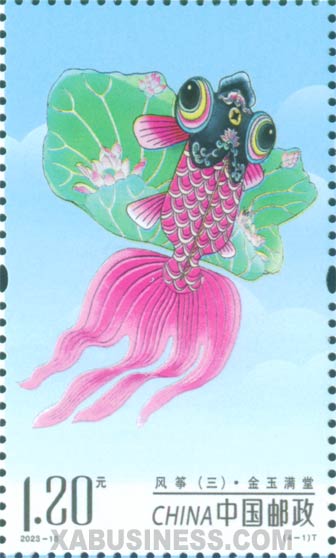
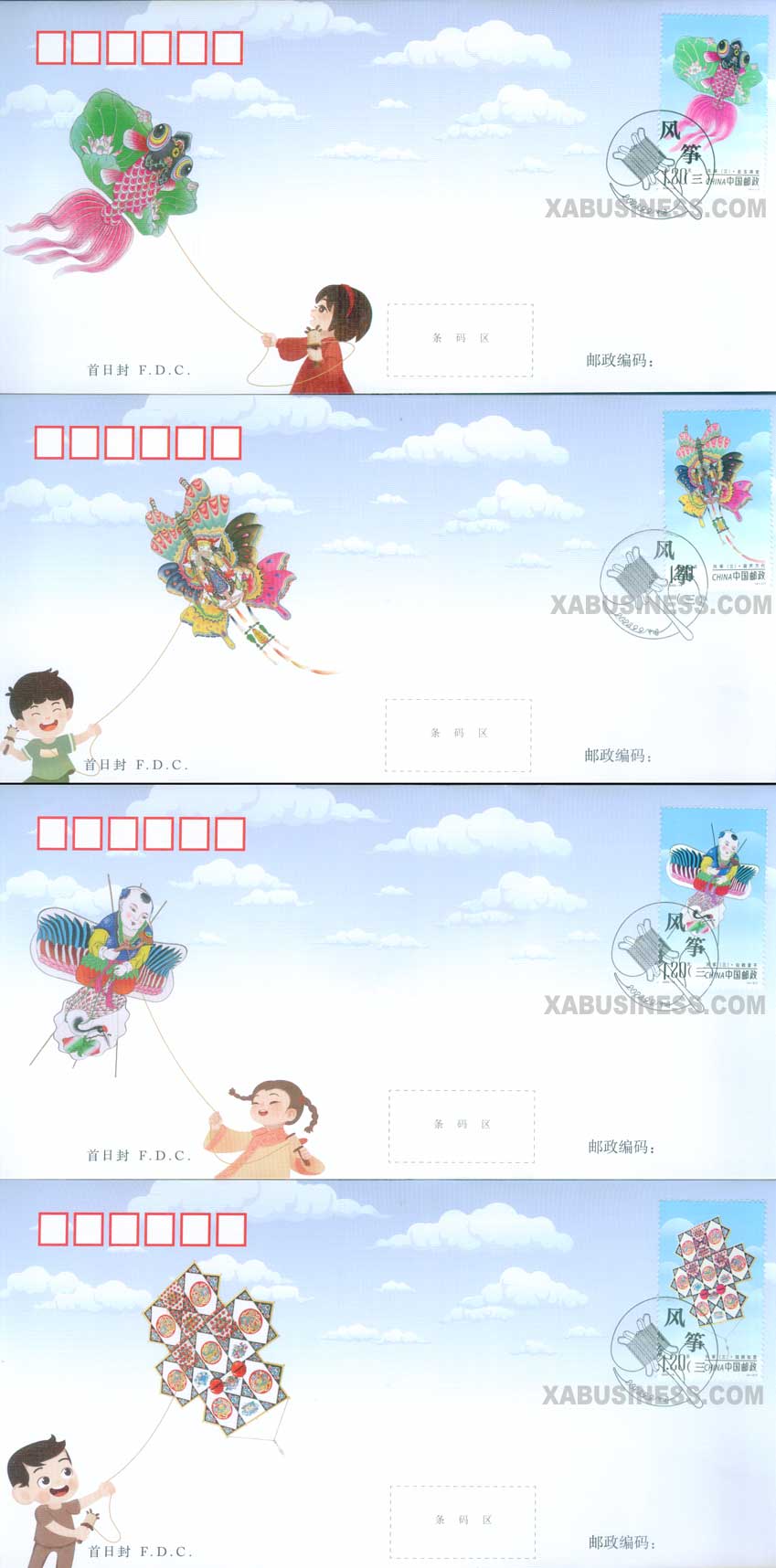
 (4-1), Golden Opulence, 120 fen, 30 * 50 mm
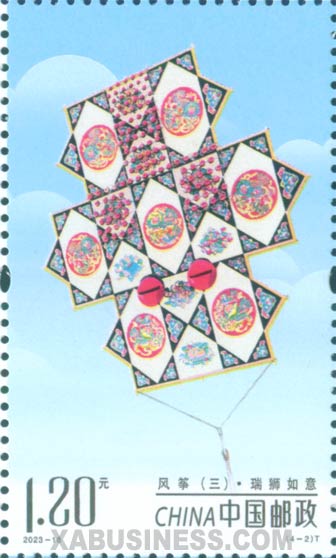 (4-2), Auspicious Lion, 120 fen, 30 * 50 mm
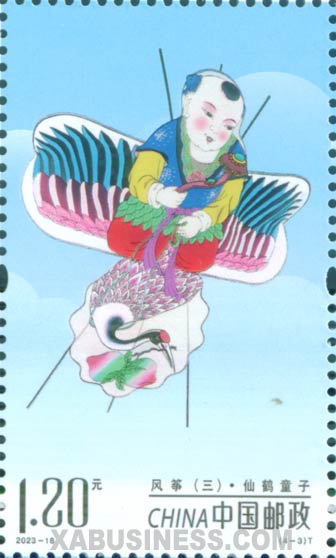 (4-3), Immortal Crane and Child, 120 fen, 30 * 50 mm
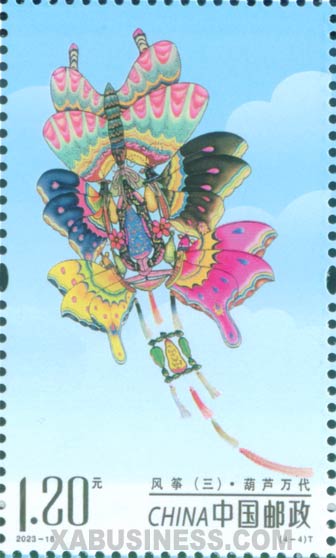 (4-4), Fertile Gourd, 120 fen, 30 * 50 mm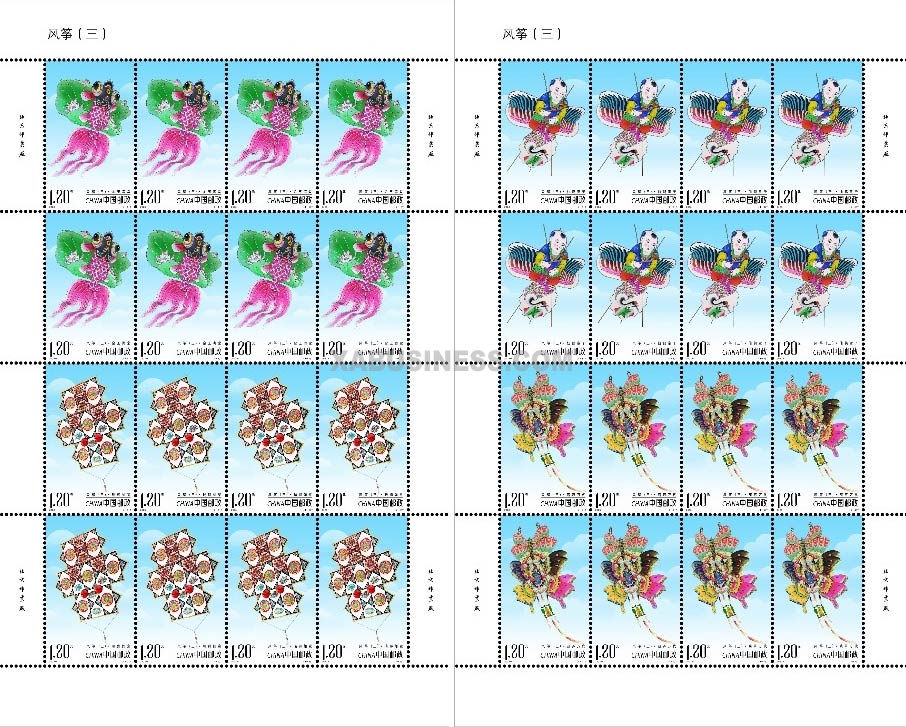

Technical details
Scott No: -Serial number: 2023-18
Values in set: 4
Date of issue: September 9, 2023
Denomination: 480 fen
Designer: Shen Jiahong
Size of stamps: 30 * 50 mm
Perforation: 13.5
Sheet composition: 16
(Value 1,2 in Sheet I;
Value 3, 4 in Sheet II;
Size of sheet: 150 * 240 mm;
Printing process: Photogravure
Printing House: Beijing Postage Stamp Printing Works
Background
China Post is scheduled to issue a set of 4 special stamps themed "Kites (III)" on September 9, 2023. The stamps bear the design titles respectively: Abundance of Gold and Jade, Auspicious Lion & Ruyi Scepter, Crane with a Child, and Gourds for Generations. The total face value of the entire stamp set is 4.80 yuan, with a planned circulation of 6,515,000 sets."The children come home early from school, hurrying to fly kites while the east wind blows." Such a charming scene has been witnessed across China for more than a thousand years. Kites are not only a beloved traditional art form but also an important invention of ancient Chinese people. According to legend, during the Spring and Autumn Period (770–476 BCE), Lu Ban "carved bamboo and wood into the shape of a magpie"—a device that could fly in the air with the help of wind, known as a "wooden kite (mùyuān)". Starting from the Han Dynasty (202 BCE–220 CE), kites were made by binding bamboo strips into frameworks shaped like birds and covering them with paper, hence named "paper kites (zhǐyuān)". The verifiable historical records of kites’ origin date back to the Northern and Southern Dynasties (420–589 CE), giving kites a history of over 1,500 years. By the Tang Dynasty (618–907 CE), kites began to appear in the poems of literati. After the Song Dynasty (960–1279 CE), kites gradually evolved into a toy enjoyed by both young and old, and flying kites during the Qingming Festival (Tomb-Sweeping Day) became a stable and widespread folk activity. Since the Ming Dynasty (1368–1644 CE), kites have spread to all parts of the world via the Silk Road. Joseph Needham, the British scientist, once listed kites as one of the major scientific inventions that the Chinese nation spread to Europe.
Kites integrate art, culture, technology, and sports competition. Exquisitely crafted with profound cultural connotations, kites vary in cultural significance across different regions due to geographical differences.
The first design, Abundance of Gold and Jade, belongs to the "hard-wing kite" category and is one of the representative works of Shandong-style kites. It incorporates folk painting techniques and combines patterns of goldfish and lotus flowers, symbolizing "abundant gold and jade" and "prosperity and good fortune".
The second design, Auspicious Lion & Ruyi Scepter, is a "hard-board kite" and a classic example of southern-style kites from Jiangsu. It features patterns of an auspicious lion and the "Eight Treasures with Ruyi Scepter" (a traditional symbol of good luck). Equipped with several whistle openings of varying sizes made from gourds, moso bamboo, ginkgo nuts, and longans, it preserves the ancient kite characteristic of "sounding strings in the clear sky"—when flying, the whistles emit a harmonious and pleasant sound, implying "auspiciousness, prosperity, and eternal vitality".
The third design, Crane with a Child, is also a "hard-wing kite" and a representative of Shandong-style kites. It depicts a child riding on the back of a crane, holding a maroon lingzhi (ganoderma lucidum, a symbol of longevity), while the crane, with two peach fruits (a symbol of immortality) in its beak, spreads its wings to fly. This pattern symbolizes "auspiciousness and good health".
The fourth design, Gourds for Generations, falls into the "combined soft-wing kite" category and is a masterpiece of Tianjin-style kites. Foldable and detachable for easy carrying, it features patterns of several butterflies hovering around flower clusters, adorned with gourd elements. Gourds (húlu) are homophonic to "blessings (fú)" and "generations (dài)" in Chinese, so this design implies "many children and grandchildren" and "long-lasting happiness".
This set of stamps fully showcases kites as precious folk art with a long history, conveying the beautiful meaning that flying a kite is like releasing one’s ideals and hopes. Designed by Shen Jiahong, the stamps were printed by Beijing Stamp Factory using the photogravure process.
Share: 
Price List
Item location: China
Ships to: Worldwide
*Shipping (via registered air mail) is based on subtotal of order. See detials below.
* 1) for special items shipping and handling cost may be included. 2) Other fast shipping is available.
To special order, please let us know what you are looking for. We will help you to meet your unique interests.
Ships to: Worldwide
*Shipping (via registered air mail) is based on subtotal of order. See detials below.
| Order Subtotal | S & H |
| $0.01---$15.00 | US $5.00 |
| $15.01---$50.00 | US $6.00 |
| $50.01---$100.00 | US $7.00 |
| $100.01---$180.00 | US $8.00 |
| $180.01---over | US $9.00 |
To special order, please let us know what you are looking for. We will help you to meet your unique interests.


