

2013-23 Literators of Ancient China (3rd series)
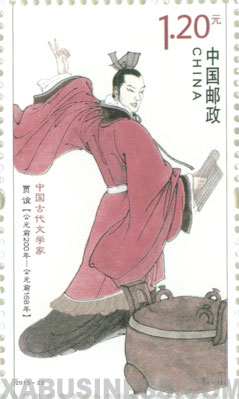
 (4-1), Jia Yi (B.C. 200 - B.C. 168), 120 fen, 30 * 50 mm
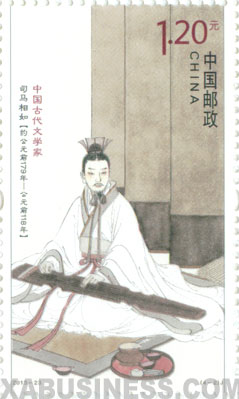 (4-2), Sima Xiangru (B.C. 179 - B.C. 118), 120 fen, 30 * 50 mm
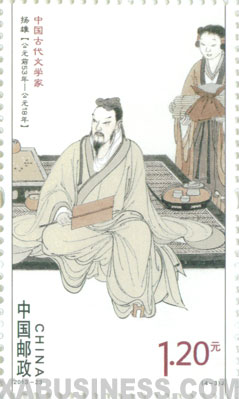 (4-3), Yang Xiong (B.C. 53 - A.C. 18), 120 fen, 30 * 50 mm
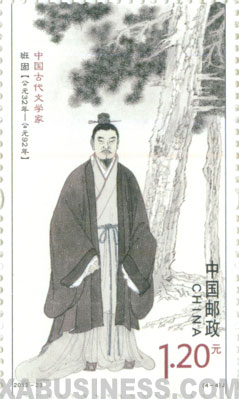 (4-4), Ban Gu (A.C. 32 - A.C. 92), 120 fen, 30 * 50 mm
Technical details
Scott No: -Serial number: 2013-23
Values in set: 4
Date of issue: September 15, 2013
Denomination: 480 fen
Designer: Gao Yun
Size of stamps: 30 * 50 mm
Perforation: 13.5
Sheet composition: 12
Sheet size: 150 * 184 mm
Printing process: Photogravure
Printing House: Beijing Postage Stamp Printing Works
Themes: Portraits,
Background
On September 15, 2013, China Post officially issued the commemorative stamp set "Ancient Chinese Writers (III)" with catalog number 2013-23. The set consists of four stamps. This is the third set in the "Ancient Chinese Writers" series, following the first set (Li Bai, Du Fu, Han Yu, Liu Zongyuan) in 1983 and the second set (Qu Yuan, Sima Qian, Cao Zhi, Tao Yuanming) in 1994. The three sets were issued at intervals of 11 and 19 years respectively, and there has been strong public interest in the continuation of this series.This stamp set focuses on four great masters of Han Dynasty rhapsody (fu): Jia Yi, Sima Xiangru, Yang Xiong, and Ban Gu. They are all representative figures of Han fu, the most iconic literary genre of the Han Dynasty, whose rhapsodies and prose laid an important foundation for classical Chinese literature.
The set comprises four stamps, each with a face value of 1.20 yuan, making a total face value of 4.80 yuan.
The designer, Gao Yun, is a renowned contemporary painter, Deputy Director of the Chinese Painting Art Committee of the China Artists Association, and Vice President of the Chinese Painting Academy. He is one of the few artists appointed as a special stamp designer by the national postal authorities—a distinction shared only with Huang Yongyu, Fan Zeng, and himself. In creating this stamp set, he established a creative principle of "three paintings and three non-paintings": first, depict personality, not just "image"; second, design stamps, not "historical materials"; and third, portray figures, not "historical paintings."
Given the limited stamp size of 30×50 mm, which precludes grand scenes, Gao Yun adopted a traditional, non-realistic approach using the gongbi (meticulous brushwork) technique with rich colors to create "portrait-style" figures. He used posture, color palette, setting, facial features, and props to express the distinct personalities of the writers. The warm brown and black tones create a simple, authentic atmosphere, evoking a sense of historical depth and elegance. Gao Yun aimed for the stamps to be elegantly "bright" and classically "refined." The painting style is more delicate and the colors are richer compared to the previous sets. Gao Yun has stated that creating this set brought him far more contemplation and challenge than his earlier works, offering a valuable opportunity to deeply engage with Han Dynasty culture.
In-depth interpretation of each stamp:
First stamp, "Jia Yi":
Depicts Jia Yi with an expressive, impassioned gesture, reflecting his outspoken and radical personality. Jia Yi (200–168 BCE), a native of Luoyang, was a renowned political essayist and writer of the early Western Han Dynasty. He was known for his exceptional talent and was summoned to the imperial court at the age of 21. He was quickly promoted to Grand Master of the Palace, but was later exiled to serve as tutor to the King of Changsha and later to Prince Huai of Liang due to political intrigue. After the Prince died in a fall, Jia Yi, deeply remorseful, died of grief at the age of 33. His prose works such as "The Faults of Qin" and his rhapsodies "Lament for Qu Yuan" and "The Owl" are masterpieces of political and literary expression.
Second stamp, "Sima Xiangru":
Portrays Sima Xiangru deeply absorbed in playing the qin, evoking his legendary love story with Zhuo Wenjun. Sima Xiangru (c. 179–118 BCE), a native of Anhan in present-day Nanchong, Sichuan, was one of the greatest writers of fu in the Western Han Dynasty. He changed his name in admiration of Lin Xiangru. His rhapsodies "Sir Fantasy" and "Sir Fantasy on the Imperial Park" were highly praised by Emperor Wu, establishing the main themes of Han fu. His diplomatic missions to the southwestern tribes also promoted ethnic unity. His romantic story with Zhuo Wenjun is celebrated as one of the world's greatest love stories. He was revered as the "Master of Rhapsodies" and the "Sage of Fu."
Third stamp, "Yang Xiong":
Shows Yang Xiong sitting side by side, holding a fan, in a serene and contemplative pose, reflecting his quiet and introspective nature. Yang Xiong (53 BCE–18 CE), a native of Chengdu, was a writer, thinker, and one of the four great fu masters of the Western Han. After years of study, he came to the capital and gained official recognition with his rhapsodies. He is regarded as the most renowned fu writer after Sima Xiangru and is sometimes called the "Confucius of the Han Dynasty." His legacy is preserved in the "Ziyun Pavilion" mentioned in Liu Yuxi's famous "Humble Room" inscription.
Fourth stamp, "Ban Gu":
Depicts Ban Gu in a plain, upright stance, embodying the refined, scholarly demeanor of a Confucian intellectual. Ban Gu (32–92 CE), a native of Anling in present-day Xianyang, Shaanxi, was a historian and writer of the Eastern Han Dynasty, often paired with Sima Qian as "Sima-Ban." Born into a scholarly family, he excelled in writing and recitation from childhood. After more than twenty years of labor, he completed the "Book of Han," a monumental work that established the dynastic history format and is counted among the "Four Great Histories" of China. He was also a distinguished fu writer, with his "Rhapsody on the Two Capitals" setting a precedent for city rhapsodies. He also compiled "Comprehensive Discussions in the White Tiger Hall," a compendium of Confucian learning, and pioneered the "Geographical Treatise" in official histories.
From 1983 to 2015, the "Ancient Chinese Writers" series was issued over 32 years, comprising four sets featuring a total of 18 writers spanning from the Warring States period to the Qing Dynasty. The styles vary—from the ethereal elegance of the Tang poets in the first set to the unadorned line drawings of the second set focusing on pre-Qin and Wei-Jin figures, to the rich colors of the third set focused on Han fu, and the larger format of the fourth set featuring Ming-Qing urban literature. Together, they form a condensed literary history of China.
This third set, the only one focusing on Han Dynasty literature, captures the spiritual essence of the four great fu masters on a national "calling card." It serves as a tribute to Han fu and as a vehicle for presenting the profound heritage of traditional Chinese culture to the world.
Share: 
Price List
Item location: China
Ships to: Worldwide
*Shipping (via registered air mail) is based on subtotal of order. See detials below.
* 1) for special items shipping and handling cost may be included. 2) Other fast shipping is available.
To special order, please let us know what you are looking for. We will help you to meet your unique interests.
Ships to: Worldwide
*Shipping (via registered air mail) is based on subtotal of order. See detials below.
| Order Subtotal | S & H |
| $0.01---$15.00 | US $5.00 |
| $15.01---$50.00 | US $6.00 |
| $50.01---$100.00 | US $7.00 |
| $100.01---$180.00 | US $8.00 |
| $180.01---over | US $9.00 |
To special order, please let us know what you are looking for. We will help you to meet your unique interests.


