

2013-22 Nanhua Temple
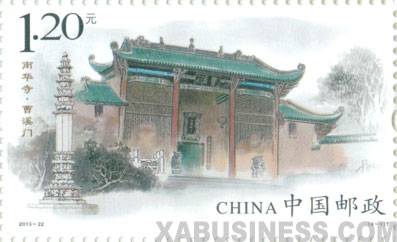
 (4-1), Cao Xi Gate, 120 fen, 50 * 30 mm
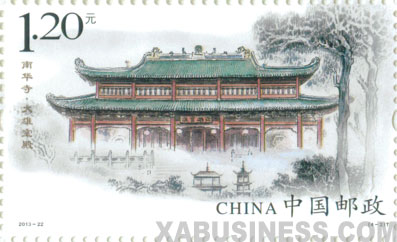 (4-2), Mahavira Hall, 120 fen, 50 * 30 mm
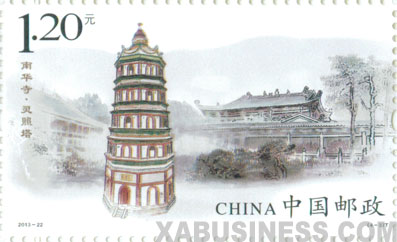 (4-3), Ling Zhao Pagoda, 120 fen, 50 * 30 mm
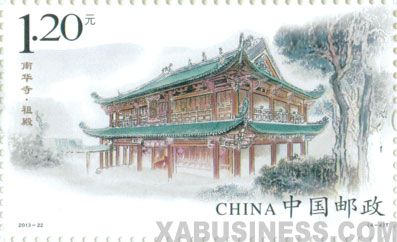 (4-4), Liu Zu Hall, 120 fen, 50 * 30 mm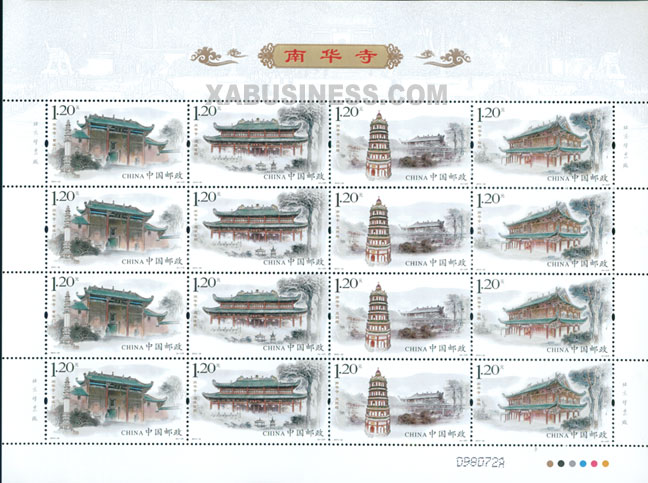

Technical details
Scott No: -Serial number: 2013-22
Values in set: 4
Date of issue: September 7, 2013
Denomination: 480 fen
Designer: Li Qingfa, Li Qun, Jiang Weijie
Size of stamps: 50 * 30 mm
Perforation: 13
Sheet composition: 16 (4 sets)
Sheet size: 230 * 170 mm
Printing process: Photogravure
Printing House: Beijing Postage Stamp Printing Works
Background
On September 7, 2013, China Post officially issued the special stamp set "Nanhua Temple" with catalog number 2013-22. The set consists of four stamps. The release of this stamp set coincided with the 1,300th anniversary of the passing of the Sixth Patriarch of Zen Buddhism, Huineng, and was also an important part of the 2013 Guangdong Zen Patriarch Huineng Culture Festival (Shaoguan) series of events. The first-day issuance ceremony was held that same day at the Caoxi Lecture Hall of Nanhua Temple in Shaoguan, Guangdong. This also marked the first time Nanhua Temple was featured on a "national calling card."The stamp set consists of four stamps: "Caoxi Gate" (1.20 yuan), "Mahavira Hall" (1.20 yuan), "Lingzhao Pagoda" (1.20 yuan), and "Patriarch Hall" (1.20 yuan). Each stamp measures 50×30 mm, with a perforation gauge of 13 degrees. Each sheet contains 16 stamps (four designs printed in a continuous strip, comprising four complete sets), with a sheet size of 230×170 mm. The format is a large sheet, with four factory marks and dot color bars per sheet.
The stamp design is distinctive, employing a continuous four-stamp format. Elements such as "continuous distant mountains, ancient trees, and flourishing incense smoke" organically link the four stamps into a complete picture of an ancient temple. Against a backdrop of ancient cedar and bodhi trees, rendered in the Chinese painting style of ink and light color washes, the composition depicts the temple's halls rising layer upon layer along the mountain, with a well-arranged, balanced, and hierarchical layout, conveying the tranquility, solemnity, and simplicity of Nanhua Temple.
In-depth interpretation of each stamp:
First stamp, "Caoxi Gate": Depicts the imposing view of the first mountain gate of Nanhua Temple, Caoxi Gate. In front of the gate is an open square, with pillars beside it. The gate bears a wooden plaque inscribed with the characters "Caoxi," and a plaque above the gate reads "Nanhua Zen Temple," inscribed by the late Mr. Zhao Puchu. The Caoxi River flows gently from east to west in front of the temple. The name "Caoxi" signifies the origin of Chinese Zen Buddhism. This gate serves as both the entrance to the ancient temple and a window into Zen culture for the world.
Second stamp, "Mahavira Hall": Depicts the grand Mahavira Hall, surrounded by bodhi trees. The Mahavira Hall is the largest temple building in Guangdong Province, first built in 1306 during the Yuan Dynasty, with renovations in the Ming and Qing dynasties and in 1934. Inside, the statues of the Three Buddhas of the Past, Present, and Future are enshrined on the central altar. A clay statue of Guanyin Bodhisattva stands behind them, and clay statues of the 500 Arhats line the walls. The stamp uses the dense foliage of bodhi trees as a foreground, highlighting the majesty and solemnity of the hall.
Third stamp, "Lingzhao Pagoda": Presents the ancient elegance of the Lingzhao Pagoda, with the Patriarch Hall and the Sutra Library in the background. The Lingzhao Pagoda is an octagonal, five-story brick pagoda with eaves and a balcony, the oldest and tallest building at Nanhua Temple. It was originally built in 712–713 AD, during the Tang Dynasty, and was named "Yuanhe Lingzhao Pagoda" by Emperor Xianzong in 812 AD. Originally a wooden pagoda, it was rebuilt several times after being destroyed by fire. During the Chenghua period of the Ming Dynasty, it was rebuilt as a brick pagoda and has remained so to this day. The stamp captures the resilient architectural spirit of this ancient pagoda through the bold lines characteristic of Ming Dynasty architecture.
Fourth stamp, "Patriarch Hall": Depicts the solemn and serene Patriarch Hall, framed by bodhi trees. The temple's most treasured relic—the preserved body of the Sixth Patriarch Huineng—is faintly visible within. In the center of the hall are three pagoda-style niches modeled after Ashoka's pagodas, housing the preserved bodies of Master Dantian of the Ming Dynasty, the Sixth Patriarch Huineng, and Master Hanshan Deqing of the Ming Dynasty. This is the most significant spiritual symbol of Nanhua Temple as the "Ancestral Home of Zen." The stamp uses deep tones and subtle light to create a reverent religious atmosphere.
Background of Nanhua Temple:
Nanhua Temple is located by the Caoxi River, southeast of Maba Town, Qujiang District, Shaoguan City, Guangdong Province. It is nestled against the mountains, facing the water, surrounded by beautiful peaks. The temple was first established in 502 AD during the Liang Dynasty by the Indian monk Zhiyao Sanzang, initially named "Baolin Temple," with a history of over 1,500 years. In 667 AD, the Sixth Patriarch Huineng took up residence at Nanhua Temple, where he propagated and developed Zen Buddhism for 37 years. He established the Southern School of Sudden Enlightenment, making Zen a major mainstream school of Chinese Buddhism. The temple was renamed several times, including "Zhongxing Temple" and "Faquan Temple" during the Tang Dynasty. In 968 AD, the first year of the Kaibao era of the Song Dynasty, Emperor Taizu bestowed the name "Nanhua Zen Temple," which is still used today. The preserved body of Huineng has remained in the temple since his passing. Nanhua Temple is therefore revered by Buddhists as the "Ancestral Home of Zen."
Nanhua Temple is one of China's most famous Buddhist temples and a key national cultural heritage site. In 1983, it was designated by the State Council as one of the first key national Buddhist temples. In 2001, it was listed as a key national cultural heritage site for its Ming and Qing Dynasty architecture. The temple preserves numerous precious artifacts. Behind the temple, near the Zhuo Xi Spring, stand several ancient Chinese swamp cypress trees, which are rare species worldwide.
The Sixth Patriarch Huineng was a renowned ancient Chinese thinker and philosopher, recognized as a cultural figure of world significance. He adapted Buddhism to Chinese culture, making it more accessible and relevant to ordinary people. His famous verse—"Bodhi is not a tree, nor a mirror stand; originally there is nothing, where can dust alight?"—reflects his profound insight. He established a distinctively Chinese Zen Buddhism, which had a major influence on Chinese intellectual history and spread widely to Korea, Japan, and Southeast Asia.
This stamp set, as a "national calling card," encapsulates the profound history of Nanhua Temple and the deep cultural heritage of Zen Buddhism within a small space. It serves both as a commemoration of the 1,300th anniversary of the Sixth Patriarch Huineng's passing and as an important medium for promoting Zen culture to the nation and the world, enhancing Shaoguan's identity as the "Ancestral Home of Zen." This stamp set holds a unique and significant place within the genre of religious-themed stamps.
Share: 
Price List
Item location: China
Ships to: Worldwide
*Shipping (via registered air mail) is based on subtotal of order. See detials below.
* 1) for special items shipping and handling cost may be included. 2) Other fast shipping is available.
To special order, please let us know what you are looking for. We will help you to meet your unique interests.
Ships to: Worldwide
*Shipping (via registered air mail) is based on subtotal of order. See detials below.
| Order Subtotal | S & H |
| $0.01---$15.00 | US $5.00 |
| $15.01---$50.00 | US $6.00 |
| $50.01---$100.00 | US $7.00 |
| $100.01---$180.00 | US $8.00 |
| $180.01---over | US $9.00 |
To special order, please let us know what you are looking for. We will help you to meet your unique interests.


