

2001-4, Scott 3091 National Key Protected Wildlife (Class I) (II)
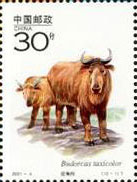
 (10-1), takin (Budorcas taxicolor), 30 fen, 30*40 mm
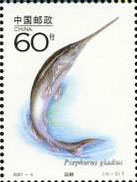 (10-2), white sturgeon (Psephurus gladius), 60 fen, 30*40 mm
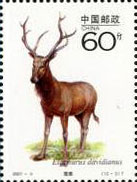 (10-3), P¨¨re david's Deer (Elaphurus davidianus),, 60 fen, 30*40 mm
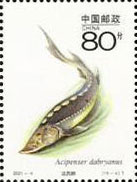 (10-4), Chinese sturgeon (Acipenser dabryanus), 80 fen, 30*40 mm
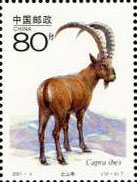 (10-5), ibex (Capra ibex), 80 fen, 30*40 mm
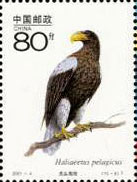 (10-6), tiger-headed sea eagle (Haliaeetus pelagicus), 80 fen, 30*40 mm
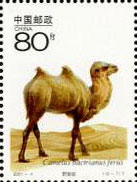 (10-7), wild camel (Camelus bactrianus ferus), 80 fen, 30*40 mm
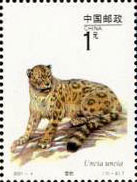 (10-8), snow leopard (Uncia uncia),, 100 fen, 30*40 mm
 (10-9), Sable (Martes zibellina), 260 fen, 30*40 mm
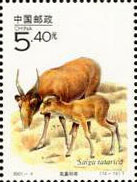 (10-10), Saiga (Saiga tatarica), 540 fen, 30*40 mm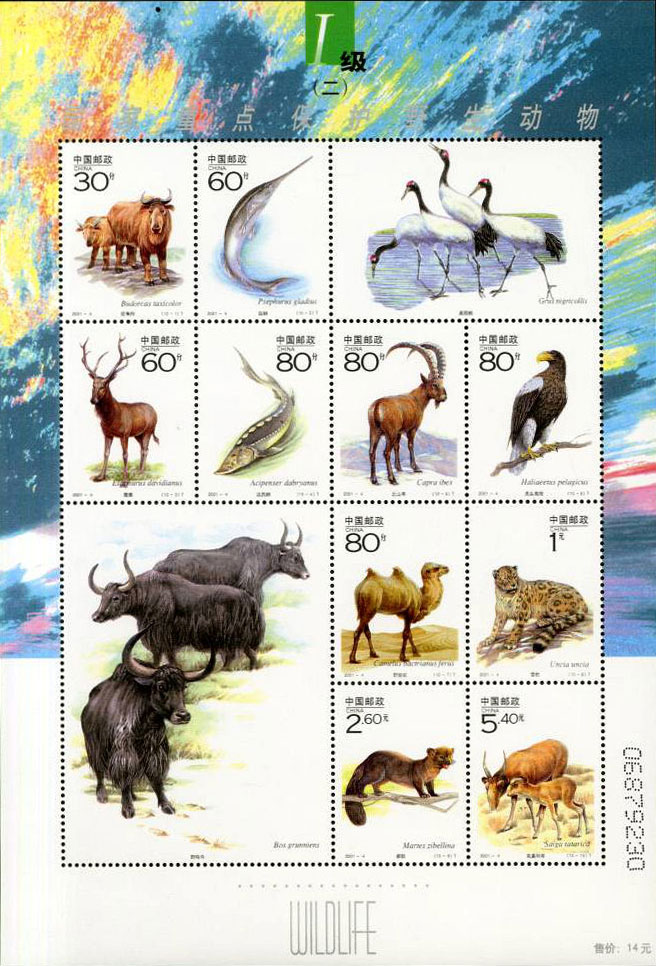

Technical details
Scott No: 3091Serial number: 2001-4
Values in set: 10
Souvenir sheet: 1
Denomination: 1370 fen
Denomination of S/S: 14.00 yuan
Date of issue: 21st April 2001
Designer: Chen Quansheng
Size of stamps: 30*40mm
Size of S/S: 146*213 mm
Printing process: gravure
Printer: Beijing Postage Stamp Printing House
Background
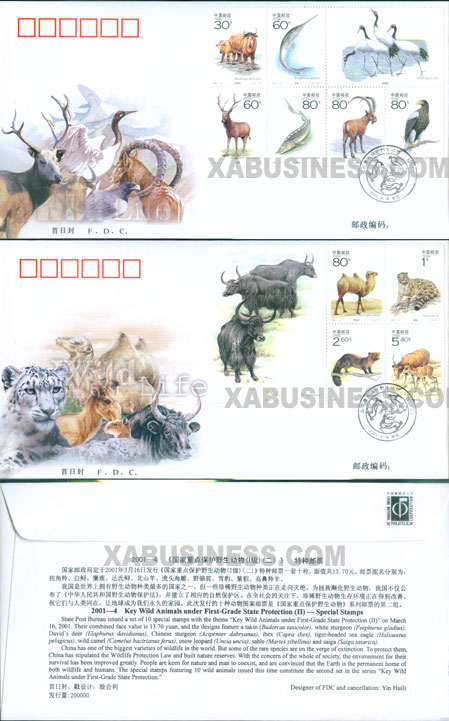
This stamp set, National Key Protected Wildlife (Class I) (II), was issued on March 16, 2001. It is a special stamp set consisting of ten stamps with a total face value of 13.70 yuan. The designers are Feng Xiaohong and Yin Huili. It was printed using photogravure by Beijing Stamp Printing Works. The perforation gauge is 13 degrees, and each stamp measures 30×40 mm. The ten stamps are printed in a continuous strip. The full sheet also includes two valueless bridge labels featuring the black-necked crane and the wild yak.This stamp set is the second group in the national first-class protected wildlife series. It features ten rare and endangered first-class protected wild animal species in China, showcasing their forms through the stamps, promoting wildlife protection concepts, and raising public awareness of the need to protect rare animals and the natural ecological environment.
Stamp Designs and Historical Background
Takin
The takin, also known as the羚牛, inhabits the high-altitude mountain forests of southwestern China. It is a large ungulate. The stamp depicts a takin standing steadily, with a thick golden coat and horns that twist outward. Takins live in herds, feeding on grasses, tender branches, and leaves, and are adapted to cold, high-altitude mountain environments. Once threatened by poaching and habitat fragmentation, their populations have been effectively protected through the establishment of nature reserves. They are a representative species of the mountain ecosystems of southwestern China.
Chinese Paddlefish
The Chinese paddlefish is an ancient, large freshwater fish endemic to the Yangtze River. It is known as the "Chinese swordfish," with a long, sword-like snout. The stamp depicts the paddlefish swimming, with its massive body and protruding snout. The paddlefish survived in the Yangtze for hundreds of millions of years. It was a migratory fish. Overfishing, water conservancy projects blocking migration routes, and water pollution caused its population to decline. It has now been declared extinct, serving as a painful warning for the protection of Yangtze aquatic life.
Milu (Père David's Deer)
The milu, commonly known as the "four不像," has antlers like a deer, a head like a horse, hooves like a cow, and a tail like a donkey. It originally inhabited the marsh wetlands of the middle and lower Yangtze River. The stamp shows a milu standing with its head raised, its branched antlers spreading out. The species once became extinct in the wild in China. The original captive royal herd was lost overseas. Later, through reintroduction projects, it returned to China, and wild populations were reestablished in Dafeng, Jiangsu, and Shishou, Hubei. It is a classic case of species reintroduction and protection in the world.
Dabry's Sturgeon
Dabry's sturgeon, also known as the Yangtze sturgeon, is an ancient sturgeon endemic to the Yangtze River basin. It is a freshwater resident sturgeon that does not undertake long-distance migration. The stamp shows a side view of Dabry's sturgeon in the water, with bony plates on its body. It prefers to feed on aquatic invertebrates on the river bottom. Water conservancy projects altering the hydrological environment and illegal fishing have interrupted its wild reproduction. It is now a critically endangered species and a key target for the protection of rare fish in the Yangtze River.
Ibex
The ibex inhabits the high-altitude bare rock and cliff areas of northwestern China and is skilled at running and climbing on steep rock faces. In the stamp, the ibex stands on a mountain rock, with its huge, curved, saber-like horns making it highly recognizable. The ibex feeds on alpine grasses and shrubs. It was once heavily hunted for its horns. With hunting bans and the establishment of nature reserves, its population has gradually recovered. It is a flagship species of the alpine rock ecosystem.
Steller's Sea Eagle
Steller's sea eagle is a large sea eagle, mainly active along the coastal areas of China's northeastern border and around Sakhalin. It is a large bird of prey. The stamp depicts the robust figure of the Steller's sea eagle, with a golden-brown head and a huge yellow beak. It feeds mainly on fish, as well as small birds and animals, and is highly dependent on coastal wetland ecosystems. Habitat destruction and reduced food sources threaten its survival. It is a globally vulnerable bird of prey.
Wild Bactrian Camel
The wild Bactrian camel is an extremely rare large desert mammal, inhabiting the Gobi deserts of Xinjiang and Gansu in China. In the stamp, the wild camel stands in a desert environment, with its two humps high and its coat thick and rough. It can tolerate extreme drought, surviving on desert vegetation and small amounts of water. Its population is very small. Continued habitat degradation and human disturbance are its main threats. It is a unique flagship species of the desert ecosystem.
Snow Leopard
The snow leopard lives in the high-altitude bare rock and snow mountain areas of the Qinghai-Tibet Plateau and surrounding regions. It is known as the "King of the Snow Mountains." The snow leopard in the stamp has thick, grayish-white long fur, and its thick, long tail helps with balance on rocky cliffs. It preys on alpine ungulates such as blue sheep and is the top predator in the plateau food chain. Once threatened by poaching and human-wildlife conflict, after years of protection, its population in China has stabilized. It is an indicator species of plateau ecological health.
Sable
The sable inhabits the primeval coniferous forests of the Greater and Lesser Khingan Mountains and Changbai Mountains in Northeast China. The stamp shows the sable's nimble and small form, with dark brown-purple fur that is fine and luxurious. The sable is an arboreal carnivore, preying on rodents and small birds and animals. Historically, it was hunted on a large scale for its precious fur, and its wild population plummeted. Deforestation of primeval forests also reduced its living space. It is now strictly protected by law.
Saiga Antelope
The most distinctive feature of the saiga antelope is its enlarged, bulging long nose. It inhabits desert grasslands. The stamp depicts the saiga antelope running with its head raised. The native population in China has become extinct in the wild. It was once distributed in Xinjiang and was hunted疯狂ly because its horns were used as medicine. China has carried out reintroduction and population recovery projects to try to rebuild the native population. It is an important rescue species in China's mammal protection efforts.
Artistic and Design Features
The stamp set uses a realistic watercolor painting style, accurately reproducing the physical characteristics, fur textures, and natural postures of each wild animal. Below each stamp is the species' Chinese name and Latin scientific name. The ten stamps are printed in a miniature sheet format, accompanied by two valueless bridge labels, enriching the layout. The background is simple and elegant, highlighting the main subjects. The colors are realistic and soft, balancing scientific accuracy with visual appeal. Using stamps as a medium to popularize knowledge about rare animals, the set combines educational value with artistic beauty.
Share: 
Price List
Item location: China
Ships to: Worldwide
*Shipping (via registered air mail) is based on subtotal of order. See detials below.
* 1) for special items shipping and handling cost may be included. 2) Other fast shipping is available.
To special order, please let us know what you are looking for. We will help you to meet your unique interests.
Ships to: Worldwide
*Shipping (via registered air mail) is based on subtotal of order. See detials below.
| Order Subtotal | S & H |
| $0.01---$15.00 | US $5.00 |
| $15.01---$50.00 | US $6.00 |
| $50.01---$100.00 | US $7.00 |
| $100.01---$180.00 | US $8.00 |
| $180.01---over | US $9.00 |
To special order, please let us know what you are looking for. We will help you to meet your unique interests.


