

2013-9 Cloisonne Ware
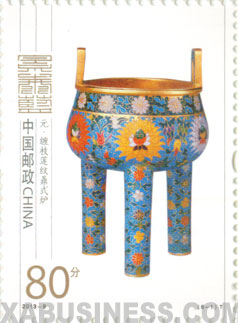
 (6-1), Cloisonne Enamel Branch Lotus Lines Tripod Type Furnace (Yuan Dynasty), 80 fen, 30 * 40 mm
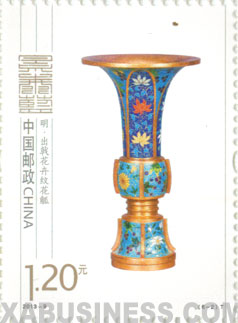 (6-2), Cloisonne Beaker with Floral Pattern and Flanges (Ming Dynasty), 120 fen, 30 * 40 mm
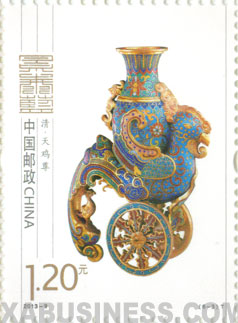 (6-3), Heavenly Fowl Shaped Zun Vessel (Qing Dynasty), 120 fen, 30 * 40 mm
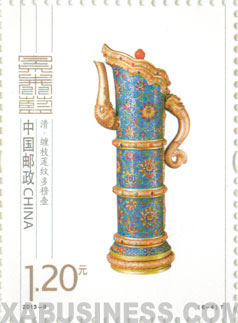 (6-4), Cloisonne Branch Lotus Lines Domou Pot (Qing Dynasty), 120 fen, 30 * 40 mm
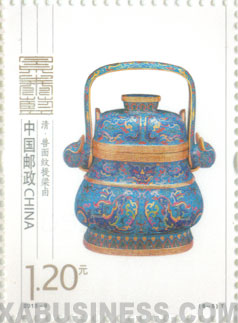 (6-5), Cloisonne Hanging Vase with Beast Mask Pattern, 120 fen, 30 * 40 mm
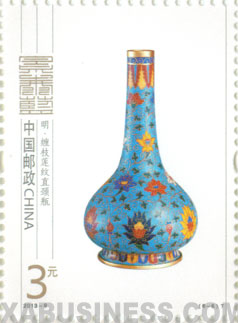 (6-6), Cloisonne Bottle Vase with Long Neck Decorated with Interlocking Lotus Design (Ming Dynasty), 300 fen, 30 * 40 mm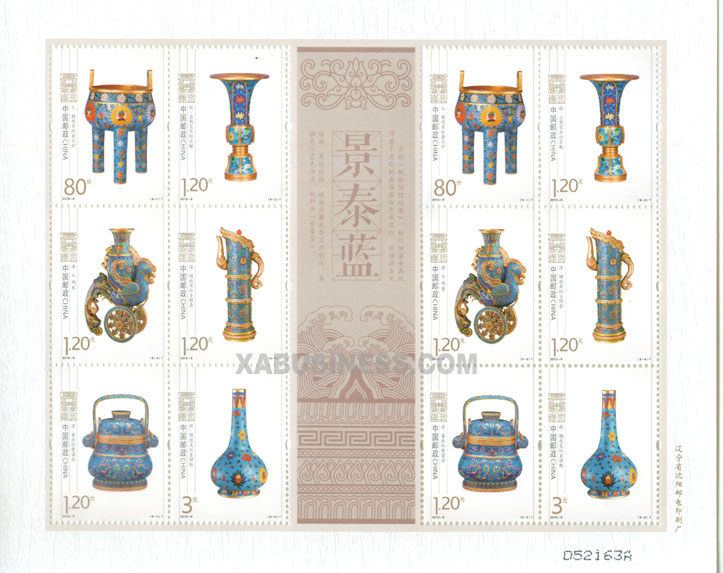

Technical details
Scott No: -Serial number: 2013-9
Values in set: 6
Date of issue: April 21, 2013
Denomination: 860 fen
Designer: Xia Jinqiu
Size of stamps: 30 * 40 mm
Perforation: 13.5
16 for Sheet I;
12 for Sheet II
Size of sheet:
150 * 200 mm for Sheet I;
184 * 150 mm for Sheet II
Printing process: Offset
Printing House: Liaoning Provincal Postage Stamp Printing Works
Background
"Cloisonné" is a set of special stamps issued by China Post on April 21, 2013, with catalog number 2013-9. The set consists of six stamps with a total face value of 8.60 yuan. This is the first time that the national-level intangible cultural heritage of "copper-body filigree enamel" has been systematically presented in a full set of stamps in China.Cloisonné, also known as copper-body filigree enamel, was introduced to China during the Yuan Dynasty and became a royal craft exclusively used by the imperial court during the Ming and Qing dynasties. The production process involves as many as 108 steps, and in ancient times, a craftsman might spend an entire lifetime mastering just one or two of these steps. The final product achieves an artistic effect that is as warm as jade, as lustrous as pearls, as delicate as porcelain, and as brilliant as gold. In 2006, cloisonné craftsmanship was included in the first batch of China's National Intangible Cultural Heritage list. The issuance of this stamp set aims to showcase the unique charm of this traditional craft and to help more people understand this nearly lost imperial art form.
The stamp set was designed by senior stamp designer Xia Jingqiu. The Palace Museum and the Guanfu Museum provided the physical materials for all six cloisonné treasures featured on the stamps. The six stamps feature six representative cloisonné treasures from the Yuan, Ming, and Qing dynasties:
(6-1) Yuan Dynasty: Filigree Enamel Tripod Censer with Interlocking Lotus Pattern
Now housed at the National Palace Museum in Taipei. Dimensions: height 28.4 cm, mouth diameter 17.1 cm. The censer is round, with two upright ears, a bulging belly, and three cylindrical feet, resembling a bronze tripod in form. It is simple and solemn, with a gold-plated copper liner inside. The upper part of the belly is divided into two sections by a gold-plated line: above it, on a green enamel ground, are 12 white chrysanthemum flowers; below it, on a blue enamel ground, are 6 interlocking lotus flowers. The three feet are decorated with multi-colored chrysanthemum flowers on a blue enamel ground. Yuan Dynasty cloisonné often features blooming interlocking lotuses as the main motif, characterized by full, spreading blossoms, thick leaves, and small buds. The composition is spacious, with bold and powerful wirework. The enamel is fine and clean, with a lustrous, crystal-like transparency; colors such as grape purple, grass green, and crimson yellow are particularly striking, suggesting the use of imported enamel materials. This censer is a representative work of Yuan cloisonné.
(6-2) Ming Dynasty: Flower Pattern Vessel with Flanges
The vessel is divided into three sections: a flared mouth, a flanged belly, and a splayed foot. Made with fine craftsmanship and uniform material, its elegant form is adorned with cloisonné enamel decoration. The body features a sky-blue ground with multi-colored interlocking lotus patterns, with a central lotus flower creating strong color contrasts.
(6-3) Qing Dynasty: Heavenly Rooster Vessel
Now housed at the National Palace Museum in Taipei, from the Qianlong period. Dimensions: height 18.9 cm, body length 13.4 cm, mouth diameter 4.5 cm. The heavenly rooster stands upright with its head raised, carrying a chi-dragon-handled vessel on its back. Its wings are raised and pressed against the vessel, its feet stand on openwork double wheels, and its long tail curls inward, with a small gold-plated heavenly rooster standing among the tail feathers. The oval vessel has a flared mouth and gold-plated chi-dragon handles. A cloud-shaped plaque is attached to the chest, with a gold-plated rectangular piece inscribed with "Qianlong Nianzhi" in single-line regular script. Made of red copper, the piece features filigree enamel filling and gold-plated exposed areas. The surface is decorated with feather-like patterns and interlocking lotuses. The heavenly rooster, a mythical bird symbolizing good fortune, was given concrete form during the Qianlong period, when the imperial workshops produced it in various materials, resulting in a visually striking and divinely inspired creation. This cloisonné piece exemplifies the exquisite craftsmanship of Qianlong-era enamel production.
(6-4) Qing Dynasty: Domu Hu Vessel with Interlocking Lotus Pattern
From the Qianlong period. Dimensions: height 53.4 cm, mouth diameter 10.4 cm, base diameter 14 cm. The vessel is cylindrical, with a monk's-cap mouth, dragon-shaped handle and spout, and a coral bead finial on the lid. The gold-plated rim, horizontal bands, and base are set with multi-colored gemstones, creating a dazzling and magnificent appearance. The body is covered with interlocking floral patterns, with flowers of varying sizes arranged in orderly rows. A gold-plated rectangular plaque on the base is inscribed with "Da Qing Qianlong Nianzhi" in regular script. The Domu Hu vessel was used by Mongolian and Tibetan ethnic groups for holding water or butter tea, reflecting strong ethnic characteristics. During the Qing Dynasty, the Manchu also used it to hold milk tea. Various materials—including porcelain, silver, and lacquer—were used to create replicas during the Qianlong period, incorporating Han cultural elements into the decoration, resulting in pieces that are both robust and elegant.
(6-5) Qing Dynasty: Animal-Mask Pattern You Vessel with Loop Handle
Formerly in the collection of the Palace Museum, now housed at the Palace Museum in Beijing. Dimensions: height 26.5 cm, mouth diameter 10.2–13.2 cm. Made by the Enamel Workshop of the Qianlong Imperial Workshops. The you vessel has a flat round belly, with the upper body tapering in and the lower body widening outward. It has a cover, a square loop handle, and a splayed foot. The upper part of the body features a gold-plated key-fret band that separates the neck and belly decoration. The center of the neck features an animal mask flanked by phoenixes; the belly features paired phoenixes in flight. The cover is decorated with four chi-dragon motifs. The interior of the foot is gold-plated and plain, with an engraved four-character, two-line inscription in regular script: "Qianlong Nianzhi." The you is a wine vessel from the Shang Dynasty. This piece is a fine replica of an ancient bronze vessel, with meticulous workmanship that reflects the high level of mid-Qing cloisonné craftsmanship.
(6-6) Ming Dynasty: Straight-Neck Vase with Interlocking Lotus Pattern
From the Xuande period of the Ming Dynasty, formerly in the Qing imperial collection, now housed at the National Palace Museum in Taipei. Dimensions: height 22 cm, mouth diameter 2.9 cm, base diameter 9 cm. The vase has a straight neck, a long neck, a drooping belly, and a ring foot. The body features a light blue enamel ground with interlocking lotus flowers in red, sapphire blue, yellow, and white (tridacna white) enamel. The base is inscribed with "Xuande Nianzhi" in regular script. The vase has a dignified form, with fine, pure-colored enamel.
Most of these treasures are from the collections of the Palace Museums on both sides of the Taiwan Strait. Among them, the Domu Hu vessel incorporates elements from Mongolian and Tibetan ethnic life, complete tracing the development of cloisonné craftsmanship from its introduction in the Yuan Dynasty to its peak in the Qing Dynasty.
The stamps were printed using offset printing with an innovative frequency-modulated ultra-high-line-screen multi-color printing process. Metallic ink was applied as a base layer, with colored inks printed on top, allowing a subtle metallic sheen to show through, precisely replicating the lustrous enamel and rich gold plating of the cloisonné pieces. This brings the enamel works to life on the stamp surface. The stamp set also incorporates four anti-counterfeiting technologies: anti-counterfeiting paper, anti-counterfeiting ink, shaped perforations, and fluorescent spray codes. It was printed by Shenyang Post and Telecommunications Printing Factory in Liaoning Province.
Share: 
Price List
Item location: China
Ships to: Worldwide
*Shipping (via registered air mail) is based on subtotal of order. See detials below.
* 1) for special items shipping and handling cost may be included. 2) Other fast shipping is available.
To special order, please let us know what you are looking for. We will help you to meet your unique interests.
Ships to: Worldwide
*Shipping (via registered air mail) is based on subtotal of order. See detials below.
| Order Subtotal | S & H |
| $0.01---$15.00 | US $5.00 |
| $15.01---$50.00 | US $6.00 |
| $50.01---$100.00 | US $7.00 |
| $100.01---$180.00 | US $8.00 |
| $180.01---over | US $9.00 |
To special order, please let us know what you are looking for. We will help you to meet your unique interests.


