

2011-6 Ancient Chinese Calligraphy - Cursive Script
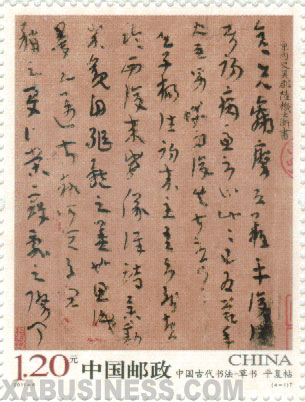
 (4-1), Pingfu Tie by Lu Ji (Jin Dynasty), 120 fen, 38 * 50 mm
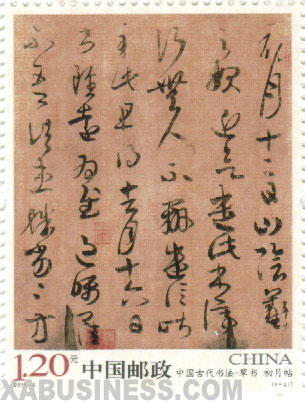 (4-2), Chuyue Tie by Wang Xizhi (Jin), 120 fen, 38 * 50 mm
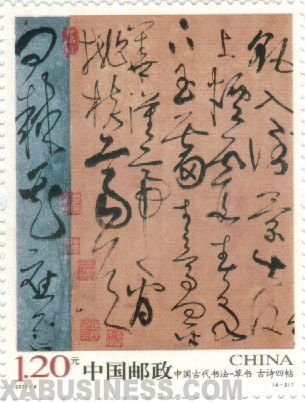 (4-3), Gushi Si Tie by Zhangxu (Tang Dynasty), 120 fen, 38 * 50 mm
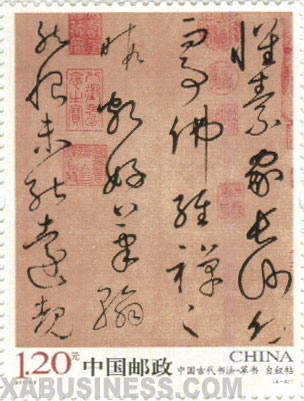 (4-4), Zixu Tie by Huaisu (Tang Dynasty), 120 fen, 38 * 50 mm
Technical details
Scott Number: -Serial number: 2011-6
Values in set: 5
Denomination: 480 fen
Date of issue: April 15, 2011
Size of stamp: 38 * 50 mm
Perforation: 13 * 13.5
Sheet composition: 12 for Value I; 8 for Value II (2 sets, silk paper)
Size of Sheet:
180 * 190 mm for Value I;
210 * 145 mm for Value II
Designer: Wang Huming
Printing process: photogravure
Printer: Henan Postage Stamp Printing House
Background
On April 15, 2011, the special stamp "Ancient Chinese Calligraphy – Cursive Script" (catalog number 2011-6) was officially issued, marking the final set in the "Ancient Chinese Calligraphy" series, following previous issues on seal script, clerical script, regular script, and semi-cursive script. The set consists of four stamps, each with a face value of 1.20 yuan, for a total face value of 4.80 yuan. The stamps were designed by Wang Huming and printed by Beijing Stamp Printing Works using the photogravure process. Calligraphy materials were provided by the Palace Museum and the Liaoning Provincial Museum.The stamps feature four masterpieces of cursive script spanning the Han, Jin, and Tang dynasties, covering the three major cursive script styles: zhangcao (draft script), jincao (modern cursive), and kuangcao (wild cursive). From the earliest surviving literati cursive work, the Pingfu Tie, to Wang Xizhi's modern cursive, and further to the wild cursive of Zhang Xu and Huai Su, the set presents the evolution of cursive script over more than a millennium. It showcases the free-spirited, expressive, and lyrical artistic charm of cursive script, bringing the ancient calligraphy series to a close.
Stamp Designs and Historical Background:
Pingfu Tie (Letter of Pingfu)
Image: The complete ink rubbing of the Pingfu Tie by Lu Ji of the Western Jin Dynasty.
History: Written by Lu Ji over 1,700 years ago, this is the earliest surviving literati calligraphy in China. Written in the archaic zhangcao style, with ancient characters difficult to decipher, it is known as the "ancestor of calligraphy model works." It is now housed in the Palace Museum.
Significance: A masterpiece of zhangcao and a national treasure at the very source of cursive script art.
Chuyue Tie (Letter of Early Moon)
Image: The Chuyue Tie by Wang Xizhi of the Eastern Jin Dynasty.
History: A representative work of Wang Xizhi's modern cursive script, this is a fine Tang Dynasty copy of his work. The brushwork is lively, free, and natural, differing from his semi-cursive style in the Lanting Preface. It is housed in the Liaoning Provincial Museum.
Significance: A landmark work of the mature modern cursive script period and a representative of the "Sage of Calligraphy" Wang Xizhi's cursive style.
Four Poems of Ancient Poetry
Image: A section of the wild cursive scroll Four Poems of Ancient Poetry by Zhang Xu of the Tang Dynasty.
History: Zhang Xu, known as the "Sage of Cursive Script," created a work of bold, flowing brushwork that represents a milestone in the development of wild cursive. The writing is romantic and free, fully expressing the artist's emotions. It is housed in the Liaoning Provincial Museum.
Significance: A foundational masterpiece of wild cursive and the pinnacle of Tang Dynasty romantic calligraphy.
Autobiography
Image: A selected section of the Autobiography scroll by Huai Su of the Tang Dynasty.
History: Huai Su became a monk in childhood and was renowned for his "mad monk" cursive script. The Autobiography features brushwork as swift as the wind, with lines flowing in continuous motion, often called the "number one cursive script under heaven." It is housed in the Palace Museum.
Significance: One of the highest achievements in wild cursive art.
Artistic and Design Features:
Visual Authenticity: Faithfully reproduces the original appearance of the ancient calligraphy, preserving the mottled paper color and the seals of past collectors, maximizing the authentic texture of the ancient works.
Background: Antique light brown xuan paper color evokes the timeless charm of thousand-year-old scrolls.
Series Consistency: Maintains the unified vertical format of the calligraphy series, visually consistent with the seal, clerical, regular, and semi-cursive script issues.
Special Edition: A xuan paper miniature sheet was issued concurrently, using paper that replicates the texture of traditional xuan paper, offering high artistic added value.
This stamp set is the concluding issue of the ancient calligraphy series and is essential for completing the full five-set collection. The subject matter covers calligraphy history, Jin-Tang art, and the transmission of famous calligraphic works. The xuan paper miniature sheet, as a distinctive special edition, has long been highly sought after by collectors of calligraphy-themed stamps. The four works are highly renowned and offer outstanding historical and artistic appreciation value, making this a classic issue in the classical painting and calligraphy thematic stamp category.
Share: 
Price List
Item location: China
Ships to: Worldwide
*Shipping (via registered air mail) is based on subtotal of order. See detials below.
* 1) for special items shipping and handling cost may be included. 2) Other fast shipping is available.
To special order, please let us know what you are looking for. We will help you to meet your unique interests.
Ships to: Worldwide
*Shipping (via registered air mail) is based on subtotal of order. See detials below.
| Order Subtotal | S & H |
| $0.01---$15.00 | US $5.00 |
| $15.01---$50.00 | US $6.00 |
| $50.01---$100.00 | US $7.00 |
| $100.01---$180.00 | US $8.00 |
| $180.01---over | US $9.00 |
To special order, please let us know what you are looking for. We will help you to meet your unique interests.


