

2010-9 Stories of Idioms (II)
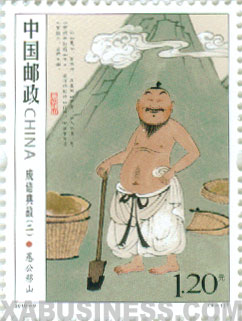
 (4-1), The old man moves a mountain, 120 fen, 30 * 40 mm
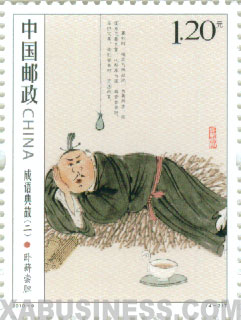 (4-2), Sleeping on brushwood and tasting gall, 120 fen, 30 * 40 mm
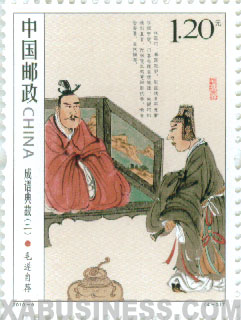 (4-3), Mao Sui recommending himself, 120 fen, 30 * 40 mm
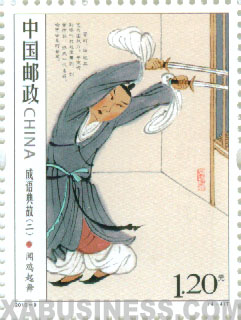 (4-4), Rising Up upon Hearing the Crow of a Rooster to Practise Sword Playing, 120 fen, 30 * 40 mm
Technical details
Scott No: -Serial number: 2010-9
Values in set: 4
Denomination: 480 fen
Date of issue: April 18, 2010
Designer: Xue Lele
Size of stamps: 30 * 40 mm
Perforation: 13.5
Sheet composition: 16
Sheet Size: 146 * 200 mm
Printing process: gravure
Printer: Beijing Postage Stamp Printing House
Themes: Culture, Literature,
Background
On April 18, 2010, the special stamp "Chinese Idioms and Allusions (II)" (catalog number 2010-9) was officially issued, as a continuation of the 2004-5 "Chinese Idioms and Allusions (I)" series. The set consists of four stamps, each with a face value of 1.20 yuan, for a total face value of 4.80 yuan. The stamps were designed by Xu Lele and printed by Beijing Stamp Printing Works using the photogravure process.Idioms are treasures of the Chinese language, embodying historical stories and traditional spiritual values. This stamp set features four widely known classic historical idioms that are rich in inspirational spirit: "The Foolish Old Man Removes the Mountains," "Sleeping on Brushwood and Tasting Gall," "Mao Sui Recommends Himself," and "Rising at the Rooster's Call." Through these miniature images, the stamps recreate the scenes of these stories, conveying the traditional virtues of perseverance, resilience in adversity, courage to take responsibility, and diligent self-discipline. Through these stamps, historical allusions are popularized, Chinese literary and cultural heritage is preserved, and the series of idiom-themed stamps is enriched.
Stamp Designs and Historical Background:
The Foolish Old Man Removes the Mountains
Image: The Foolish Old Man stands holding a hoe in front of the Taihang and Wangwu mountains, with baskets and tools in the background.
History: This allusion comes from the Liezi (Book of Master Lie), telling the story of the Foolish Old Man of North Mountain who resolved to level the mountains, persisting for generations until his determination moved the heavens. It signifies perseverance, fearlessness in the face of difficulty, and sustained effort.
Significance: A classic parable demonstrating the spirit of perseverance and determination.
Sleeping on Brushwood and Tasting Gall
Image: King Goujian of Yue lies on brushwood, holding a gall bladder, with a resilient and determined expression.
History: Based on the historical rivalry between Wu and Yue during the Spring and Autumn period. After defeat, King Goujian endured hardships and worked diligently to restore his kingdom. It symbolizes perseverance in adversity and determination for self-strengthening.
Significance: A highly representative inspirational historical allusion from the Spring and Autumn period.
Mao Sui Recommends Himself
Image: Mao Sui conversing with Lord Pingyuan, recreating the scene of a court strategy session.
History: From the Records of the Grand Historian. When the Qin army besieged Zhao, Mao Sui volunteered to accompany Lord Pingyuan on a diplomatic mission to Chu, successfully securing an alliance through his courage. This idiom means to take the initiative and step forward in times of need.
Significance: A classic idiom advocating self-confidence and a sense of responsibility.
Rising at the Rooster's Call
Image: Zu Ti practicing swordsmanship at dawn, with a dynamic and vigorous pose.
History: Based on the story of Zu Ti and Liu Kun from the Eastern Jin Dynasty, who encouraged each other and rose to practice martial arts at the rooster's call, aspiring to serve their country. It represents diligent study and a sense of patriotism.
Significance: An ancient story encouraging diligence and self-discipline.
Artistic and Design Features:
Format: Uniform vertical stamp format with consistent compositions across the four stamps, forming a coordinated series.
Artistic Style: The artist Xu Lele employs a unique literati freehand figure painting style, with slightly exaggerated forms and simple, elegant brushwork, retaining the charm of traditional Chinese painting.
Layout: Each stamp features the main figure with minimal environmental details, accompanied by a brief textual explanation of the idiom, combining visual appeal with educational value.
Series Continuity: This set continues the style of the first group, jointly building a thematic system for idiom culture stamps.
This stamp set is an important continuation of the idiom and allusion thematic issue, covering ancient history, traditional literature, Chinese culture, and inspirational stories. The four stamps all feature popular classic stories with strong artistic recognition, making them suitable for thematic collections on Chinese cultural education, historical allusions, and figure painting.
Share: 
Price List
Item location: China
Ships to: Worldwide
*Shipping (via registered air mail) is based on subtotal of order. See detials below.
* 1) for special items shipping and handling cost may be included. 2) Other fast shipping is available.
To special order, please let us know what you are looking for. We will help you to meet your unique interests.
Ships to: Worldwide
*Shipping (via registered air mail) is based on subtotal of order. See detials below.
| Order Subtotal | S & H |
| $0.01---$15.00 | US $5.00 |
| $15.01---$50.00 | US $6.00 |
| $50.01---$100.00 | US $7.00 |
| $100.01---$180.00 | US $8.00 |
| $180.01---over | US $9.00 |
To special order, please let us know what you are looking for. We will help you to meet your unique interests.


