

2010-11 Ancient Chinese Calligraphy - Running Script
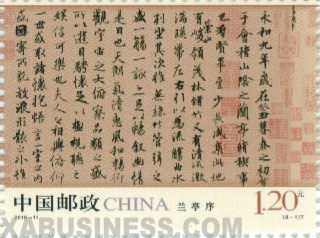
 (6-1), Preface to the Orchid Pavilion, 120 fen, 30 * 40 mm
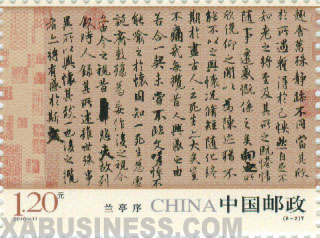 (6-2), Preface to the Orchid Pavilion, 120 fen, 30 * 40 mm
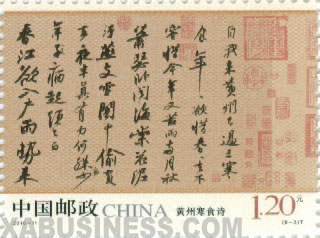 (6-3), Poems Composed during the Cold Food Festival in Huangzhou, 120 fen, 30 * 40 mm
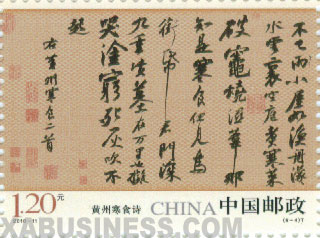 (6-4), Poems Composed during the Cold Food Festival in Huangzhou, 120 fen, 30 * 40 mm
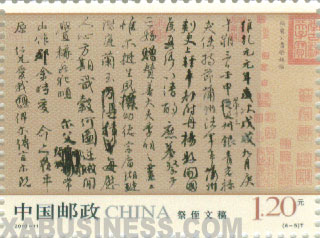 (6-5), Elegiac Lament for My Nephew, 120 fen, 30 * 40 mm
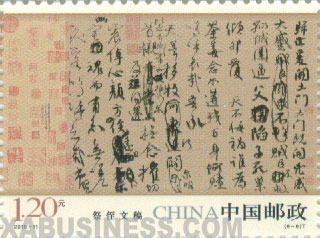 (6-6), Elegiac Lament for My Nephew, 120 fen, 30 * 40 mm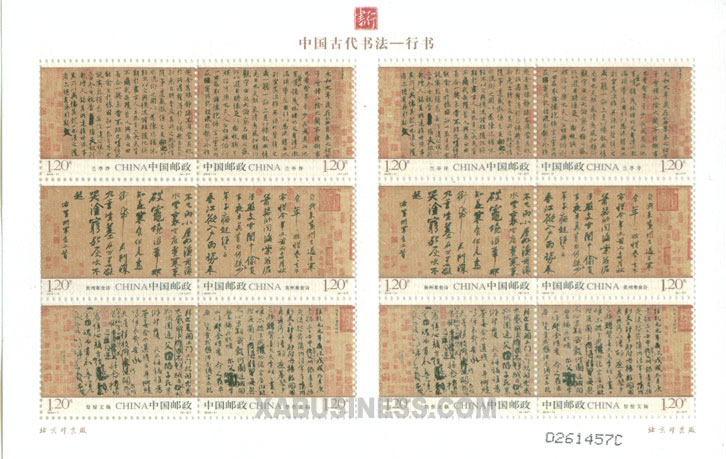

Technical details
Scott No: -Serial number: 2010-11
Values in set: 6
Denomination: 720 fen
Date of issue: May 15, 2010
Designer: Wang Huming
Size of stamp: 40 * 30 mm
Perforation: 13 * 13.5
Sheet composition:
16 for Sheet I;
12 for Sheet II ( rice paper )
Size of sheet:
186 * 160 mm for Sheet I;
186 * 120 mm for Sheet II
Printing process: gravure
Printer: Beijing Postage Stamp Printing House
Background
On May 15, 2010, the special stamp "Ancient Chinese Calligraphy – Running Script" (catalog number 2010-11) was officially issued. The set consists of six stamps, each with a face value of 1.20 yuan, for a total face value of 7.20 yuan. The stamps were designed by Wang Huming, with materials provided by the Palace Museum, and printed by Beijing Stamp Printing Works using the photogravure process.This set is the fourth in China Post's "Ancient Chinese Calligraphy" series, following seal script, clerical script, and regular script, showcasing the art of running script. The stamps feature the three famous "Top Running Scripts" in calligraphy history: Wang Xizhi's Preface to the Orchid Pavilion, Su Shi's Poems on the Cold Food Festival in Huangzhou, and Yan Zhenqing's Manuscript for the Memorial to My Nephew. Each masterpiece is presented in two consecutive detail sections. Running script, positioned between regular script and cursive script, combines writing efficiency with artistic beauty. This stamp set reproduces the different characteristics of these three great running scripts, presenting the diverse artistic charm of Chinese running script and preserving the cultural heritage of Chinese calligraphy.
Stamp Designs and Historical Background:
Preface to the Orchid Pavilion (Detail)
Image: The opening passage of the Preface to the Orchid Pavilion, describing the gathering at the Orchid Pavilion.
History: Wang Xizhi's Preface to the Orchid Pavilion of the Eastern Jin Dynasty is known as the "Top Running Script in the World." It was written during a gathering of literati at the Orchid Pavilion, with elegant and flowing brushwork, embodying the graceful spirit of "Wu's Wind-blown Sleeves."
Significance: The ultimate model of running script art.
Preface to the Orchid Pavilion (Detail)
Image: The latter part of the Preface to the Orchid Pavilion, expressing reflections on life.
History: The text is beautiful, with varied brushwork in weight and density, making it the most important model for learning running script.
Significance: Continues the opening, presenting the complete context of the Preface to the Orchid Pavilion.
Poems on the Cold Food Festival in Huangzhou (Detail)
Image: The first half of Su Shi's Poems on the Cold Food Festival in Huangzhou.
History: Written by Su Shi during his exile in Huangzhou in the Northern Song Dynasty, expressing his desolate feelings. It is known as the "Third Top Running Script in the World," with spontaneous and varied brushwork.
Significance: A classic representative of expressive literati running script.
Poems on the Cold Food Festival in Huangzhou (Detail)
Image: The latter half of the poem, with characters of varying sizes, presenting an escalating emotional intensity.
History: The calligraphy changes with the emotional flow, breaking away from conventional structure, pioneering the "Shang Yi" (advocating personal expression) style of the Song Dynasty.
Significance: A direct expression of the innovative style of Song Dynasty running script.
Manuscript for the Memorial to My Nephew (Detail)
Image: The opening section of Yan Zhenqing's Manuscript for the Memorial to My Nephew.
History: During the An Lushan Rebellion, Yan Zhenqing wrote this manuscript in grief and anger to mourn his nephew Yan Jiming, who died in battle. It is revered as the "Second Top Running Script in the World."
Significance: A masterpiece of calligraphy expressing genuine emotion.
Manuscript for the Memorial to My Nephew (Detail)
Image: The latter part of the manuscript, with visible corrections and erasures, conveying grief and indignation.
History: Writing freely without concern for technique, using calligraphy to express sorrow, achieving a state of unity between the calligrapher and the work.
Significance: The pinnacle of emotionally charged calligraphy.
Artistic and Design Features:
Format: Horizontal stamp format, with the three works presented in pairs, allowing for viewing of continuous passages when combined.
Color: Faithfully reproduces the beige tone of ancient paper, preserving original seals and corrections, accurately recreating the original appearance.
Technical Highlight: The introduction of a Xuan paper miniature sheet, a significant innovation in stamp production, where the texture of Xuan paper naturally complements the ancient calligraphy.
Stylistic Contrast: The three works present distinct styles: Wang Xizhi's elegance, Su Shi's spontaneity, and Yan Zhenqing's grief, creating a rich artistic comparison.
This stamp set is a core issue in the ancient calligraphy series, bringing together the three top running scripts. It covers traditional calligraphy, literary and artistic history, and ancient inscriptions. Available in both regular sheets and the scarce Xuan paper miniature sheet, the latter is a landmark innovation in stamp history. Together with the seal script, clerical script, and regular script stamps, it forms a complete ancient calligraphy collection, making it an essential item for thematic collections on ancient calligraphy.
Share: 
Price List
Item location: China
Ships to: Worldwide
*Shipping (via registered air mail) is based on subtotal of order. See detials below.
* 1) for special items shipping and handling cost may be included. 2) Other fast shipping is available.
To special order, please let us know what you are looking for. We will help you to meet your unique interests.
Ships to: Worldwide
*Shipping (via registered air mail) is based on subtotal of order. See detials below.
| Order Subtotal | S & H |
| $0.01---$15.00 | US $5.00 |
| $15.01---$50.00 | US $6.00 |
| $50.01---$100.00 | US $7.00 |
| $100.01---$180.00 | US $8.00 |
| $180.01---over | US $9.00 |
To special order, please let us know what you are looking for. We will help you to meet your unique interests.


