

2001-22, Scott 3145 The Six Steeds at the Zhaoling Mausoleum
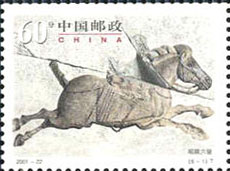
 (6-1), Shifachi, 60 fen, 40*30 mm
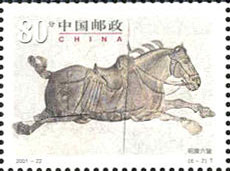 (6-2), Qingzhui, 80 fen, 40*30 mm
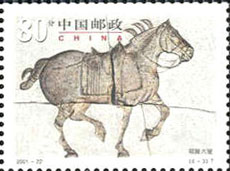 (6-3), Teqinbiao, 80 fen, 40*30 mm
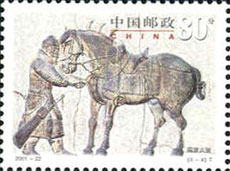 (6-4), Saluzi, 80 fen, 40*30 mm
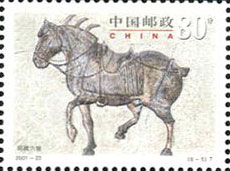 (6-5), Quanmaogua, 80 fen, 40*30 mm
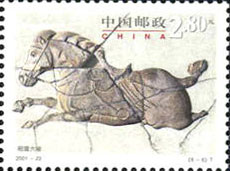 (6-6), Baitiwu, 280 fen, 40*30 mm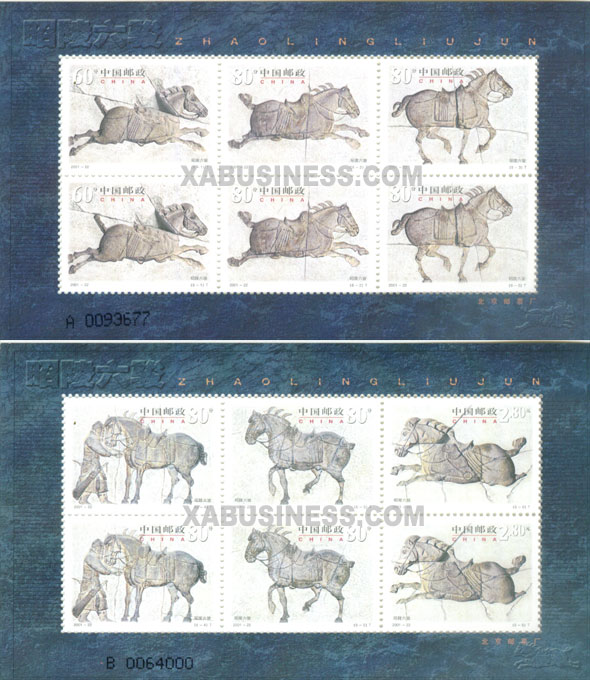

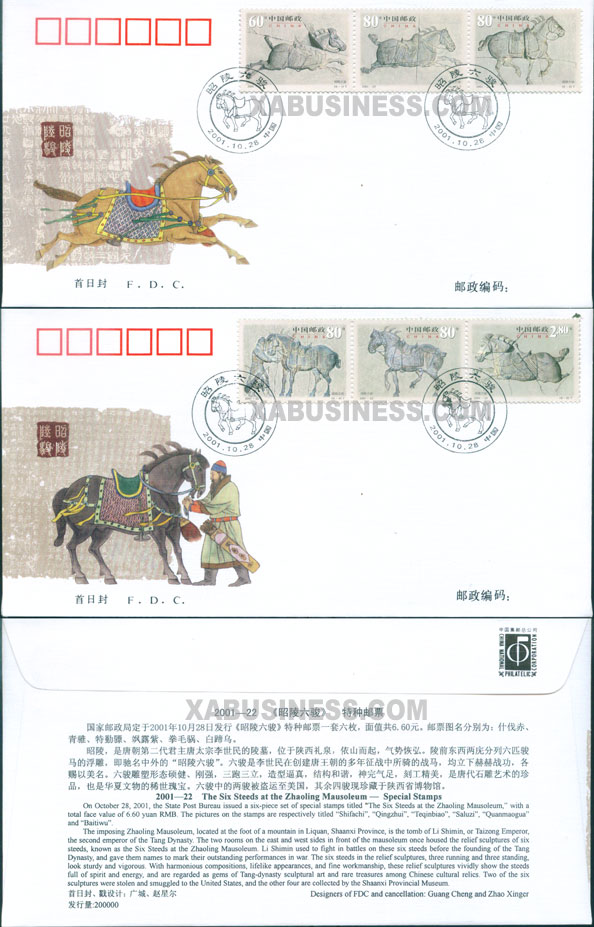
Technical details
Scott No: 3145Serial number: 2001-22
Values in set: 6
Denomination: 6.60 yuan
Date of issue: 28th October 2001
Designer: Wang Huming
Size of stamps: 40*30 mm
Perforation:12
Sheet composition: 24
Printing process: gravure
Printer: Beijing Postage Stamp Printing House
Background
This stamp set, The Six Steeds of Zhaoling, was issued on October 28, 2001. It is a special stamp set consisting of six stamps with a total face value of 4.40 yuan. The designer is Wang Huming. It was printed using photogravure by Beijing Stamp Printing Works. The perforation gauge is 12 degrees, and each stamp measures 40×30 mm. The set is printed in a horizontal continuous format of six stamps.This stamp set features six Tang Dynasty limestone relief sculptures of warhorses from the Zhaoling Mausoleum of Emperor Taizong of Tang. It reproduces the majestic style of early Tang stone carving, commemorates the six meritorious warhorses that accompanied Li Shimin on battlefields, showcases the superb relief carving techniques of the Tang Dynasty, and preserves this world-renowned Chinese stone carving national treasure.
Stamp Designs and Historical Background
Shifachi
Shifachi was a reddish horse ridden by Li Shimin during the great battle at Hulao Pass against Wang Shichong and Dou Jiande. The stone carving shows the horse galloping through the air, all four hooves off the ground, mane flying. The warhorse, though hit by several arrows, still charges forward. The Six Steeds of Zhaoling were designed by Yan Liben and carved by Tang Dynasty craftsmen. Emperor Taizong personally wrote a eulogy for each horse. This relief bears the marks of time and erosion, fully displaying the martial posture of the warhorse.
Qingzhui
Qingzhui had a blue-white coat and was also a mount in the decisive battle at Hulao. In the image, the horse gallops swiftly, with a light and vigorous posture. Hit by five arrows, it still charges forward. The Battle of Hulao was a key campaign in the unification of the Tang Dynasty, and this horse witnessed this decisive battle. The relief lines are concise and powerful, capturing the dynamic speed of the warhorse. It is a model of early Tang realistic sculpture.
Telebiao
Telebiao's name derives from a Turkic official title. The horse had a yellow-white coat. This horse was Li Shimin's mount during his northern campaign against Liu Wuzhou and Song Jingang, helping the Tang army recover Hedong and Taiyuan. In the stone carving, the horse advances steadily, head held high, chest out, with a steady gait and composed momentum, reflecting the campaign of long-distance raids and pacifying the north.
Saluzi
Saluzi means "brave purple horse" and was the mount during the attack on Wang Shichong in Luoyang. The image depicts the classic scene of the general Qiu Xinggong bending down to pull an arrow from the wounded Saluzi. In the fierce battle, the horse was hit by an arrow in the chest. Qiu Xinggong fought desperately to protect his master and pulled the arrow from the horse. This relief is highly narrative and is the only one of the six steeds with a human figure. The original stone was stolen and shipped overseas in modern times and is now housed in the University of Pennsylvania Museum in the United States.
Quanmaogua
Quanmaogua had a yellow coat with curly hair all over its body. It was the warhorse during the campaign against Liu Heita. In the stone carving, the horse is hit by nine arrows. Despite being severely wounded, it still stands unyielding. The Battle of Mingshui was fierce, and Quanmaogua died on the battlefield. The original stone of this carving was also stolen overseas and is housed together with Saluzi in the University of Pennsylvania Museum in the United States.
Baitiwu
Baitiwu was entirely black with four white hooves. It was Li Shimin's mount during the campaign to pacify Xue Rengao and recover the Longyou region. The stone carving depicts the horse with its head raised, eyes glaring, mane flying in the wind, galloping at full speed. Li Shimin led his army in a long-distance pursuit of the enemy. This horse galloped day and night, rendering great service. The eulogy describes it as chasing the wind and lightning, pacifying Long and Shu.
Artistic and Design Features
The stamp set faithfully reproduces the original appearance of the Tang Dynasty limestone reliefs, preserving the historical traces of weathering and damage without beautification. The six stamps are printed in a horizontal continuous format, with a unified and antique style. A light gray background sets off the stone carvings, accurately reproducing the simple and vigorous carved lines of the stone sculptures and restoring the majestic, realistic, and expressive artistic qualities of Tang Dynasty sculpture. The six steeds are either galloping or standing, each with a different expression. Through the stamps, the treasures of Tang Dynasty stone carving are reproduced, combining historical depth with artistic appeal.
Share: 
Price List
Item location: China
Ships to: Worldwide
*Shipping (via registered air mail) is based on subtotal of order. See detials below.
* 1) for special items shipping and handling cost may be included. 2) Other fast shipping is available.
To special order, please let us know what you are looking for. We will help you to meet your unique interests.
Ships to: Worldwide
*Shipping (via registered air mail) is based on subtotal of order. See detials below.
| Order Subtotal | S & H |
| $0.01---$15.00 | US $5.00 |
| $15.01---$50.00 | US $6.00 |
| $50.01---$100.00 | US $7.00 |
| $100.01---$180.00 | US $8.00 |
| $180.01---over | US $9.00 |
To special order, please let us know what you are looking for. We will help you to meet your unique interests.


