

2000-4, Scott 3007-12 Dragons ( Cultural Relics )
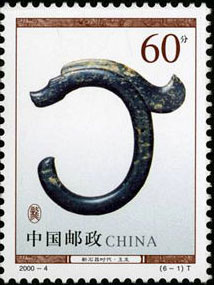
 (6-1), Jade Dragon from the Neolithic Age, 60 fen, 40*30mm
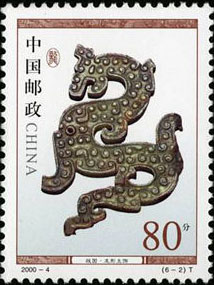 (6-2), Dragon-shaped Ornament from the Warring States, 80 fen, 40*30mm
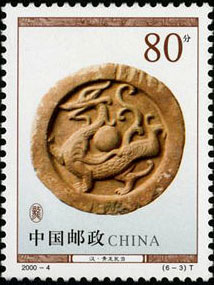 (6-3), Eaves-tile Carved with Dragon from the Han Dynasty, 80 fen, 40*30mm
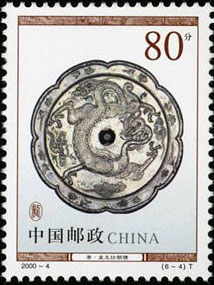 (6-4), Copper Mirror with a Coiled Dragon from the Tang Dynasty, 80 fen, 40*30mm
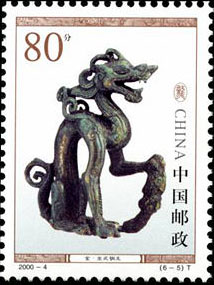 (6-5), Bronze Curled Dragon from the Jin Dynasty, 80 fen, 40*30mm
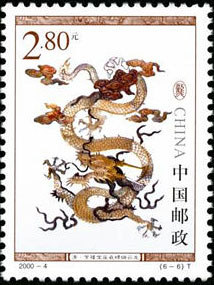 (6-6), Dragon on the Red Sandalwood Throne from the Qing Dynasty, 280 fen, 40*30mm
Technical details
Scott No: 3007-12Serial number: 2000-4
Values in set: 6
Denomination: 6.60 yuan
Date of issue: March 7, 2000
Designer: Wang Huming
Size: 40*30mm
Perforation: 12
Sheet composition: 50
Printing process: offset
Printer: Henan Post and Telecommunication Printing Works
Background
The special stamp set Dragon (Cultural Relics) was issued on March 7, 2000. It consists of six stamps with a total face value of 6.60 yuan. It was designed by Wang Huming and printed by Henan Post and Telecommunications Printing Factory using offset printing. This stamp set features dragon-shaped artifacts from different periods, from the Neolithic Age to the Qing Dynasty. Using actual artifacts as prototypes, it fully presents the evolution of Chinese dragon imagery over thousands of years. It echoes the Gengchen zodiac dragon stamps issued in the same year, interpreting the long-standing Chinese dragon culture from the perspective of archaeology and cultural relics.The dragon is the most core cultural totem of the Chinese nation. Its form has evolved continuously over time, becoming embedded in various ancient objects such as jade, roof tiles, bronze mirrors, bronzes, and furniture. This stamp set selects six representative dragon artifacts in chronological order, spanning more than five thousand years of Chinese civilization. It showcases the stylistic changes of dragon imagery in different dynasties, presents the ancient aesthetic shaping of dragons, and carries forward the national spirit of self-improvement and auspicious prosperity embodied in dragon culture.
Stamp Designs and Historical Background
Neolithic Age – Jade Dragon
This is a Hongshan culture jade dragon, unearthed in Ongniud Banner, Inner Mongolia. It is known as the "First Dragon of China." The dragon's body is curled in a C-shape, with a simple and archaic form and no elaborate decoration. It is the earliest known physical representation of a dragon in China, opening the source of the Chinese dragon totem.
Warring States Period – Dragon-Shaped Jade Ornament
Unearthed from the tomb of Marquis Yi of Zeng in Suizhou, Hubei, it is a fine Warring States jade piece. The dragon's body is slender and graceful, covered with grain patterns, with a posture of soaring upward. The lines are lively and elegant, reflecting the exquisite jade craftsmanship of the Warring States period. The dragon image is more dynamic and decorative.
Han Dynasty – Azure Dragon Roof Tile
Unearthed from the site of Chang'an City of the Han Dynasty in Xi'an, it is one of the Four Divine Beasts roof tiles of the Han Dynasty. The dragon's body winds and stretches, with a majestic momentum. The azure dragon is the foremost of the Four Divine Beasts. The ancients regarded it as an auspicious beast guarding the east and warding off evil. It is a classic representative of Han Dynasty dragon art.
Tang Dynasty – Bronze Mirror with Coiled Dragon Pattern
Unearthed in Xi'an, Shaanxi. The mirror features a coiled dragon winding and spiraling. The dragon's body is vigorous and powerful, with clear scales and claws. The Tang Dynasty was powerful and prosperous. The coiled dragons on bronze mirrors are full and unrestrained, fully displaying the majestic and grand artistic style of the High Tang and reflecting the advanced bronze casting techniques of the time.
Jin Dynasty – Seated Bronze Dragon
Unearthed from the site of the Jin Dynasty Shangjing in Acheng, Heilongjiang. The bronze dragon is in a seated posture, with its head raised and chest out, substantial and steady in form. This Jin Dynasty bronze dragon blends northern ethnic aesthetics. The dragon's expression is majestic and vigorous. It is a dragon cultural relic of a northern minority regime.
Qing Dynasty – Red Sandalwood Throne Inlaid with Mother-of-Pearl Cloud Dragon
Taken from the backrest decoration of a Qing Dynasty imperial red sandalwood throne, using mother-of-pearl inlay. Cloud dragons weave through clouds and waves. The dragon patterns are intricate and magnificent, with prominent five-clawed dragons. It is a typical imperial dragon pattern, displaying the majesty and splendor of the royal family.
Artistic and Design Features
The stamp set is designed based on photographs of actual artifacts. The images are clean and elegant, preserving the original texture of the ancient artifacts to the greatest extent. The offset printing provides soft and delicate colors, faithfully reproducing the textures of jade, bronze, mother-of-pearl, and other materials. The six stamps are arranged in chronological order, clearly presenting the evolution of dragon imagery from simple and archaic to ornate and elaborate. It integrates archaeological artifacts, arts and crafts, and dragon culture, making it a classic series in artifact-themed stamps.
Share: 
Price List
Item location: China
Ships to: Worldwide
*Shipping (via registered air mail) is based on subtotal of order. See detials below.
* 1) for special items shipping and handling cost may be included. 2) Other fast shipping is available.
To special order, please let us know what you are looking for. We will help you to meet your unique interests.
Ships to: Worldwide
*Shipping (via registered air mail) is based on subtotal of order. See detials below.
| Order Subtotal | S & H |
| $0.01---$15.00 | US $5.00 |
| $15.01---$50.00 | US $6.00 |
| $50.01---$100.00 | US $7.00 |
| $100.01---$180.00 | US $8.00 |
| $180.01---over | US $9.00 |
To special order, please let us know what you are looking for. We will help you to meet your unique interests.


