

T59, Scott 1660-64 Fables - Marking the Boat to Seek the Sword

 (5-1), Marking the Boat to Seek the Sword, 8 fen, 40*30 mm
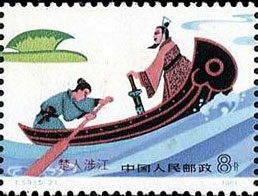 (5-2), The Man of Chu Crosses the River, 8 fen, 40*30 mm
 (5-3), The Sword Falls into the Water, 8 fen, 40*30 mm
 (5-4), Then He Carves the Boat, 8 fen, 40*30 mm
 (5-5), Entering the Water to Seek It, 8 fen, 40*30 mm
Technical details
Scott No: 1660-1664 Serial number: T59
Values in set: 5
Date of issue: March 10, 1981
Denomination: 40 fen
Designer: Pan Keming
Size of stamps: 40*30mm
Perforation: 11*11.5
Sheet composition: 50 (5*10)
Printing process: Photogravure
Printing House: Beijing Postage Stamp Printing Works
Background
T59 "Fables — Marking the Boat to Seek the Sword" special stamps were issued on March 10, 1981. The set consists of 5 stamps, printed by photogravure, designed by Pan Keming, and printed by the Beijing Stamp Factory. Stamp size 40 mm × 30 mm, perforation gauge 11 × 11.5, 50 stamps per sheet, in a five-stamp se-tenant format.Theme of the Set
This set is drawn from the classic fable "Marking the Boat to Seek the Sword" in the Lüshi Chunqiu · Examining the Present. The Ministry of Posts and Telecommunications issued this set to showcase China's long and rich classical literary heritage and to popularize knowledge through a household-known fable. The story satirizes subjective thinking that clings to appearances, understands no flexibility, and ignores the dynamic changes of things, and tells people that when looking at problems they should take the objective environment into account and conform to the laws of development of things. It has strong value for ideological enlightenment and literary popularization, and it is also a rare complete fable picture-story theme among New China's stamps.
Stamp Designs and Historical Background
Marking the Boat to Seek the Sword
The design uses layered blue-green mountains and undulating blue-white water waves as the base image, with the complete original classical Chinese text of "Marking the Boat to Seek the Sword" printed in the center of the layout: "A man of Chu crossed the river. His sword fell from the boat into the water. He hastily carved a mark on the boat, saying: 'This is where my sword fell.' When the boat stopped, he entered the water to seek it from the place he had marked. The boat had moved, but the sword had not. To seek the sword in this way—is it not foolish?" The text is antique and upright, serving as the introduction to the whole story and making clear the fable's source and core text.
The Man of Chu Crosses the River
The image shows the beginning of the story: a small wooden boat travels on the river, with a sword-wearing man of Chu seated in it and a boatman rowing with an oar. The water waves are gentle and expansive, and trees on both banks are faintly visible, restoring the scene of the man of Chu crossing the river as the story unfolds.
The Sword Falls into the Water
The image depicts the moment the mishap occurs: the boat reaches the middle of the river, the sword at the man of Chu's waist slips, the precious sword leaves his body and falls into the river, ripples spread on the water's surface, and the figure's expression is startled—capturing the turning point of the story.
Then He Carves the Boat
The image presents the man of Chu's response: instead of immediately entering the water to retrieve the sword, he takes out a small knife and carefully carves a mark on the side of the boat at the place where the sword fell. He believes this mark can permanently locate the sword, highlighting the figure's rigid understanding.
Entering the Water to Seek It
The image depicts the ending: the small boat has already reached the opposite bank, and the river water and the place where the sword fell are already far apart. The man of Chu, comparing the mark on the side of the boat, bends down and leaps into the water to look for the sword. The picture intuitively presents the absurdity of the behavior, echoing the fable's satirical thrust.
Artistic Design Features
The whole set is a five-stamp se-tenant structure, with the water-wave patterns between the five stamps connecting and flowing into one another, so that the pictures join into a single whole, with continuous and smooth narration like an unfolded picture-story book. The figures are simple and naive, with clean, neat lines and bright, fresh colors, mainly in a flat-color decorative painting style without complicated light-and-shade rendering. The designer balances the story's readability with the stamps' decorative quality, using accessible, intuitive pictures to break down the classical text's plot. It suits all ages and conveys the literary and philosophical nature of the classical fable in a visual way. It is a highly representative work among literary-themed stamps of the 1980s.
Share: 
Price List
Item location: China
Ships to: Worldwide
*Shipping (via registered air mail) is based on subtotal of order. See detials below.
* 1) for special items shipping and handling cost may be included. 2) Other fast shipping is available.
To special order, please let us know what you are looking for. We will help you to meet your unique interests.
Ships to: Worldwide
*Shipping (via registered air mail) is based on subtotal of order. See detials below.
| Order Subtotal | S & H |
| $0.01---$15.00 | US $5.00 |
| $15.01---$50.00 | US $6.00 |
| $50.01---$100.00 | US $7.00 |
| $100.01---$180.00 | US $8.00 |
| $180.01---over | US $9.00 |
To special order, please let us know what you are looking for. We will help you to meet your unique interests.


