

W13, Scott 999 Chairman Mao's Latest Instruction
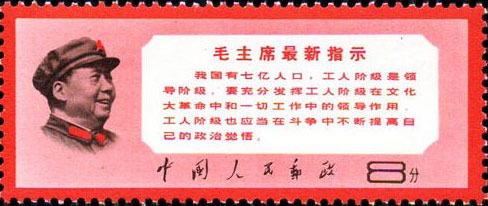
 (1-1), Portrait of Chairman Mao and the Latest Instruction, 8 fen, 62*26 mm
Technical details
Scott No: 999Serial number: W13
Values in set: 1
Date of issue: August 18, 1968
Denomination: 8 fen
Designer: Feng Meizhen, Peng Qinxun
Size of stamps: 62*26mm
Perforation: 11.5
Sheet composition: 50(5*10)
Printing process: Photogravure
Printing House: Beijing Postage Stamp Printing Works
Themes: Mao zedong,
Background
Issued on 18 August 1968, the set contains a single stamp, printed in photogravure, designed by Feng Meizhen and Peng Qinxun, and produced by Beijing Stamp Factory. Stamp size: 62mm × 26mm; perforation: 11.5; sheet composition: 50 stamps (5 × 10); face value: 8 fen; print run: 20,992,550.Main Theme of the Stamp
On 27 July 1968, the workers' Mao Zedong Thought propaganda team from the capital entered Tsinghua University to stop armed clashes and restore order. On 15 August, Mao Zedong issued to the whole country a latest instruction on the leading role of the working class. On 25 August, the journal Red Flag carried Yao Wenyuan's article "The Working Class Must Lead Everything", which published Mao Zedong's instruction on the educational revolution; on the same day the Central Committee of the Communist Party of China, the State Council, the Central Military Commission and the Central Cultural Revolution Group issued the "Notice on Sending Workers' Propaganda Teams into Schools", after which workers' propaganda teams entered universities, secondary and primary schools and all fields of the superstructure throughout the country. To support this publicity, the Ministry of Posts and Telecommunications issued this stamp three days after the instruction appeared in the press. It is the W-series stamp with the shortest interval between the choice of subject and issuance.
Stamp Design and Historical Context
Portrait of Chairman Mao and the Latest Instruction
The design uses a horizontal composition. On the left is a profile portrait of Mao Zedong in military uniform, smiling, in the image of the Cultural Revolution period. On the right, the full text of the latest instruction published on 15 August 1968 is set against a white ground: "Our country has a population of seven hundred million. The working class is the leading class. It is necessary to give full play to the leading role of the working class in the Cultural Revolution and in all work, and the working class should also continuously raise its own political consciousness in struggle." The characters are red on white, arranged in horizontal lines, forming a layout in which the left portrait occupies half of the stamp and the right text occupies the other half. Placing a portrait and a quotation side by side within a single horizontal format was a common approach for quotation stamps of this period.
The origins of this stamp were unusual. After the instruction appeared in the press on 15 August 1968, the mass organization at Beijing Stamp Factory held that a stamp should be issued with the greatest speed, and two women plate-making workers at the factory, Feng Meizhen and Peng Qinxun, designed the artwork themselves. Once the artwork was finalised, it was reported upward and approved by the Military Control Commission of the Ministry of Posts and Telecommunications; printing began in the early hours of 17 August and the stamp was issued on 18 August, only four days in all. On the day of issue only a small quantity could be printed and supplied for sale, making this set the fastest-born among the W-series stamps. The print run was about 20 million; because the face value was low and the stamp was widely used, postal consumption was heavy, and mint copies are actually comparatively scarce today. Also because market prices are high, later forgeries have appeared, made by perforating full-colour, same-size printed reproductions and applying fake gum to the back. Authentication mainly depends on the printing method and ink colour: genuine copies are photogravure with thick, bright ink, while forgeries are mostly offset multi-colour printing in which halftone dots are visible under magnification.
Artistic Features of the Design
The horizontal format is unusual among the W-series stamps, and the slender proportion of 62mm × 26mm is exactly suited to accommodating a portrait and a full passage of text side by side. The portrait on the left is handled in a drawing-like manner with soft gradations, while the red characters on white on the right create a strong contrast and are especially striking visually; the whole stamp surface is clean without being ornate. This stamp belongs, together with the W10 strip of five quotation stamps, to the "latest instruction" series, but whereas W10 divides five passages of instruction across a joined strip of five, W13 carries one complete instruction on a single stamp — one elaborate, one simple — forming the two typical patterns by which quotations entered stamps in this period. Because design, approval and printing took only four days in all, there was scarcely any room to polish the artwork; what remains instead is the issuing tempo of "acting on the wind" of that era, making this a case often cited in studies of Cultural Revolution postal history and of stamp production history.
Share: 
Price List
Item location: China
Ships to: Worldwide
*Shipping (via registered air mail) is based on subtotal of order. See detials below.
* 1) for special items shipping and handling cost may be included. 2) Other fast shipping is available.
To special order, please let us know what you are looking for. We will help you to meet your unique interests.
Ships to: Worldwide
*Shipping (via registered air mail) is based on subtotal of order. See detials below.
| Order Subtotal | S & H |
| $0.01---$15.00 | US $5.00 |
| $15.01---$50.00 | US $6.00 |
| $50.01---$100.00 | US $7.00 |
| $100.01---$180.00 | US $8.00 |
| $180.01---over | US $9.00 |
To special order, please let us know what you are looking for. We will help you to meet your unique interests.


