

W8, Scott 981 Sailing the Seas Depends on the Helmsman, Making Revolution Depends on Mao Zedong Thought
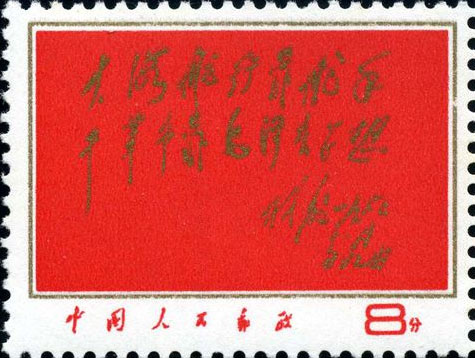
 (1-1), Lin Biao's Inscription for the First Conference of Activists in Studying Chairman Mao's Works of the Chinese People's Liberation Army Navy, 8 fen, 40*30 mm
Technical details
Scott No: 981Serial number: W8
Values in set: 1
Date of issue: December 26, 1967
Denomination: 8 fen
Designer: Wan Weisheng
Size of stamps: 40*30 mm
Perforation: 11
Sheet composition: 50(5*10)
Printing process: Photogravure
Printing House: Beijing Postage Stamp Printing Works
Background
Issued on 26 December 1967, the set consists of a single stamp, printed in photogravure, designed by Wan Weisheng and produced by Beijing Stamp Factory. Stamp size: 40mm × 30mm; perforation: 11 × 11.5; sheet composition: 50 stamps (5 × 10); face value: 8 fen; total set face value: 0.08 yuan; print run: 10 million, with further printings added after May 1969.Main Theme of the Stamp
On 29 November 1967, Lin Biao wrote an inscription for the First Conference of Activists in Studying Chairman Mao's Works of the Chinese People's Liberation Army Navy, reading: "Sailing the seas depends on the helmsman; making revolution depends on Mao Zedong Thought." The first half of the line comes from the song *Sailing the Seas Depends on the Helmsman*, which was then very widely sung, while the second half directly links "reading Chairman Mao's books" with "making revolution"; both were quoted repeatedly in those years. A month after the inscription, on 26 December, Mao Zedong's birthday, the Ministry of Posts and Telecommunications printed this piece of handwriting as a single stamp. It is one of the earliest "inscription stamps" among the W-series, known in philatelic circles colloquially as the "Red Inscription", and is distinguished from W11, which likewise uses an inscription as its design.
Stamp Design and Historical Context
Lin Biao's Inscription for the First Conference of Activists in Studying Chairman Mao's Works of the Chinese People's Liberation Army Navy
The design is a complete reproduction of the handwriting of Lin Biao's inscription, set in two horizontal lines across the full width, the writing free and the strokes exposed. The stamp uses a red ground with the inscription printed in gold, the red ground and gold characters forming a strong contrast; below the inscription space is left for the "Chinese People's Postal Service" inscription and the face value. The stamp has no figures, scene or decorative pattern; the text itself is the entire design, a typical pattern among W-series stamps in which handwriting forms the main subject. In his treatment the designer Wan Weisheng simply scaled the original inscription proportionally into the stamp format, preserving as far as possible the beginnings and endings of strokes and the connecting threads between them, without rewriting or retracing, so that the appearance of the stamp is extremely close to the original.
The issue of this stamp is connected with Lin Biao's own political fate. After the incident of 13 September 1971 the official assessment of Lin Biao changed fundamentally, and in 1980 and 1981, when the Special Tribunal of the Supreme People's Court tried the case of the Lin Biao and Jiang Qing counter-revolutionary cliques, he was identified as a principal culprit of that clique. Postal items bearing his inscription or name were subsequently withdrawn from sale and recalled one after another, and W8, like W11, became material evidence of this period of history. The print run of the stamp itself was not small, but because the face value was low and the stamp was widely used, postal consumption was heavy, and copies from the early printings are actually not numerous today.
Artistic Features of the Design
The layout of this stamp is extremely simple: a horizontal format of 40mm × 30mm, red ground with gold characters, the two lines of the inscription running across the stamp surface with blank space above and below, so that the eye falls naturally on the lettering. The gold ink is printed by photogravure, the strokes full, and against the red ground the gold carries a lustre, which earned it the name "Red Inscription" in philatelic circles. There is almost no embellishment in the design; the rhythm of the handwriting is the rhythm of the picture. This practice of simply reproducing the original was both convenient and safe at the time, and it became a common characteristic of the W-series stamps.
Because demand continued after issue, several further printings were made after May 1969. The reprinted versions differ from the first printing in the number of stamps per sheet, a format of 70 (7 × 10) appearing, and the ink and paper also differ slightly from the first printing; the price gap between early printings and later reprints is marked, and care is needed to distinguish them when collecting. Authentication depends mainly on the printing method and the gold ink: on genuine copies the photogravure gold ink is substantial and the strokes clear, whereas forgeries are mostly offset, in which the gold characters are actually built up from coloured halftone dots and show no golden lustre under magnification, while the red is also comparatively dull.
Share: 
Price List
Item location: China
Ships to: Worldwide
*Shipping (via registered air mail) is based on subtotal of order. See detials below.
* 1) for special items shipping and handling cost may be included. 2) Other fast shipping is available.
To special order, please let us know what you are looking for. We will help you to meet your unique interests.
Ships to: Worldwide
*Shipping (via registered air mail) is based on subtotal of order. See detials below.
| Order Subtotal | S & H |
| $0.01---$15.00 | US $5.00 |
| $15.01---$50.00 | US $6.00 |
| $50.01---$100.00 | US $7.00 |
| $100.01---$180.00 | US $8.00 |
| $180.01---over | US $9.00 |
To special order, please let us know what you are looking for. We will help you to meet your unique interests.


