

S73, Scott 834-841 Cradle of the Revolution, Jinggangshan
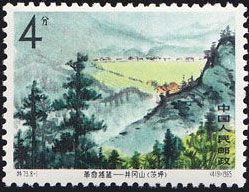
 (8-1), Ciping, 4 fen, 36.5*26mm mm
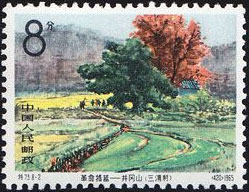 (8-2), Sanwan Village, 8 fen, 36.5*26mm mm
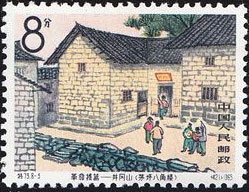 (8-3), The Octagonal Building at Maoping, 8 fen, 36.5*26 mm
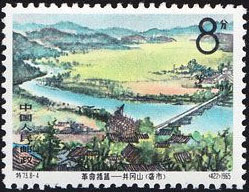 (8-4), Longshi, 8 fen, 36.5*26 mm
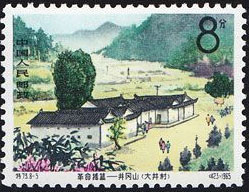 (8-5), Dajing Village, 8 fen, 36.5*26 mm
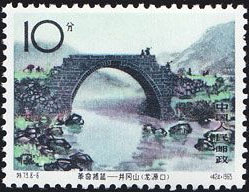 (8-6), Longyuankou, 10 fen, 36.5*26 mm
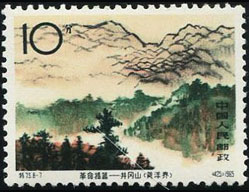 (8-7), Huangyangjie, 10 fen, 36.5*26 mm
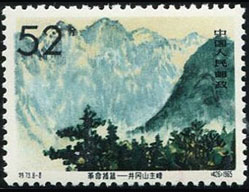 (8-8), Main Peak of Jinggangshan, 52 fen, 36.5*26 mm
Technical details
Scott No: 834-841Serial number: S73
Values in set: 8
Date of issue: July 1, 1965
Denomination: 108 fen
Designer: Wu Jiankun
Size of stamps: 36.5*26mm
Perforation: 11*11.5
Sheet composition: 50(5*10)
Printing process: Photogravure
Printing House: Beijing Postage Stamp Printing Works
Themes: Mountain,
Background
Issued on 1 July 1965, the set contains eight stamps, printed in photogravure, designed by Wu Jiankun and produced by Beijing Stamp Factory. Stamp size: 40mm × 30mm; perforation: 11 × 11.5; sheet composition: 50 stamps (5 × 10); total set face value: 1.08 yuan. Print runs: the 4 fen Ciping, 3 million; the 8 fen Sanwan Village, the Octagonal Building at Maoping, Longshi and Dajing Village, 5 million each; the 10 fen Longyuankou and Huangyangjie, 2.5 million each; the 52 fen Main Peak of Jinggangshan, 1.3 million.Main Theme of the Set
In October 1927 Mao Zedong led the troops of the Autumn Harvest Uprising to Jinggangshan and established China's first rural revolutionary base area, opening the revolutionary road of "encircling the cities from the countryside and seizing power by armed force". In 1928 Zhu De and Chen Yi led their forces there to join him, and the Fourth Red Army was formed; Jinggangshan has ever since been honoured as the cradle of the revolution. The Ministry of Posts and Telecommunications chose 1 July, the Party's birthday, for the issue of this set, selecting in turn eight landmark revolutionary sites and scenic places, linked together to trace the important historical moments of the struggle in Jinggangshan and to commemorate those extraordinarily arduous revolutionary years.
Stamp Designs and Historical Context
Ciping
Ciping was the centre of the Jinggangshan base area at the time and the seat of its Party, government and military organs. The design depicts the Ciping basin nestled among the mountains, houses scattered and screened among trees, ranges of hills stretching away — a tranquil and grand mountain landscape, and the central symbol of the Jinggangshan revolutionary base area.
Sanwan Village
This is the place where the Sanwan Reorganisation took place. After the Autumn Harvest Uprising the troops came to Sanwan in Yongxin and were reorganised there, establishing the principle of "building the Party branch in the company", which laid the foundation for the political construction of the people's army. The design shows the village and its fields, with gentle hills in the distance; the plain countryside carried an important turning point in the history of the people's army's building.
The Octagonal Building at Maoping
The Octagonal Building at Maoping was where Mao Zedong lived and worked during the Jinggangshan period, named for the octagonal skylight in its roof. Many of the articles guiding the struggle in the base area were written under its lamp. The design gives prominence to this small brick-and-timber building, its setting quiet and secluded, simple and dignified.
Longshi
Longshi is the place where Zhu and Mao joined forces. In April 1928 Zhu De and Chen Yi led the remaining forces of the Nanchang Uprising together with the troops of the Southern Hunan Uprising to Longshi, where they joined in victory with the Workers' and Peasants' Revolutionary Army led by Mao Zedong; after the junction the forces were combined as the Fourth Army of the Chinese Workers' and Peasants' Red Army. The design portrays the surroundings of the meeting site, with open fields.
Dajing Village
Dajing was an important village inside the five outposts of Jinggangshan, where the Red Army set up rear organs and places for the care of the wounded and sick and carried out mass work. The design shows the village, large trees and distant hills, reflecting the scene of those years when the Red Army took root in the countryside and relied on the masses in carrying out the struggle.
Longyuankou
The stone bridge at Longyuankou is the site of the battle of Longyuankou. In June 1928 the Red Army routed the enemy there and won a great victory, consolidating the Jinggangshan base area; a folk rhyme still circulated: "Without spending three tenths of the Red Army's strength, the two Yangs of Jiangxi were defeated." The main subject of the design is the famous arched bridge at Longyuankou.
Huangyangjie
Huangyangjie is the first of the five outposts of Jinggangshan, its terrain strategically dangerous, guarding the route down the mountain; the famous battle for the defence of Huangyangjie took place here. In those years the Red Army defeated a far larger attacking force there, and Mao Zedong wrote *Jinggangshan — to the Tune of Xi Jiang Yue* for the occasion. The design shows the towering, precipitous mountains wreathed in cloud and mist, fully expressing the menace of a natural stronghold.
Main Peak of Jinggangshan
The main peak, also called Wuzhi Peak (Five-Finger Peak), consists of five peaks standing side by side like the five fingers of a hand; it is the landmark summit of Jinggangshan, lofty and majestic. As the close of the set, its grand mountain form symbolises the firm foundation of the revolution and the spark that sets the prairie ablaze.
Artistic Features of the Design
The whole set uses a uniform horizontal format and adopts the manner of watercolour landscape painting, blending the revolutionary sites with mountain and water scenery into one. The tonality of each stamp changes with its scene; the mist among the mountains and the layers of trees and fields are soft and gentle, without the forceful brushwork of the propaganda poster, inclining rather to poetic realism and combining historical commemoration with the aesthetic appreciation of landscape. The photogravure printing gives warm, luminous colour, with natural transitions between distant hills, nearby trees and buildings.
Share: 
Price List
Item location: China
Ships to: Worldwide
*Shipping (via registered air mail) is based on subtotal of order. See detials below.
* 1) for special items shipping and handling cost may be included. 2) Other fast shipping is available.
To special order, please let us know what you are looking for. We will help you to meet your unique interests.
Ships to: Worldwide
*Shipping (via registered air mail) is based on subtotal of order. See detials below.
| Order Subtotal | S & H |
| $0.01---$15.00 | US $5.00 |
| $15.01---$50.00 | US $6.00 |
| $50.01---$100.00 | US $7.00 |
| $100.01---$180.00 | US $8.00 |
| $180.01---over | US $9.00 |
To special order, please let us know what you are looking for. We will help you to meet your unique interests.


