

S67, Scott 799-803 Petroleum Industry
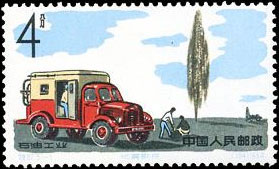
 (5-1), Seismic Exploration, 4 fen, 48.5*27 mm
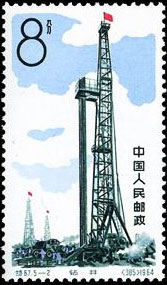 (5-2), Drilling, 8 fen, 27.5*48 mm
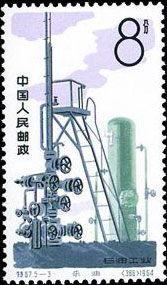 (5-3), Oil Extraction, 8 fen, 27.5*48 mm
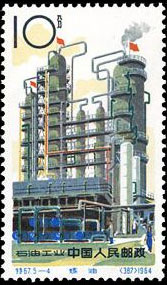 (5-4), Refining, 10 fen, 27.5*48 mm
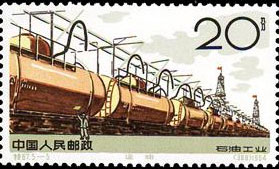 (5-5), Oil Transport, 20 fen, 48.5*27 mm
Technical details
Scott No: 799-803Serial number: S67
Values in set: 5
Date of issue: October 1, 1964
Denomination: 50 fen
Designer: Liu Shuoren
Size of stamps:
48.5*27mm for Value 1, 5;
27.5*48mm for Value 2, 3, 4
Perforation: 11.5
Sheet composition:
50(5*10) for Value 1, 5;
50(10*5) for Value 2, 3, 4
Printing process: Photogravure
Printing House: Beijing Postage Stamp Printing Works
Themes: Industry,
Background
S67 "Petroleum Industry" special stamps were issued on October 1, 1964. The set consists of 5 stamps, printed by photogravure, designed by Liu Shuoren, and printed by the Beijing Stamp Factory. Seismic Exploration and Oil Transport measure 52 mm × 31 mm, perforation gauge 11.5, 50 stamps per sheet (5 × 10); Drilling, Oil Extraction, and Refining measure 31 mm × 52 mm, perforation gauge 11.5, 50 stamps per sheet (10 × 5), with a total face value of 0.50 yuan for the set; circulations: 4-fen Seismic Exploration 4 million copies, 8-fen Drilling 5 million copies, 8-fen Oil Extraction 5 million copies, 10-fen Refining 2 million copies, and 20-fen Oil Transport 1 million copies.Theme of the Set
In the early 1960s, the Daqing Oilfield campaign achieved great success, breaking at one stroke the foreign assertion that "China is oil-poor." By 1963 China had basically achieved self-sufficiency in petroleum—a milestone achievement in the history of New China's heavy industry. The Ministry of Posts and Telecommunications issued this set on the National Day of the 15th anniversary of the founding of the People's Republic of China, laying out the pictures in sequence along the complete petroleum production chain—from underground exploration, drilling, and extraction to refining and outward transport—completely presenting the brand-new appearance of China's petroleum industry, paying tribute to the oil workers fighting on the wilderness and Gobi, and recording the historical moment of the birth of an independent modern petroleum system.
Stamp Designs and Historical Background
Seismic Exploration
The main subject of the design is a red exploration engineering vehicle loaded with professional seismic exploration equipment, with detection cables laid on the ground, and two exploration team members carrying out field survey operations. Seismic exploration is the leading process in the search for underground oil reservoirs, relying on artificial seismic waves to detect stratigraphic structures and pre-locate oil-bearing structures on the wilderness. This stamp presents the geological survey link at the very front of petroleum development—the starting point of the whole story.
Drilling
The main subject of the design is a towering oil drilling derrick, with a red flag flying at the top, various construction equipment at the well site, and other derricks standing in the distance. Drilling is the key process for opening up underground oil layers. During the Daqing campaign, countless drilling team members took root in the wilderness, overcame severe cold and worked hard, and erected derricks on the Songnen Plain; the picture is vigorous and powerful, highlighting the core position of drilling in tackling key problems.
Oil Extraction
The design shows wellhead extraction equipment, with pumping units, control valves, pipelines, and separation storage tanks arranged in sequence—the facilities for preliminary gathering, transportation, and separation at the well site after crude oil is extracted from underground. Crude oil gathers along the pipelines, marking the successful development of underground oil and gas resources and representing the oilfield's entry into the stable production stage. The concise industrial pipeline composition restores the on-site appearance of the extraction station.
Refining
The design shows a large refinery unit complex, with rows of distillation towers, heating furnaces, pipelines, and factory buildings, and faint smoke rising from the towers. After extraction, crude oil is sent to the refinery for fractional distillation and processing into gasoline, kerosene, diesel, and various refined oils—the key link that turns underground crude oil into usable fuel for the country's industry and transportation, representing the capacity for deep petrochemical processing.
Oil Transport
The design shows a long train of railway tank cars, with the tanks connected end to end and the railway extending into the distance, and oilfield derricks visible in the far background. Crude oil and refined oil are transported by rail to all parts of the country and delivered to factories, mines, and cities—the final link of the petroleum industry connecting the national economic network, symbolizing petroleum energy being delivered to every part of the motherland and supporting socialist construction.
Artistic Design Features
The set alternates horizontal and vertical formats: the first and last are horizontal, and the middle three are vertical, giving the rhythm variety. The style is the classic industrial propaganda decorative painting of the 1960s: generalized forms, clean lines, and flat color blocks shaping factory buildings, derricks, and vehicles, without elaborate light-and-shadow sketching, with fresh, bright colors highlighting the high-spirited, upward atmosphere of industrial construction. The photogravure printing has even, clean colors and solid color blocks, effectively distinguishing different scenes such as the field wilderness, well site, refinery, and railway.
The five stamps are arranged in sequence along the production flow of exploration, drilling, extraction, refining, and outward transport, with a complete narrative logic. In the set, the 20-fen Oil Transport has the smallest circulation and is the core key stamp of the whole set, followed by the 10-fen Refining; the two high-denomination stamps were mostly used for international mail and few survive; the 4-fen Seismic Exploration also has a relatively small surviving quantity. This set is a highly renowned industrial-themed stamp among the old Ji-te stamps; communication consumption was large at the time, and complete sets with original gum in perfect condition are relatively difficult to collect.
Share: 
Price List
Item location: China
Ships to: Worldwide
*Shipping (via registered air mail) is based on subtotal of order. See detials below.
* 1) for special items shipping and handling cost may be included. 2) Other fast shipping is available.
To special order, please let us know what you are looking for. We will help you to meet your unique interests.
Ships to: Worldwide
*Shipping (via registered air mail) is based on subtotal of order. See detials below.
| Order Subtotal | S & H |
| $0.01---$15.00 | US $5.00 |
| $15.01---$50.00 | US $6.00 |
| $50.01---$100.00 | US $7.00 |
| $100.01---$180.00 | US $8.00 |
| $180.01---over | US $9.00 |
To special order, please let us know what you are looking for. We will help you to meet your unique interests.


