

S50, Scott 606-609 Ancient Chinese Architecture - Bridges
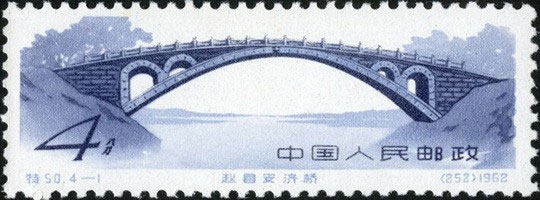
 (4-1), Anji Bridge, Zhao County, 4 fen, 50.5*16 mm
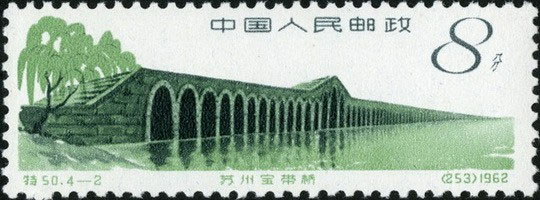 (4-2), Baodai Bridge, Suzhou, 8 fen, 50.5*16 mm
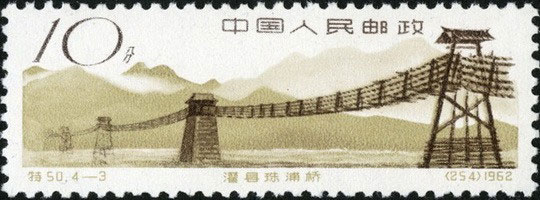 (4-3), Zhupu Bridge, Guan County, 10 fen, 50.5*16 mm
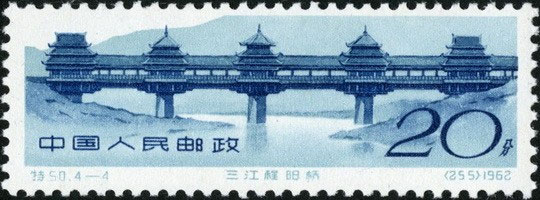 (4-4), Chengyang Bridge, Sanjiang, 20 fen, 50.5*16 mm
Technical details
Scott No: 606-609Serial number: S50
Values in set: 4
Date of issue: May 15, 1962
Denomination: 42 fen
Designer: Liu Shuoren
Size of stamps: 50.5*16mm
Perforation: 11
Sheet composition: 75(5*15)
Printing process: Photogravure
Printing House: Beijing Postage Stamp Printing Works
Themes: Architecture, Bridges,
Background
S50 "Ancient Chinese Architecture — Bridges" special stamps were issued by the Ministry of Posts and Telecommunications on May 15, 1962. The set consists of 4 stamps, designed by Liu Shuoren, and printed by the Beijing Stamp Factory by photogravure. Stamp size 54 mm × 20 mm, perforation gauge 11, 75 stamps per sheet, layout 5 × 15, with a total face value of 0.42 yuan for the set.Stamp Designs and Historical Background
Anji Bridge, Zhao County
The design presents the complete posture of the Anji Bridge spanning the Xiao River, with its open-spandrel arch structure clearly and expansively visible and distant mountains faintly set behind. The Anji Bridge, commonly known as the Zhaozhou Bridge, is located in Zhao County, Hebei, and was built under the direction of the Sui dynasty craftsman Li Chun. It is the world's earliest surviving and well-preserved single-span open-spandrel stone arch bridge. The open-spandrel design both reduces the bridge's own weight and allows water to be diverted during floods; it represents the pinnacle of Sui dynasty stone engineering and has stood for centuries through repeated floods and earthquakes.
Baodai Bridge, Suzhou
The long bridge lies flat on the water, with weeping willows on the banks and fifty-three arches stretching in sequence into the distance. Baodai Bridge is located at the confluence of Tantai Lake and the Grand Canal in Suzhou; first built in the Tang dynasty, it is the longest surviving multi-arch stone bridge in China. Legend says that the prefect Wang Zhongshu donated his jade belt to fund the bridge's construction, hence the name. The ancient bridge was both an important thoroughfare on the Grand Canal and a landmark landscape of the Jiangnan water towns; its arches are spaced in a varied rhythm, their reflections in the water, with a clear and elegant scenery.
Zhupu Bridge, Guan County
The design outlines the appearance of a bamboo-cable suspension bridge: thick cables connect the two banks, wooden bridge pavilions stand at both ends, and the continuous Min Mountains are in the background. Zhupu Bridge, also known as Anlan Suspension Bridge, spans the Min River above the Dujiangyan water conservancy hub. First built in the Song dynasty, it uses bamboo cables as the main load-bearing cables and wooden planks as the bridge deck—a model of ancient suspension bridges. Paired with Dujiangyan, it bears witness to the history of water management and passage on the Chengdu Plain and embodies the bridge-building wisdom of the southwest in adapting to local conditions.
Chengyang Bridge, Sanjiang
The main subject of the design is a Dong ethnic wind-and-rain bridge: a series of multi-eaved pavilions stand on the long bridge, with layered upturned corners, and the bridge body spans a stream. Chengyang Bridge is located in Sanjiang, Guangxi, and is a Dong wooden covered bridge; the entire bridge uses not a single nail or rivet, relying entirely on mortise-and-tenon joints, and combines the functions of passage, rest, shelter from rain, and gathering. It is a representative work of Dong architectural art and an outstanding relic of ancient minority architecture.
Artistic Design Features
The set adopts a horizontal long stamp format, shaped like a long scroll, suited to expressing the stretching, expansive posture of bridges. The four bridges respectively correspond to four entirely different ancient bridge types—a long stone arch bridge, a single-arch stone bridge, a suspension bridge, and a wooden covered bridge—covering both northern and southern regions and the building techniques of different ethnic groups, with highly representative subjects. Each stamp has an independent tone: the Anji Bridge a calm blue-gray, the Baodai Bridge a warm blue-green, the Zhupu Bridge a plain brown-yellow, and the Chengyang Bridge a clear pale blue. The colors are restrained and soft, without gorgeous rendering, focusing on restoring the antique, weighty temperament of the ancient bridges. The photogravure layers transition softly, the distant landscapes are simple with blank space, and the architectural subjects are placed at the visual center, combining the rigor of an architectural atlas with the artistic conception of Chinese painting. It is a widely praised classic among the old Ji-te architectural-themed stamps.
Share: 
Price List
Item location: China
Ships to: Worldwide
*Shipping (via registered air mail) is based on subtotal of order. See detials below.
* 1) for special items shipping and handling cost may be included. 2) Other fast shipping is available.
To special order, please let us know what you are looking for. We will help you to meet your unique interests.
Ships to: Worldwide
*Shipping (via registered air mail) is based on subtotal of order. See detials below.
| Order Subtotal | S & H |
| $0.01---$15.00 | US $5.00 |
| $15.01---$50.00 | US $6.00 |
| $50.01---$100.00 | US $7.00 |
| $100.01---$180.00 | US $8.00 |
| $180.01---over | US $9.00 |
To special order, please let us know what you are looking for. We will help you to meet your unique interests.


